July Newsletter: Fyren means “made of fire”

Hello, and welcome to the July newsletter! It won’t be too long. July is kind of a terrible month, anyway. Too long, too hot, too bright.

This month I came across the phrase “in olden times” in a story. This is a fairly common phrase that I had never given much thought to, but what the heck is “olden”? Immediately I assumed it was some kind of back formation to make the word “old” seem…well, older. But it isn’t! The -en suffix turns out to be common in Old, Middle, and early Modern English, where it is used to create adjectives meaning “made of, of the nature of,” and we actually use it in other familiar terms, for example in words like “golden”’ or “wooden,” although it’s common to just use the non-suffixed form of those adjectives (we usually say “wool sweater,” rather than “woolen sweater”). Etymonline.com also notes the obsolete words “beanen” (made of beans), “hunden” (of dogs), “wreathen” (entwined), and “fyren,” meaning “on fire, made of fire.” I feel like I have been made of fire lately, so perhaps we need to bring fyren back.

Writing Updates

I have finished writing the first draft of a novella that is currently titled Blood Magic! At the Beach that chronicles Sam and Ulysses’s attempt to take a honeymoon in a place that isn’t Madison. This completes the last promised piece of Wisconsin Gothic ephemera. I will have to think about distribution methods at some point; at about 25k words, it’s too short to print on its own. Ideally, I could release it as an ebook, and hold onto it to print until I have a few of the other short things (including “Dous”). But I know some people have a strong enough preference for print that they won’t read it until it comes out like that. So I guess I’m still thinking it through. If you have any ideas or preferences, feel free to shoot me an email.

I am starting revisions on book 5.

Appearances and Book Sales

My ebooks will be 75% off at Smashwords for the month of July. Here’s a link to the series.

I will be at Middleton Book Fair on August 2nd, joined by Rowan with their tarot decks after noon. Last year we sold out, so come by early. Also, it’s Mustard Days I think? So if you like mustard a lot…Middleton’s got you covered. (The National Mustard Museum is in Middleton.) The sale will be on Hubbard Ave. on both sides of the Stone Horse Green.

In September, I’ll be at Booked Eau Claire (in Eau Claire, WI) on the 12th and 13th. I’ll be selling books both days, and also appearing on two panels—one on writing sex scenes (open vs closed door) and one on indie publishing. If you’re going and interested in preordering a copy of one or more of my books, the form is here.

There’s more stuff happening in October, but we won’t go into that right now, since it’s really far away.
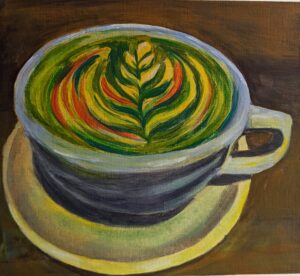
An acrylic painting of a green tea latte with colorful latte art on top that looks like a floweer.
I went mad and painted about ten lattes this month.

What I’ve Been Reading

The No. 1 Ladies’ Detective Agency, by Alexander McCall Smith. An episodic detective novel set in Botswana with a sort of meandering plot connecting all the episodes. I could not tell if all the little bits were completely in chronological order or not, and I didn’t care. McCall Smith obviously loves Botswana a lot, and the way he described the Kalahari made me want to visit it.

Bombshell, by Sarah McClean. (Cis M/F) I stumbled into reading a bunch of novels set during the reign of William IV into the early Victorian years, and this was the best of the group. McClean doesn’t really care about historical specifics (case in point, a character refers to the ugly duckling story about five years before it was published), but she writes exciting, sweeping feminist fantasies in which women find ways to circumvent societal strictures in order to take revenge on those who wronged them and fall in love along the way. I find I generally don’t like the way gender is handled in these types of books—all the men are the most manly men ever, all the women fall in love because the men are big and strong and make them feel safe and protected. In this one, the heroine gets to kick butt and take names (she has a special leather-lined pocket in her skirts for her knife). And what’s not to like about that?

Sailor’s Delight, by Rose Lerner. (Cis M/M) I’ve read only a few romances where one main character was Jewish, but in two of them, that character was named Eleazar, which is weird. I genuinely hadn’t read this one before I selected that name for Dr. Eli Sobel, and although I probably wouldn’t have changed it (the Eleazar/Lazarus thing was too tempting), I feel odd. Luckily, this Elie (note the extra “e”) is a great dude. It’s 1813, and he’s kind of an accountant for sailors in the Royal Navy. And he’s in love with one of his clients. Who happens to be engaged. No spoilers, but everyone gets a fair shake, the Judaism is approached with care and deliberation by both the main characters and the author, there’s a lot of period atmosphere, and in general I wished this was longer. 

A Gentleman’s Gentleman, by TJ Alexander. (Trans M/M) A slightly improbable but gentle and loving regency romance that spends a lot of time meditating on the different ways to be a man, and more broadly, a human. Includes a very exciting carriage chase and many other hijinks. Alexander was up for a Lammy the same year I was and lost, and I hope they get back there for this.

Wow, that’s more than I thought. (NB I deleted two book reviews from this, so it was even longer in the first draft.)

Podcasts

In June we put out two podcasts, both on the pope. Episode 93: Take Me Down to Vatican City and episode 94: Popes and Antipopes. More pope-related episodes soon.

On the blog

As threatened, I got this post about the bibliography for Lazarus, Home from the War up. Yesterday. I got it up yesterday. Still counts.

Lazarus, Home from the War Bibliography

I don’t always cite my sources for novels–in fact, they’re novels, and I think in general I’d prefer not to make it clear where I’ve hewn close to the truth and where I’ve wandered. But I did so much reading for Lazarus, Home from the War, and it touches on so many topics I think people might be somewhat interested in, I thought I might as well give a few options for further reading.

On Buddhism

I spent what felt like half of my academic career studying Buddhism, from the very first semester of my undergraduate life (thank you, Professor Hallisey) to the final moments of my second MA. Some good non-academic introductions to the ideas of Buddhism might be:

Siddhartha, by Hermann Hesse (1922). An imagining of the life of the Buddha. I think this was probably the first thing I read (when I was in my teens!) about Buddhism.

The Empty Mirror: Experiences in a Japanese Zen Monastery, by Janwillem van de Wetering (1971). When it’s the 1950s and you’re in postwar Japan studying Zen and also Gary Snyder is there.

The Snow Leopard, by Peter Matthiessen (1978). When your wife just died and you are a Zen Buddhist and you decide to go to the Himalayas with George Schaller to look for the snow leopard for two months. (Side note: Matthiessen had kids with his wife, the youngest of whom was 8 at the time of their mother’s death. It’s not clear why he gets to go traipsing around Nepal, and they go…where? This has nothing to do with the book, which is wonderful. It’s just always bothered me. Also, Matthiessen was a spy, and later became a monk, making him I think the only monk/spy I’m going to mention in this list.)

But those are all about Buddhism generally or Zen Buddhism, which is Mahayana Buddhism. Laz is a Theravada Buddhist, because he converted in Thailand. These are different sports, although they are played on the same field. (Sorry, I’m not a sports person. Does that…make sense?)

For slightly more academic looks at Buddhism (note that none of these texts is exactly introductory)

World Conqueror and World Renouncer : A Study of Buddhism and Polity in Thailand against a Historical Background, by Stanley J. Tambiah (1976). He’s an anthropologist, so you know it’s gonna be a bad old time. There’s survey data. There’s tables. But there’s also info about how one becomes a monk (in Buddhism, unlike in the West, it can be a temporary commitment, rather than something you sign up to do for the rest of your life.)

The Lovelorn Ghost and the Magical Monk: Practicing Buddhism in Thailand, by Justin Thomas McDaniel (2011). It’s about how modern-day Thai Buddhists practice their religion.

“Buddhism and Conscience: An Exploratory Essay,” by Gananath Obeyesekere. Daedalus, vol. 120, no. 3 Religion and Politics (Summer, 1991), pp. 219–239. Mostly about Col. Henry Steel Olcott, who I find fascinating. I don’t know. This is my bibliography, let me alone. (Olcott: born 1832, became a spiritualist, served in the Civil War, helped investigate Lincoln’s assassination, became a lawyer, helped found the religion of Theosophy, converted to Buddhism along with Madame Blavatsky, moved to Bombay, wound up in Sri Lanka, and developed what is now known as the Buddhist catechism, which was his attempt to educate Westerners in the precepts of Buddhism. He also designed a Buddhist flag, which is still in use today.)

“Attack of the Widow Ghosts: Gender, Death, and Modernity in Northeast Thailand,” by Mary Beth Mills. In Bewitching Women, Pious Men: Gender and Body Politics in Southeast Asia, edited by Aihwa Ong and Michael G Peletz, Berkeley: University of California Press, 1995, pp. 244–273. I don’t know if this is actually helpful, it’s just about using wooden penis votives (among other methods of gender performance) to ward off evil ghosts, and I think that’s kind of neat.

On Judaism

Okay, I actually am Jewish, so I don’t have a lot of elementary texts on this. It’s just my life. Like: Why does Eli not know when Hanukkah is? Because when I didn’t have kids, I always had to look it up, because I didn’t care. (I still don’t care. But now I have to look it up.) But I do have some stuff on dybbuks.

“Appropriating the Golem, Possessing the Dybbuk:  Female Retellings of Jewish Tales,” by Ruth Bienstock Anolik. Modern Language Studies, vol. 31, no. 2 (Autumn 2001): pp. 39–55. https://doi.org/10.2307/3195336

The Dybbuk: The Origins and History of a Concept,” by Morris M. Faierstein. In olam he-zeh v’olam ha-ba: The World and the World to Come in Jewish Belief and Practice, ed. Leonard J. Greenspoon. Purdue University Press, 2017, pp. 135–150. This is an excellent paper.

Jewish Magic and Superstition, by Joshuah Trachtenberg (1939, updated 2023 edition published by Global Grey referenced). Beware: it’s a bummer.

A Dybbuk: and Other Tales of the Supernatural, by Tony Kushner and Joachim Neugroschel (1997). Although the idea of dybbuks is relatively old, the play The Dybbuk by S. Ansky (1914) is really what popularized the idea; it was later made into a movie (in Yiddish) in 1937. Here, Kushner works with Neugroschel’s translation to produce a new English version.

On the Air Force

People who fly airplanes are insane, as far as I can tell. No one has ever looked at an airplane and thought, yes, it would be totally cool to fly that and also been 100% all right. This goes double for fighter jets.

Alone, Unarmed, and Unafraid: Tales of Unarmed Reconnaissance During Vietnam, by Taylor Eubank (2014). There was something weird with my copy, which came from Barnes and Noble’s website. So maybe try Amazon? He has a website, too, with many photos and supplementary information.

Voodoo Warriors, by Group Captain Nigel Walpole (2007). How do you get from someone designing an airplane in their sketchbook through to flying it in a war? 

The Bomber Mafia: A Dream, a Temptation, and the Longest Night of the Second World War, by Malcolm Gladwell (2022). Is it accurate? I don’t know. People had some specific complaints in their Goodreads reviews that I didn’t really understand. But it does really enforce the point about how crazy the guys who founded the Air Force were. Also, it’s not every day I learn a new fact about WWII that makes me blanch, and this had several.

On the Vietnam War

There’s so much out there. These are things I happened upon, mostly because my library happened to have them.

Boots on the Ground: America’s War in Vietnam, by Elizabeth Partridge (2018). TW: Look, most books on the Vietnam War contain graphic descriptions of what it feels like to watch your friends get killed in a violent and arbitrary way, and this is no different. Good context for the war though. Weird that Kennedy comes out looking like a bad guy and Nixon comes out…well, I don’t have anything good to say about him one way or the other, and this book didn’t help.

The Boys of ‘67: Charlie Company’s War in Vietnam, by Andrew Wiest. My biggest reaction to this was I was surpriseed that Wiest hadn’t heard of PTSD by the late 1990s (I think that’s when this book begins). The descriptions of marching through the Vietnamese jungle took me back…not in a great way. Also it’s a collection of oral histories and it made me cry, so.

Voices from the Vietnam War: Stories from American, Asian, and Russian Veterans, by Xiaobing Li (2012). I only read a few of the stories in here. It’s of particular interest because Li managed to interview veterans from South and North Vietnam and China, among others (as it says in the subtitle, I guess). Not a lot of other books do that.

On Earth We’re Briefly Gorgeous, by Ocean Vuong (2019). I feel like it’s hard to talk about the impact of the Vietnam War without at least touching on some of the effects on the people most impacted by it—arguably the South Vietnamese. I don’t think that I can write with the necessary honesty about the most complicated parts of these experiences, but I do like to be conscious of them when I’m working. TW: this contains one of the most stomach-turning scenes I’ve encountered in a book, and it involves animal harm.

And of course, if you’re interested in the protest movement in Madison, the seminal book is They Marched into Sunlight: War and Peace, Vietnam and America, by David Maraniss (2003). (Or at least the seminal book I’ve heard about. I know there are local historians working on this period right now, and probably other stuff I haven’t stumbled across.)

On Neurology

The best-known neurologist in the world is probably Oliver Sacks. Which is good, because he was both one of the world’s great weirdos and a total delight. He also happens to have been a British Jewish queer man who was born in 1933, meaning he was in his prime during the craziness of the middle of the twentieth century. (He moved to San Francisco in the ’60s. He knew a ton of queer writers and artists, like Auden and Gunn. He had a fairly cavalier attitude toward drug use. He rode a motorcycle and was like 6’4″. He could squat 500 lbs. He was also surprisingly shy.) His memoir, On the Move: A Life (2015) is a great resource for finding out about any of the above, plus how neurologists think about cases. His other books are great too; I’ll recommend The Man Who Mistook His Wife for a Hat (1985) and An Anthropologist on Mars (1995) not just for the clinical insight but for the empathy on display. He was also on Radiolab quite a bit: here’s a good episode.

The less well-known but still pretty cool Harold Klawans also had a few books of clinical cases, of which Toscanini’s Fumble: And Other Tales of Clinical Neurology (1988) is the one I remember the best.

Finally, Cook County ICU: 30 Years of Unforgettable Patients and Odd Cases, by Cory Franklin (2015) isn’t about neurology, but has interesting things to say about how physicians think. Also it contains the interesting fact that chemists who commit suicide often do so by ingesting cyanide. (Is this true? There was a 1969 paper on the topic, “Suicide Among Chemists,” by Frederick P. Li MD. Archives of Environmental Health: An International Journal, 19(4), 518–520. https://doi.org/10.1080/00039896.1969.10666878 But it only looked at female chemists. As I try to find later data, the computer is mostly offering me suicide prevention hotlines, which is unfortunate.)