February 2026: Six More Weeks

At least January is over. (Or, as I write these words on the 23rd of January, I hope that it will be over when I send this. I have faith that January cannot last forever.)

Living in the upper Midwest, never a picnic during the winter, has been especially stressful for the last couple of weeks owing to the ICE occupation of Minneapolis, a place where I have many friends and family members. I generally donate a book’s first day Amazon profits to a charity, and since I didn’t get that done in December for The Alignments, I wound up giving my money to the Immigrant Law Center of Minnesota. If you’re interested in making a donation to a Minnesota organization but don’t have any particular org in mind, you might like to look at this website that lists a whole bunch of good ones.

(Just to be clear, I don’t do this donation thing to goad people into preordering from Amazon or anything; it’s just the most popular single site people buy my books from. Amazon is patently not a good company, but also I respect them for the way they have made self-publishing both accessible and very popular. Business, it seems to me, is often about figuring out how to work with awful people and keep hold of your soul. This is my way.)

I can usually tell when I’m stressed out, because I read a lot more. Right now I am at six novels and two academic articles for the year, and we won’t even talk about the amount of fanfiction I consumed. I realize this isn’t that many comparted to many, but I do have a novel to finish. Part of my stress came from trying to finish Renaissance before sending it out for developmental edits. Then with it off my plate I didn’t know what to do with myself, so I read a lot, and eventually started revising the first draft of book 6. And now I’m revising Renaissance again before copyedits.

Thank you to everyone who has preordered Renaissance already, by the way. In less than a month, it reached the number of preorders The Alignments had during its entire preorder period (which, to be fair, was only slightly more than a month). This is a stat that means almost nothing, but also I’m extremely buoyed by it. It is wonderful to hear how many people enjoyed the previous books enough to take a chance on this one, and how excited everyone is for it.

Upcoming Events

Madison’s new mobile romance bookstore, WanderLust Mobile Books, will be having its grand opening on Valentine’s Day, and I’ve been invited to participate. I’ll be selling and signing books at Giant Jones Brewing Company, at 931 East Main Street in Madison, from 3–7pm. The bookmobile will be outside and we will be inside, so come by and say hi! We may also have little felted chickens in honor of Lupercalia Valentine’s Day.

On March 3rd at 6pm CT/7pm ET, I’ll be doing a zoom book talk with the Ashland, MA Public Library’s Romance Book Club. It doesn’t look like you have to be a MA resident to sign up. There’s also an option to order signed copies of books 1-4 through Tropes and Trifles in Minneapolis, MN. (I will be supplying them with signed Wisconsin Gothic book plates and they will mail the books, presumably around 3/3 or slightly thereafter.)

On March 11th, I’m participating in a romance panel discussion hosted by Forward Theater and the Wisconsin Book Festival at the Madison Central Public Library! Forward Theater is an exciting local theater company that does great work, and they’re presenting the world premier of Lady Disdain (by Lauren Gunderson!), which led to this event. I’m so excited to be a part of this evening. It will be at the Central Public Library from 7-8pm. I think this event is free and does not require a ticket.

Podcasts

We put out two podcasts in January—episode 98, on what the heck was wrong with Roman calendars, and episode 99, on authority! Stay tuned for episode 100 in February!

Book Reviews

I feel like I am in no way an early adopter on this, but Death in the Spires by KJ Charles was very good. It’s a mystery novel with a lot to say about bodies and liberation, about law and morality. There’s a relationship in it, but it is not a romance.

A Bloomy Head (cis F/trans M) by J. Winifred Butterworth was also delightful. It’s 1820 and the newly widowed Kate is trying to save her family farm by making cheese, her brother brought home his doctor friend who is recovering from a severely broken femur in the corner of her kitchen, and someone just found a decapitated body in the creek. You can order signed copies directly from the author if you are a lover of signed copies!

Finally, if you’re looking for something academic, I’ll recommend “Monster Culture (Seven Theses)” by Jeffrey Jerome Cohen. Come for the postmodernist theorist drinking game (take one drink if he mentions Foucault, Derrida, Kristeva, Bakhtin, Butler…maybe we better stop there, you’re looking wobbly), stay for the weirdly (annoyingly?) prescient things he says about outsiders, categories, and desire. It’s in a lot of places; I read the copy available here: https://www.qc.cuny.edu/academics/prod4/wp-content/uploads/sites/147/2024/08/FYW-Sample-Reading-B.pdf (warning, pdf).

That’s all for this month! Stay warm and fuck ICE!
Books of 2025

For those who are really interested in what writers read. This year, I read a lot of somewhat random romances because I swung hard into audiobooks. My library generally has crummy waiting times for queer romances, but when I sorted by “available now,” I found a few interesting ones.

Organized by genre.

Romance

  1. You Should Be So Lucky, by Cat Sebastian (m/m, both cis). I don’t care about baseball but this was good. (Reread.)
  2. The Secret Lives of Country Gentlemen, by KJ Charles (m/m, both cis). I read the second one first, so I knew how this ended, which was good because it was very tense there for a moment.
  3. The Sugared Game, by KJ Charles (m/m, both cis). Love Will Darling. (Reread.)
  4. Subtle Blood, by KJ Charles (m/m, both cis) (Reread.)
  5. True Pretenses, by Rose Lerner (m/f, both cis). I had a lot of problems with the use of some antisemitic tropes here. But the characters are compelling.
  6. Hither, Page, by Cat Sebastian (m/m, both cis). Another reread. Very lovely and quiet.
  7. Never Judge a Lady by Her Cover, by Sarah MacLean (m/f, both cis). Look, MacLean writes very particular stuff. I wish this one specifically had allowed the FMC to be less gender? And the implicitly gay viscount should have gotten a happy ending.
  8. Bombshell, by Sarah MacLean (m/f, both cis). Early Victorian feminist revenge fantasy rather than actual historical romance, but not in a bad way.
  9. Lord of Darkness, by Elizabeth Hoyt (m/f, both cis). A well-written excursion into definitely not my thing.
  10. Nine Rules to Break When Romancing a Rake, by Sarah MacLean (m/f, both cis). Also wish there had been a lot less gender in this one.
  11. Sailor’s Delight, by Rose Lerner (m/m, both cis). Another Jewish character, and it’s really well done! Closed door, I wish it wasn’t, just for reasons of closure.
  12. A Gentleman’s Gentleman, by TJ Alexander (m/m, both trans). There is one major historical…call it a choice that isn’t in accordance with reality, let’s say, and if you can get past that, I think you will enjoy it. More than that, I think it is worth trying to suspend your disbelief and getting to know this book, because there’s a lot of interesting stuff here (philosophically) and there’s a lot of fun stuff (the actual plot).
  13. The Queer Principles of Kit Webb, by Cat Sebastian (m/m, both cis, one of them is bi). The rare reread where I think I liked parts of it better and parts of it worse on the second go-round. It doesn’t really work on its own as well as I initially thought.
  14. The Perfect Crimes of Marian Hayes, by Cat Sebastian (m/ bi f, both cis). A reread where I came out loving it. Let Marian do crimes! She’s good at it. And she could use a treat.
  15. Wilde in Love, by Eloisa James (m/f, both cis). James doesn’t really care about historical accuracy, and no one has a problem that can’t be solved by having a lot of money and smiling winningly at people. This series would be better with a couple of queer characters in the mix to up the camp levels, but it’s already so silly and fluffy, I don’t know what to do.
  16. Too Wilde to Wed, by Eloisa James (m/f, both cis)
  17. Born to be Wilde, by Eloisa James (m/f, both cis)
  18. A Caribbean Heiress in Paris, by Adriana Herrera (m/f, both cis). I wish she had subverted some of the more problematic tropes she’s playing with (like protective man/weak lady in need of protection–girl never even got to shoot anyone despite carrying a pistol the whole time!), but the way it addressed race, class, and colonialism was tremendous.
  19. Mr. Collins in Love, by Lee Welch (m/m, both cis). Remember Mr. Collins from Pride and Prejudice? Remember hating him for proposing to Lizzy badly and being kind of a doofus? Turns out he’s an anxious wet cat. This is a really daring little novella, and Welch totally pulls it off.
  20. Seducing the Sorcerer, by Lee Welch (m/m, both cis). Um…does what it says on the tin. Read it while I was sick and up nights, and it was great. There was a magic horse made of an old burlap sack. In the way that horses aren’t just a mode of transportation for a historical story but a character, it really becomes a character, and I loved it so much.
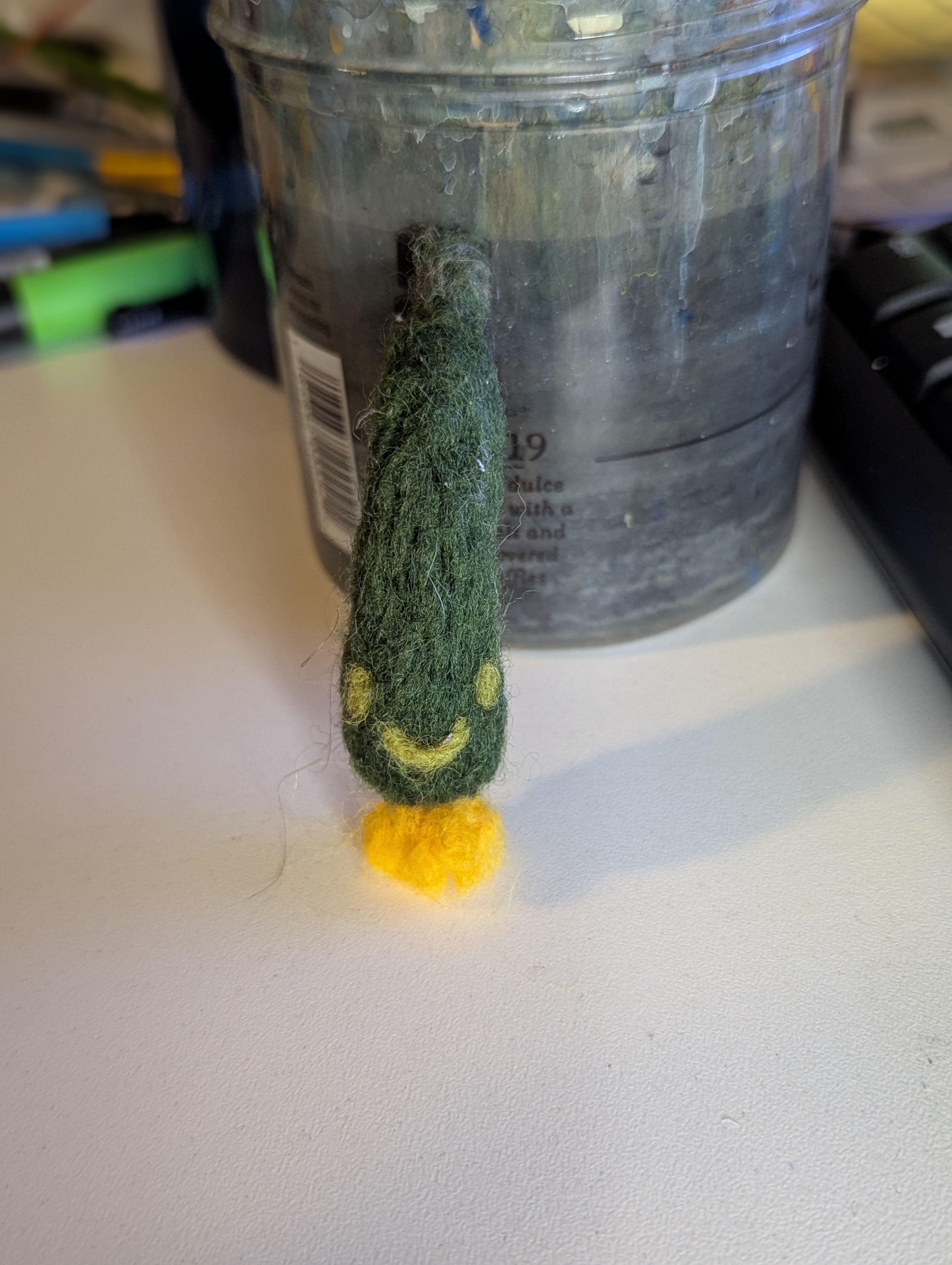
  21. The Barkeep and the Bro, by AJ Truman (m/m, both cis). A contemporary romcom, which was always going to be a hard sell, and indeed it didn’t work for me. This is an age gap, forbidden boss/employee, daughter’s ex-boyfriend, gay-or-possibly-bi-for-you book, and the tropes kind of took over. But because I read it and mentioned it to a friend, I was given a felted zucchini. (There is a scene in the novel in which a zucchini figures prominently.) So. Take that as you will.
  22. Paladin’s Grace, by T. Kingfisher (m/f, both cis). These books (yeah, I read all four) are all so fun and funny. The world reminds me a bit of Terry Pratchett.
  23. Paladin’s Strength, by T. Kingfisher (m/f, both cis). I liked this one the best. 
  24. Paladin’s Hope, by T. Kingfisher (m/m, both cis). I was disappointed that this is the shortest of the books.
  25. Paladin’s Faith, by T. Kingfisher (m/f, both cis). Probably the best plot of the four books in the series but my least favorite romance. Honestly I’m not sure these actually qualify as romances? They might be fantasy novels with romantic elements. 
  26. Husband of the Year, by MA Wardell (m/m, both cis). I still don’t really read contemporary, but this was nice–Jewish guy in interracial relationship gets married and adopts his husband’s nephew. More serious stuff than I expected from a romcom, but it tends to flinch away from any kind of real conflict; either you will like that or you won’t.
  27. Breakout Year, by KD Casey (m/m, both cis). A sweet Jew4Jew sports romance that was somewhat oddly shaped, story-wise. A little squishy in the middle, but Casey writes a delicious sentence, and ultimately it was enjoyable.
  28. Home Ice Advantage, by Ari Baran (m/m, both cis). A former NHL star becomes the head coach of his hometown team and winds up falling for the (Jewish) assistant coach who got overlooked for the job. I know even less about hockey than I do about baseball, but the emotional arc here was delicious and subtle.

A felt zucchini (green), with yellow blossom at one end. It is smiling.

Scifi/Fantasy/Horror

  1. Gideon the Ninth, by Tamsyn Muir. Lesbian space Jesus saves the planet with swords.
  2. Harrow the Ninth, by Tamsyn Muir. Ten thousand years is exactly the amount of time needed to develop the most toxic workplace in the universe.
  3. Nona the Ninth, by Tamsyn Muir. What if instead of gender, we had swords, ghosts, and spaceships?
  4. System Collapse, by Martha Wells. I think this is the one I got hit by a car while I was listening to the audiobook. So, uh. Distracting.
  5. All Systems Red, by Martha Wells. Reread. If I had Kevin R. Free dollars, I’d hire him to do my audiobooks. I also read this aloud to my 8yo. I read this book probably too many times in a short period. It impressed me more after having read through all the other books.
  6. Artificial Condition, by Martha Wells. Reread.
  7. Fugitive Telemetry, by Martha Wells. Reread.
  8. “Home, Habitat, Range, Niche, Territory,” by Martha Wells. Technically a short story. Also a reread?
  9. The Haunting of Hill House, by Shirley Jackson. Masterful. More queer than I remembered. Technically this was a reread but I read it the first time when I was maybe 20.
  10. The Masquerades of Spring, by Ben Aaronovich. I want to recommend this to everyone. Delightful and funny. Like Wodehouse but add Americans, race, queerness, magic, and jazz.
  11. We Have Always Lived in the Castle, by Shirley Jackson. Look, Merricat should be allowed to murder all those dreadful people. As a treat.

Plays

  1. The Bacchae of Euripides: A Communion Rite, by Wole Soyinka. He really gets Dionysus and creates a great, very dark, comedy.
  2. The Bakkhai, by Euripides, trans. by Anne Carson. Not as good as Soyinka’s. Sorry, tumblr. Get your “not for me…not if it’s you” out of here, Anne Carson.
  3. Father Comes Home from the War, by Suzan-Lori Parks. She’s one of the top playwrights of our modern times and this is a banger.
  4. We Bombed in New Haven, by Joseph Heller. Not famous for a reason.

Mysteries

  1. No. 1 Ladies’ Detective Agency, by Alexander McCall Smith. Is it a mystery? There’s a detective. But it’s a wonderful portrait of a time and place he clearly loved.
  2. Fer-de-lance, by Rex Stout. Very clever, a little racist and sexist.
  3. Fadeout, by Joseph Hansen. When I was getting sick in August, I spent a lovely rainy morning reading this in my brother’s sunroom while the kids ran around playing. Also it’s a nice California noir.
  4. Lavender House, by Lev AC Rosen. Rosen is way more about vibes than about creating a mystery that wraps up well. And the vibes are good! I was just left with a lot of questions.

Nonfiction

  1. Ghostland: An American History in Haunted Places, by Colin Dickey. Very interesting. 
  2. Hi Honey, I’m Homo: Sitcoms, Specials, and the Queering of American Culture, by Matt Baume. I had a lot of thoughts about how you get to see what they want you to see. But mostly I was left imagining showing Bewitched to Ulysses, and I couldn’t stop laughing.
    • No, okay, I guess I am going to talk about this. When you watch TV (and this is still true even with streaming), what you see is the shows they decided to make. Obviously. But why do they decide to make a show? It’s because they (they being network executives) do a complex calculation that boils down to “what will catch the public’s imagination such that we can make a boatload of dollars from this?”
    • And a lot of this is predicated on this idea of what “middle America” wants. (What is “middle America”? I feel like I live there? But also where I live, I have a lesbian mayor, a lesbian senator, and a gay congressperson.)
    • Anyway, whenever you’re asking, “Why weren’t there any gay main characters on TV before Will and Grace?” the answer is basically an exec thought that “middle America” wouldn’t like it. Even getting queer recurring characters or story lines that painted queer guest stars as sympathetic could be a stretch during some periods.
    • And now we have had a mainstream sitcom with a married gay couple who adopts a child and they’re main characters in the show, yay progress.
    • But if you think about this, and think about the world, and the vastness of the stories that are never being told because someone thinks they won’t be profitable stories, it gets very sad. I feel very tinfoil hat-y when I talk about it, but the censorship freaks me out. Not the “pulling your book out of a library” censorship, which is devastating, but the “we are going to ignore your ideas and not give you a chance” censorship.
    • Anyway, yay, self-publishing?
  3. “Appropriating the Golem, Possessing the Dybbuk: Female Retellings of Jewish Tales,” by Ruth Bienstock Anolik. Modern Language Studies, vol. 31, no. 2 (Autumn 2001): pp. 39-55.
  4. Alone, Unarmed, and Unafraid: Tales of Unarmed Reconnaissance During Vietnam, by Taylor Eubank. Engaging, but I don’t know if I recommend it.
  5. Three Men in a Boat (To Say Nothing of the Dog), by Jerome K. Jerome. Is this nonfiction? I don’t know. I had an abridged audiobook narrated by Hugh Laurie. I wish he’d done the whole thing.
  6. Things I Overheard While Talking to Myself, by Alan Alda. I’m not big on celebrity memoirs but this was good. Alda is an old school, fought-for-the-ERA liberal, and I love him.
  7. You Could Make This Place Beautiful, by Maggie Smith. A divorce memoir. I…wish she’d just hate him. Or talk more about craft, because she obviously wants to. But as it stands, it was good but felt a little like Swiss cheese?
  8. An Unfinished Love Story: A Personal History of the 1960s, by Doris Kearns Goodwin. I cried, even though I knew who died and when. For example, her husband Dick Goodwin was at the White House getting the East Room ready when they brought Kennedy’s body back from Dallas to lie in state. Everyone was so young and idealistic and they worked so hard. The audiobook has clips of the original deliveries of many of the speeches she talks about (including RFK [original recipe] talking about the death of MLK Jr. on the campaign trail in Indiana the night King died), which was amazing.
  9. A Swim in a Pond in the Rain, by George Saunders. Ultimately I disagree with him about the interpretations of the stories that he offers, and I only sort of like his ideas about how to write a story, but I liked the book. Make of that what you will.
  10. Manhood for Amateurs, by Michael Chabon. An older volume of essays, but one I really enjoyed. Made me laugh aloud at times.
  11. Entangled Life: How Fungi Make Our Worlds, Change Our Minds, & Shape Our Futures, by Merlin Sheldrake. Mushrooms are terrifying, and I’m 20 million microbes walking around in a human suit.
  12. Reading Selfishly: A Craft Journal for Writers, by KD Casey. I don’t think this is officially out yet, but she dropped a link to the first public version on Bluesky, and I think I’m officially a fan.
  13. Crochet Monsters: With more than 35 body patterns and options…, by Megan Lapp. I made four monsters out of this. All in all they were the biggest crochet projects I’ve finished to date. Even with a smallish hook (3.75-4mm), the monsters are all about 8″ tall or more. The book is well laid out, the instructions it offers are easy to parse even for a beginner-to-intermediate crocheter, and there are loads of photos. My kids liked flipping through it and coming up with new monsters, and I didn’t hate making them.

YA Novels I Read Aloud to My Children

  1. Wintersmith, by Terry Pratchett. It was good. I have no notes except that it felt like the main character has out-aged the kid I was reading this to a bit and I want to wait before I read him the next one.
  2. Over Sea, Under Stone, by Susan Cooper. Not as good as The Dark Is Rising. The child still really liked it.
  3. Greenwitch, by Susan Cooper. Very good.
  4. The Grey King, by Susan Cooper. Cooper is a powerhouse. I don’t know what to say. More creepy poems in fantasy novels! (Content warning! There’s a dog that gets shot in this one. I was a little shocked.)
  5. The Hobbit, by JRR Tolkien. Reads aloud well. (Not only was this a reread, this wasn’t even the first time I’d read this aloud.)
  6. The Halloween Moon, by Joseph Fink. If you want a middle-grade YA novel about a Jewish kid, you could do worse.

Lazarus, Home from the War Bibliography

I don’t always cite my sources for novels–in fact, they’re novels, and I think in general I’d prefer not to make it clear where I’ve hewn close to the truth and where I’ve wandered. But I did so much reading for Lazarus, Home from the War, and it touches on so many topics I think people might be somewhat interested in, I thought I might as well give a few options for further reading.

On Buddhism

I spent what felt like half of my academic career studying Buddhism, from the very first semester of my undergraduate life (thank you, Professor Hallisey) to the final moments of my second MA. Some good non-academic introductions to the ideas of Buddhism might be:

Siddhartha, by Hermann Hesse (1922). An imagining of the life of the Buddha. I think this was probably the first thing I read (when I was in my teens!) about Buddhism.

The Empty Mirror: Experiences in a Japanese Zen Monastery, by Janwillem van de Wetering (1971). When it’s the 1950s and you’re in postwar Japan studying Zen and also Gary Snyder is there.

The Snow Leopard, by Peter Matthiessen (1978). When your wife just died and you are a Zen Buddhist and you decide to go to the Himalayas with George Schaller to look for the snow leopard for two months. (Side note: Matthiessen had kids with his wife, the youngest of whom was 8 at the time of their mother’s death. It’s not clear why he gets to go traipsing around Nepal, and they go…where? This has nothing to do with the book, which is wonderful. It’s just always bothered me. Also, Matthiessen was a spy, and later became a monk, making him I think the only monk/spy I’m going to mention in this list.)

But those are all about Buddhism generally or Zen Buddhism, which is Mahayana Buddhism. Laz is a Theravada Buddhist, because he converted in Thailand. These are different sports, although they are played on the same field. (Sorry, I’m not a sports person. Does that…make sense?)

For slightly more academic looks at Buddhism (note that none of these texts is exactly introductory)

World Conqueror and World Renouncer : A Study of Buddhism and Polity in Thailand against a Historical Background, by Stanley J. Tambiah (1976). He’s an anthropologist, so you know it’s gonna be a bad old time. There’s survey data. There’s tables. But there’s also info about how one becomes a monk (in Buddhism, unlike in the West, it can be a temporary commitment, rather than something you sign up to do for the rest of your life.)

The Lovelorn Ghost and the Magical Monk: Practicing Buddhism in Thailand, by Justin Thomas McDaniel (2011). It’s about how modern-day Thai Buddhists practice their religion.

“Buddhism and Conscience: An Exploratory Essay,” by Gananath Obeyesekere. Daedalus, vol. 120, no. 3 Religion and Politics (Summer, 1991), pp. 219–239. Mostly about Col. Henry Steel Olcott, who I find fascinating. I don’t know. This is my bibliography, let me alone. (Olcott: born 1832, became a spiritualist, served in the Civil War, helped investigate Lincoln’s assassination, became a lawyer, helped found the religion of Theosophy, converted to Buddhism along with Madame Blavatsky, moved to Bombay, wound up in Sri Lanka, and developed what is now known as the Buddhist catechism, which was his attempt to educate Westerners in the precepts of Buddhism. He also designed a Buddhist flag, which is still in use today.)

“Attack of the Widow Ghosts: Gender, Death, and Modernity in Northeast Thailand,” by Mary Beth Mills. In Bewitching Women, Pious Men: Gender and Body Politics in Southeast Asia, edited by Aihwa Ong and Michael G Peletz, Berkeley: University of California Press, 1995, pp. 244–273. I don’t know if this is actually helpful, it’s just about using wooden penis votives (among other methods of gender performance) to ward off evil ghosts, and I think that’s kind of neat.

On Judaism

Okay, I actually am Jewish, so I don’t have a lot of elementary texts on this. It’s just my life. Like: Why does Eli not know when Hanukkah is? Because when I didn’t have kids, I always had to look it up, because I didn’t care. (I still don’t care. But now I have to look it up.) But I do have some stuff on dybbuks.

“Appropriating the Golem, Possessing the Dybbuk:  Female Retellings of Jewish Tales,” by Ruth Bienstock Anolik. Modern Language Studies, vol. 31, no. 2 (Autumn 2001): pp. 39–55. https://doi.org/10.2307/3195336

The Dybbuk: The Origins and History of a Concept,” by Morris M. Faierstein. In olam he-zeh v’olam ha-ba: The World and the World to Come in Jewish Belief and Practice, ed. Leonard J. Greenspoon. Purdue University Press, 2017, pp. 135–150. This is an excellent paper.

Jewish Magic and Superstition, by Joshuah Trachtenberg (1939, updated 2023 edition published by Global Grey referenced). Beware: it’s a bummer.

A Dybbuk: and Other Tales of the Supernatural, by Tony Kushner and Joachim Neugroschel (1997). Although the idea of dybbuks is relatively old, the play The Dybbuk by S. Ansky (1914) is really what popularized the idea; it was later made into a movie (in Yiddish) in 1937. Here, Kushner works with Neugroschel’s translation to produce a new English version.

On the Air Force

People who fly airplanes are insane, as far as I can tell. No one has ever looked at an airplane and thought, yes, it would be totally cool to fly that and also been 100% all right. This goes double for fighter jets.

Alone, Unarmed, and Unafraid: Tales of Unarmed Reconnaissance During Vietnam, by Taylor Eubank (2014). There was something weird with my copy, which came from Barnes and Noble’s website. So maybe try Amazon? He has a website, too, with many photos and supplementary information.

Voodoo Warriors, by Group Captain Nigel Walpole (2007). How do you get from someone designing an airplane in their sketchbook through to flying it in a war? 

The Bomber Mafia: A Dream, a Temptation, and the Longest Night of the Second World War, by Malcolm Gladwell (2022). Is it accurate? I don’t know. People had some specific complaints in their Goodreads reviews that I didn’t really understand. But it does really enforce the point about how crazy the guys who founded the Air Force were. Also, it’s not every day I learn a new fact about WWII that makes me blanch, and this had several.

On the Vietnam War

There’s so much out there. These are things I happened upon, mostly because my library happened to have them.

Boots on the Ground: America’s War in Vietnam, by Elizabeth Partridge (2018). TW: Look, most books on the Vietnam War contain graphic descriptions of what it feels like to watch your friends get killed in a violent and arbitrary way, and this is no different. Good context for the war though. Weird that Kennedy comes out looking like a bad guy and Nixon comes out…well, I don’t have anything good to say about him one way or the other, and this book didn’t help.

The Boys of ‘67: Charlie Company’s War in Vietnam, by Andrew Wiest. My biggest reaction to this was I was surpriseed that Wiest hadn’t heard of PTSD by the late 1990s (I think that’s when this book begins). The descriptions of marching through the Vietnamese jungle took me back…not in a great way. Also it’s a collection of oral histories and it made me cry, so.

Voices from the Vietnam War: Stories from American, Asian, and Russian Veterans, by Xiaobing Li (2012). I only read a few of the stories in here. It’s of particular interest because Li managed to interview veterans from South and North Vietnam and China, among others (as it says in the subtitle, I guess). Not a lot of other books do that.

On Earth We’re Briefly Gorgeous, by Ocean Vuong (2019). I feel like it’s hard to talk about the impact of the Vietnam War without at least touching on some of the effects on the people most impacted by it—arguably the South Vietnamese. I don’t think that I can write with the necessary honesty about the most complicated parts of these experiences, but I do like to be conscious of them when I’m working. TW: this contains one of the most stomach-turning scenes I’ve encountered in a book, and it involves animal harm.

And of course, if you’re interested in the protest movement in Madison, the seminal book is They Marched into Sunlight: War and Peace, Vietnam and America, by David Maraniss (2003). (Or at least the seminal book I’ve heard about. I know there are local historians working on this period right now, and probably other stuff I haven’t stumbled across.)

On Neurology

The best-known neurologist in the world is probably Oliver Sacks. Which is good, because he was both one of the world’s great weirdos and a total delight. He also happens to have been a British Jewish queer man who was born in 1933, meaning he was in his prime during the craziness of the middle of the twentieth century. (He moved to San Francisco in the ’60s. He knew a ton of queer writers and artists, like Auden and Gunn. He had a fairly cavalier attitude toward drug use. He rode a motorcycle and was like 6’4″. He could squat 500 lbs. He was also surprisingly shy.) His memoir, On the Move: A Life (2015) is a great resource for finding out about any of the above, plus how neurologists think about cases. His other books are great too; I’ll recommend The Man Who Mistook His Wife for a Hat (1985) and An Anthropologist on Mars (1995) not just for the clinical insight but for the empathy on display. He was also on Radiolab quite a bit: here’s a good episode.

The less well-known but still pretty cool Harold Klawans also had a few books of clinical cases, of which Toscanini’s Fumble: And Other Tales of Clinical Neurology (1988) is the one I remember the best.

Finally, Cook County ICU: 30 Years of Unforgettable Patients and Odd Cases, by Cory Franklin (2015) isn’t about neurology, but has interesting things to say about how physicians think. Also it contains the interesting fact that chemists who commit suicide often do so by ingesting cyanide. (Is this true? There was a 1969 paper on the topic, “Suicide Among Chemists,” by Frederick P. Li MD. Archives of Environmental Health: An International Journal, 19(4), 518–520. https://doi.org/10.1080/00039896.1969.10666878 But it only looked at female chemists. As I try to find later data, the computer is mostly offering me suicide prevention hotlines, which is unfortunate.)

June Newsletter

Thank you all for the support for Lazarus, Home from the War. Many people posted lovely reviews on social media and shared my posts, and in general made release day very delightful for me. I donated the first day’s profits from Amazon to Doctors without Borders and Amazon Conservation, two organizations I’ve supported for a long time.

June is Pride Month! (Except in Madison, where Pride happens in August because all the serious Pride-goers go to Milwaukee and/or Chicago first, I guess.) Happy Pride to everyone! Last year I had a short story for you all. This month, well…I wrote you a novel. Actually, I’ve been working on some shorter things, but nothing is done yet. Sorry! I did write you a novel.

Speaking of which, I’m pleased to announce that last week, I finished work on the first draft of book 8. This means that all nine books in the Wisconsin Gothic series have first drafts written! All of them clock in between 63 to 80k words; the fastest any of them was written was about eight weeks, and the slowest was about 55 weeks. (Length doesn’t correlate with writing speed, surprisingly.) And, if you’re curious, the order in which they were written, as far as I can remember, was: Dionysus in Wisconsin, Old Time Religion, Lazarus, Troth, book 6 started, book 7, book 6 completed, book 9, book 5, book 8.

Thanks to artist S. S. Genesee, I have a new Wisconsin Gothic sticker! I will be sending them to various bookstores as freebies and will also have them at events. And maybe send them out with direct orders. If you find yourself jonesing for a T-shirt or a tote bag with this logo, let me know.

Which reminds me: I am now fully stocked with paperbacks of all the books! If you want one, you can email me, slide into my DMs on a social media site, or head on over to itch.io. I charge $17 if I have to ship and $15 if you’re local and want to pick it up. If you want multiple books, definitely message me and I can give you a small discount. I know a few bookstores also have Lazarus in stock, notably Tropes and Trifles in Minneapolis (I saw a photo).

Upcoming Appearances

I will be at the Author Fair at the Hedberg Public Library in Janesville, WI on June 21st. It runs from 2:30-4:30pm. In addition to copies of all four novels, we’ll have tarot decks available, and Rowan will be doing tarot readings for $5 (space permitting).

I will be at the Middleton Book Fair on August 2nd from 10am–4pm (or whenever we sell out). It’s being held on Stone Horse Green this year, which is at the corner of Elmwood and Parmenter.

I’ll be at Tropes and Trifles in Minneapolis, MN the first week of August to sign some stock and say hi. This is a very unofficial visit. Specific date/time TBD.

And in September, I’ll be at Booked Eau Claire! It’s a big event taking place from 12–13 September. I will be speaking on two panels (one on closed vs open door romance and one on indie publishing). If you’re planning to attend and would like a signed book, you can pre-order here. (Note that this is a very manual process, so if you try to pre-order and don’t hear from me with a bill, send me an email!)

Other Announcements

New Milwaukee-area romance bookstore The Well-Red Damsel will be carrying Dionysus in Wisconsin when they open, so make sure you drop by and pick up a copy so they know it is a good idea! I’m going to send them some stickers too, although I may not have them for their opening, which I believe is June 21st.

In May we did zero podcasts. Whomp whomp.

I’ve written a blog post with a bibliography of sources I looked through while writing Lazarus. It’s not up yet, but look for it later this week.

That’s it. Have a good month!

May Newsletter: The Fiftieth Anniversary of the Fall of Saigon

When I noticed the date, I decided to send out the newsletter early. Probably I’ve been thinking about Viet Nam too much. (April 27th was also the 50th anniversary of the release of the film Monty Python and the Holy Grail, so…take your pick what to commemorate this week.)

In eleven days, I am running Ice Age 50k, which is held in Kettle Moraine State Park (the southern unit) outside of La Grange, Wisconsin. I registered for the race in December. In the time since then, I have run somewhere in the neighborhood of seven hundred miles, had a brief bout of COVID that left me with a chronic cough, and got hit by a car once (non-fatally; don’t worry about it). There were days when the temperature was about 10°F. There were days when it was lower. There were mysterious aches and pains in calves and hamstrings that I worried would blossom into injuries. And there were times when the days were very dark and I thought perhaps I should pack it in altogether.

Nevertheless, here we are.

Running is a lot like writing. (Haruki Murakami wrote a whole book about this—What I Talk About When I Talk About Running—so I won’t belabor the comparison.) Both because when it’s going badly, you can always crawl into a nearby bush and wait for the end…or because it doesn’t help to get ahead of yourself. Standing on the starting line with 31 miles to go is intimidating. Staring at a blank page with eighty thousand words in front of you is terrifying. But I can run one mile (some days, I can run to the next mailbox). And then I can run another one. I can write a word, or a page, or a couple hundred words.

All of which is to say, we’re fifteen days away from the release of Lazarus, Home from the War, and I’m very excited. I’ve spent so long doing research and tightening the screws and buffing out the dents, that I’ve hardly let myself look up and see that this day was coming. I’ve spent many weeks dragging myself through edits by saying I could do one chapter, or one page, or one sentence, and then repeat and repeat and repeat.

And somehow, we’ve made it.

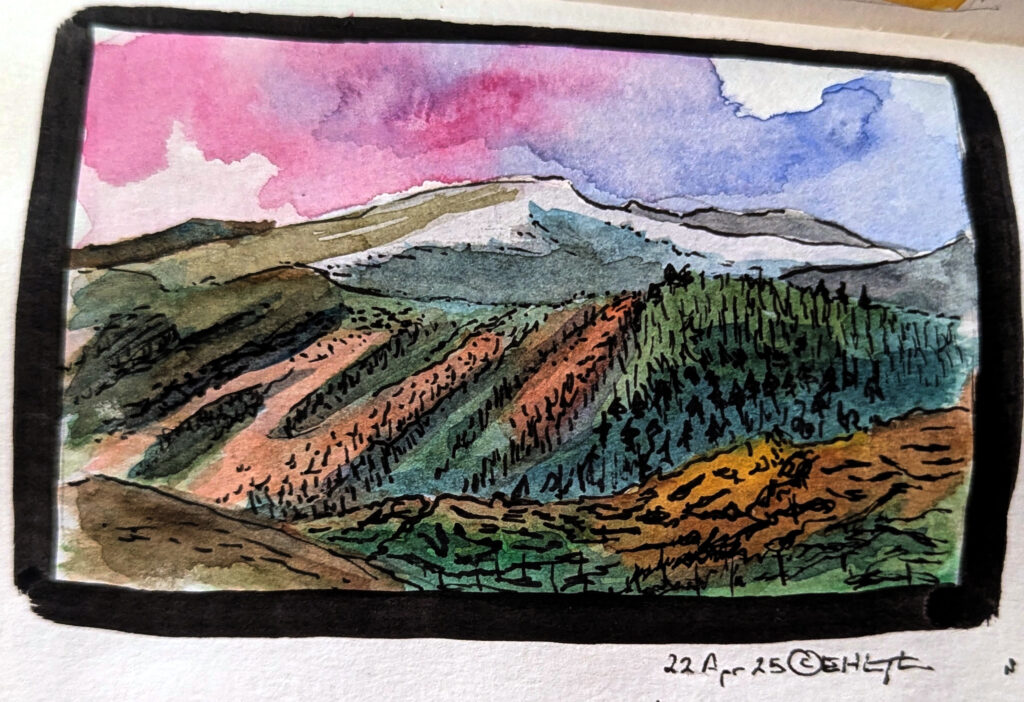
A watercolor sketch of a mountain in Tasmania with some pink and purple clouds behind it.
Original photo by @antongorlin@mastodon.art

Publicity and Appearances

Rebecca Crunden, who runs the Indie Book Spotlight blog/account on Bluesky, interviewed me for her blog here.

I’ll be at WisCon the weekend of May 23–26. It’s being held online, and you can get tickets here. Disappointingly, they don’t seem to be doing readings this year, but I’ll be participating in a panel on writing about religion in sci-fi and fantasy at 4pm CT on Friday, May 23rd. 

For those in Janesville, Wisconsin, I’ll be at the Hedberg Public Library’s Book Fest on June 21, selling books and tarot decks from 2:30-4:30pm. Their website is here. Fun fact: the Hedberg Public Library was originally a Carnegie Library, and it cost $35,000 in 1902 dollars.

Podcast News

We put out two episodes on medieval memes: “Ask a Memevalist” and “The Field Where I Grow My [D]ucks” (thanks to autocorrect for inspiring the episode title). Both episodes examine some medieval memes we collected from across the web, all of which can be found in the episode notes (we also describe them in the episode). We also put out “An Emergency Popecast” on Pope Francis and the upcoming conclave. (Has it started yet? Hmm.)

Things I’ve Been Reading

I read We Bombed in New Haven, a play by Joseph Heller. Was it Catch-22: The Play? No. Did it send me down a rabbit hole during which I read some guy’s PhD thesis on performances of masculinity in WWII novels? Yes. (Playing a Terrible Game of Pretend: Masculine Performance and Gender Humor in the WWII Novels of Heller, Vonnegut, Pynchon, and Weaver, by Tomas Glover Pollard.)

I listened to an (abridged) audiobook of Three Men in a Boat (To Say Nothing of the Dog), by Jerome K. Jerome. It was short, funny, and narrated by Hugh Laurie, which made it even better. If you enjoyed Jeeves and Wooster, this is just the ticket. Honestly, my only complaint is how far abridged it was. 

I listened to the audiobook of The Haunting of Hill House, by Shirley Jackson. I read it years ago (it’s referenced in “Dous,” at least partly because it is where the word/concept of “planchette” entered my vocabulary, which later became a central component of a delightful set piece in Dionysus in Wisconsin), but the narrator’s performance really brings out some of the humor I’d either missed when I read it with my eyeballs or forgotten about. The work as a whole is so well-written. It’s taut with tension and spare, but the details that are there really sing. As a story, it knows exactly where it is going from the very first moments. What an impressive achievement.

Further Administratrivia

Starting with this edition, all newsletters will be publicly archived on my blog, so if you delete this and then want to refer to the information contained herein, you can find them at https://ehlupton.com/blog/.

If you signed up to be an ARC reader and did not receive a copy of the book, let me know! I sent everything out fifteen days ago, but fear some may have been caught in spam filters.

That’s all for now. I’ll send out another message when the book’s out, so talk to you all in two weeks.

Em oi! #454: Sad Not SAD

Here are all the books I read in 2024. I’m not going to rank them, but I’ll give brief reviews. I usually try to read the abbreviation of the year in books, so my goal for 2024 was 24 books. I read slightly more than that across many genres, although romance was the plurality.

Children’s/YA books

  1. The Dark is Rising, by Susan Cooper. Read aloud; I don’t think I have to convince anyone that this is an amazing book.
  2. The Amazing Maurice and His Educated Rodents, by Terry Pratchett. Read aloud; at times we were laughing too hard to go on, and really, what other endorsement is needed?
  3. Camp Damascus, by Chuck Tingle. Some excellent moments but ultimately too much Jesus for my tastes. Already lived all that shit by proxy growing up.
  4. Belle of the Ball, by Mari Costa. A pretty graphic novel with a big heart. Full disclosure: I met Mari Costa at the Lammys!
  5. The Golden Thread: A Song for Pete Seeger, by Colin Meloy. I may be biased because I’m a fan of both Colin Meloy and Pete Seeger, but this was delightful. (I never read it to the kids, though. Just saw it at back to school night.)
  6. The Boy Who Loved Math: The Improbable Life of Paul Erdos, by Deborah Heiligman. Too many words for a bedtime story, but my 3yo inexplicably loved it. The story is very cute, and Erdos was a loveable weirdo.

Romance (pairings and settings as noted)

  1. I’m So (Not) Over You, by Kosoko Jackson (M/M, contemporary). I hope Berkeley feels embarrassed by how dirty they did this poor book. Could have been good, but it was an entirely unedited mess.
  2. Take a Hint, Dani Brown, by Talia Hibbert (M/bi F, contemporary). For what it was, it was fine.
  3. Bisclavret, by KL Noone (M/M but one of them is a werewolf, middle ages?). A novella retelling the werewolf story “Bisclavret” by Marie de France. I usually think novella is not the best format for a romance, but this was charming. Full disclosure: I’ve been on panels with KL Noone a few times now at Rainbow Space Magic Con. (I don’t think she remembers me though.)
  4. A Marvellous Light, by Freya Marske (M/M, late Edwardian). Book 1 in the Last Binding series. The plot was fine and the writing was good.
  5. A Restless Truth, by Freya Marske (F/bi F, late Edwardian). Book 2 in the Last Binding series. The supporting characters were good.
  6. You Should Be So Lucky, by Cat Sebastian (M/M, 1960s America just pre-Kennedy). I am not interested in baseball, but this was a delight start to finish and a standout. The second in the Mid-Century New York series (I lost the Lammy to the first one).
  7. A Minor Inconvenience, by Sarah Granger (M/M, Regency). Don’t think too hard about the plot. Or the sex scenes. The setting was nice.
  8. Letters to Half Moon Street, by Sarah Wallace (M/M, Regency). A gentle epistolary novel with almost no plot and an interesting queernorm regency setting that nevertheless left me with a lot of questions.
  9. An Appreciation of Cats, by Des DeVivo (M/M, contemporary?). Another novella that I read. I got this one as an ARC.
  10. Oak King Holly King, by Sebastian Nothwell (M/M but one of them is an elf, early Victorian). A standout–set in 1844, with strong medieval undertones and a delightful episodic plot that draws on the story of The Green Knight. Full disclosure: I was on Sebastian Nothwell’s podcast (Right Here, Write Queer) and he was recently on mine.
  11. A Power Unbound, by Freya Marske (M/M, late Edwardian). Book 3 in the Last Binding series. I didn’t hate it. Also I liked the characters from A Marvellous Light a lot better here.
  12. The Nobleman’s Guide to Seducing a Scoundrel, by KJ Charles (M/M, Regency). This was a delight. I have to go read book one now.
  13. Scandal in Spring, by Lisa Kleypas (M/F, early Victorian). This was the third book in a row that I read where one character had a BIG TERRIBLE SECRET that got revealed at or after the 50% mark in the book and turned out to be eminently overcomeable, and I am so over it.
  14. Cutting It Close by Reese Knightley (M/M, contemporary). I kind of lost track of the number of (war) crimes committed by the ostensible heroes. This book is a reminder that I need to stop picking audiobooks by just grabbing whatever is listed under “available now.”
  15. Dead Egyptians by Del Blackwater (M/M but one of them is a ghost, Edwardian). More of a character study, but a really lush and intriguing one. TW for an assault that happens around the 75% mark. Full disclosure: I have met Del Blackwater a few times (she lives in the area).
  16. My Last Duchess, by Eloisa James (M/F, Georgian). I want to say that it doesn’t make sense to try to body-shame someone when the fashion is to wear panniers, but that really diminishes the amount of fun that this book was.

Literature and Scifi/Fantasy

  1. Matrix, by Lauren Groff. If you’re the oldest daughter, and you sometimes get given distasteful tasks, and you maybe feel the need to do a really, really superior job at everything, you will see your experience reflected here. This had so many good lines–the writing was really an amazing achievement.
  2. On Earth We’re Briefly Gorgeous, by Ocean Vuong. It was very good and also sad. Contained the single most stomach-turning scene I read (heard, I guess–I had this as an audiobook) this year, maybe ever.
  3. Interior Chinatown, by Charles Yu. This was amazing and everyone should read it. And give Charles Yu more money to write more books. A real standout (and I got B to read it too).
  4. No One Is Talking About This, by Patricia Lockwood. Part I was like having tw*tter slow-dripped into my ear. Part II made me cry.
  5. Space Opera, by Catherynne M. Valente. So amazing I immediately made B read it. Also a standout.
  6. Translation State, by Ann Leckie. A tricky book; not enough connection to the earlier Imperial Raadch novels and too much. Good but unsatisfying; I think it tried a lot of interesting things and I love it for that.
  7. Legends and Lattes, by Travis Baldree. The real magic rock was the friends we made along the way, I guess. This book managed to be very boring and also keep my interest, which feels like an achievement.

Nonfiction, Biography, and Memoir

  1. The Bomber Mafia, by Malcolm Gladwell. It’s all fun and games until Curtis LeMay firebombs Tokyo. (Of note, LeMay also introduced judo into the US and later was the VP candidate under George Wallace in 1968. Gladwell doesn’t mention either of these facts. I had to find them out by myself.)
  2. Cook County ICU: 30 Years of Unforgettable Patients and Odd Cases, by Cory Franklin. Franklin is honest to a fault and I find I like him a lot for it.
  3. A Molecule Away from Madness: Tales of a Hijacked Brain, by Sara Manning Peskin. Unfortunately this was reported stories focusing on the neurochemical underpinnings of various neurological issues rather than Oliver Sacks-esque first-hand case studies.
  4. On the Move: A Life, by Oliver Sacks. This was so delightful, and I’m glad he published it while he was still alive so no family members could stop him. (Would they? I don’t know. It was kinda scandalous. But also very good.) Key quote (not of the scandalous parts):
    As soon as I could get away from work on Friday, I saddled my horse–I sometimes thought of my bike as a horse–and would set out for the Grand Canyon, five hundred miles away but a straight ride on Route 66. I would ride through the night, lying flat on the tank; the bike had only 30 horsepower, but if I lay flat, I could get it to a little over a hundred miles per hour, and crouched like this, I would hold the bike flat out for hour after hour. Illuminated by the headlight–or, if there was one, by a full moon–the silvery road was sucked under my front wheel, and sometimes I had strange perceptual reversals and illusions. Sometimes I felt that I was inscribing a line on the surface of the earth, at other times that I was poised motionless above the ground, the whole planet rotating silently beneath me.
  5. Cultish, by Amanda Montell. I don’t know that her thesis (that cults use in-group language to promote belonging and a sense of community) is all that surprising, but I learned some interesting stuff.
  6. The Commitment: Love, Sex, Marriage, and My Family, by Dan Savage. I don’t know if I should say, “Wow, the early 2000s were genuinely as bad as I remember thinking they were at the time,” or “Dan Savage is the most Gen X writer.” Now I’ve said both.
  7. The Boys of ’67: Charlie Company’s War in Vietnam*, by Andrew Wiest. A group memoir (biography? collection of oral histories?). This made me fucking cry. While driving.
  8. Boots on the Ground: America’s War in Vietnam, by Elizabeth Partridge. (Technically maybe YA nonfiction? oral histories woven together with bits of the larger historical record of the era, from the early ’60s through to the early ’90s.) I didn’t cry but only because I was running on the dreadmill at the time.

* Note–the company that committed war crimes in the village of Son My known as the My Lai massacre was also called Charlie Company, but that’s a different company. Because Army companies are named A, B, C, etc., and then referred to using the NATO Phonetic Alphabet, there’s lots of Charlie Companies.

Other Things I Read

  1. Three Hundred Ramayanas: Five Examples and Three Thoughts on Translation,” by AK Ramanujan. In The Collected Essays of A. K. Ramanujan, Oxford: Oxford University Press, 2004, pp. 131-160. I love this essay so much I wrote my MA thesis about it. I love this essay so much we did a podcast on it.
  2. The Dybbuk: The Origins and History of a Concept,” by Leonard J. Greenspoon. In olam he-zeh v’olam ha-ba: The World and the World to Come in Jewish Belief and Practice, Perdue University Press, 2017, pp. 135-150. This was really informational, and well-written to boot. I learned so much.
  3. “The Etymology of Condom,” by Zacharias P. Thundy. In American Speech, vol. 60, no 2 (summer 1985): pp. 177-179. This started as a joke about the etymology of “condiment” that got way out of hand.

Books and Other Works I Published

  1. Old Time Religion. This was a scary book to write. Dionysus in Wisconsin was received well by a small but enthusiastic coterie, and I didn’t want to disappoint them. Luckily the Lammy shortlist hadn’t come out yet when I released it in January, or I would have freaked out even more than I already did. I got fewer preorders for this book than I did for DIW, which was unpleasant, and although I offered ARC copies no one wanted one. On the production side, the book was beset by some last-minute problems with the cover, which were a real learning experience and did nothing for my stress level. Fortunately, it has been well-received and sold steadily! I don’t track earnings by book, but it has earned out at this point, and slightly faster than DIW did (eleven months instead of twelve).
  2. Dous.” This was so fun to write. I did catch myself trying to decide if I’d unfairly leveraged an argument Spivak makes about the way women are oppressed in India in a context she would object to, and then decided that I was getting a little too serious about the philosophy side of things for a lighthearted short story. As far as I can tell only a few people bothered to read it, probably because I gave it a weird title (it makes sense if you’ve read OTR, I think). But that’s fine. I know a few people really loved it, and that means a lot to me.
  3. Troth. This was a fun book to write, a hard book to revise, and now that it’s done I am extremely happy it’s out in the world. The last few chapters made me very happy to write. I got a lot more preorders for this one than I did for DIW and OTR–as many as both of them combined, actually. I didn’t bother to send out ARC copies. How do you offer ARC copies for the third book in a series without cannibalizing your audience? But despite the lack of hype, it has sold very well, including the best first month sales of any of my books.
  4. “Vivienne.” I sold this to Asimov’s Science Fiction and I have the check stubs to prove it, but although I received galleys, it was not published in 2024. I don’t know exactly what the story is; selling it was quite a coup, perhaps the most high-profile sale I’ve ever made. Maybe it will appear in 2025. Keep an eye out.
  5. Em oi! 452, 453, and 454 (above). I have another comic that I sketched and inked and then set aside because I needed to focus on something else.
  6. Lazarus, Home from the War. I have written two and a half full drafts of this novel this year, I think. I am so excited to show it to people in 2025. It’s got so much cool stuff that I love–a guy trying to put himself back together! A Jewish neurologist! A really scary snake! It will be out in May 2025, so keep an eye out!

Em oi! #452: An Honor to be Nominated

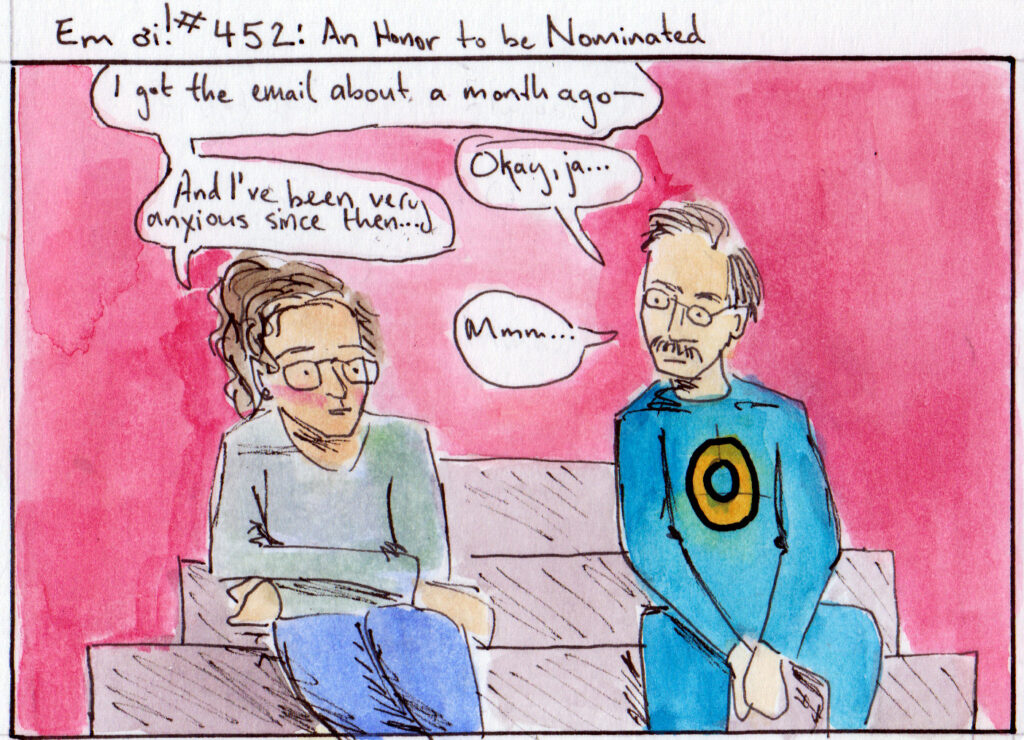
Em oi! #452: An Honor to be Nominated Em: I got the email about a month ago-- Nietzsche: Okay, ja... Em: And I've been very anxious since then... Nietzsche: Mmm...
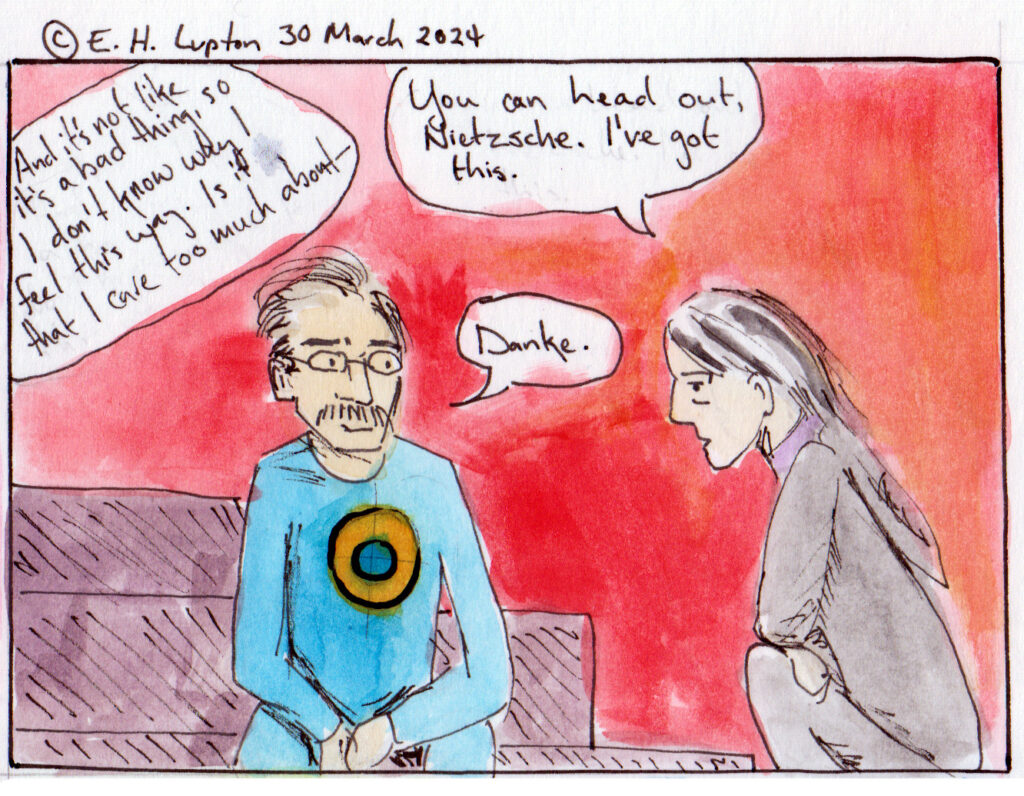
Em: (out of frame) And it's not like it's a bad thing, so I don't know why I feel this way. Is it that I care too much about--- Mary Oliver: You can head out, Nietzsche. I've got this. Nietzsche: Danke.
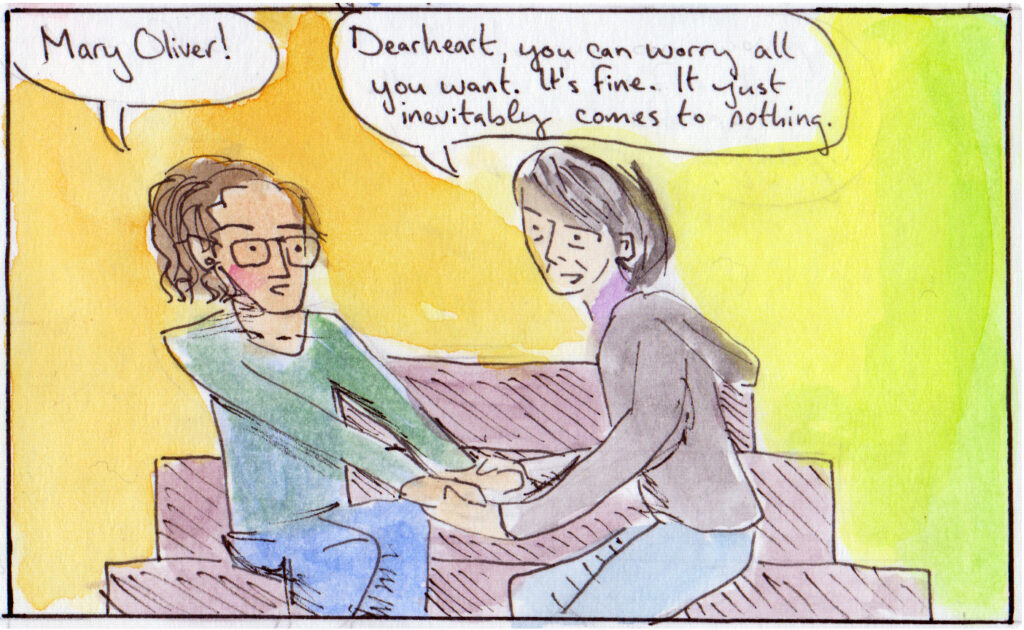
Em: Mary Oliver! Mary: Dearheart, you can worry all you want. It's fine. It just inevitably comes to nothing.
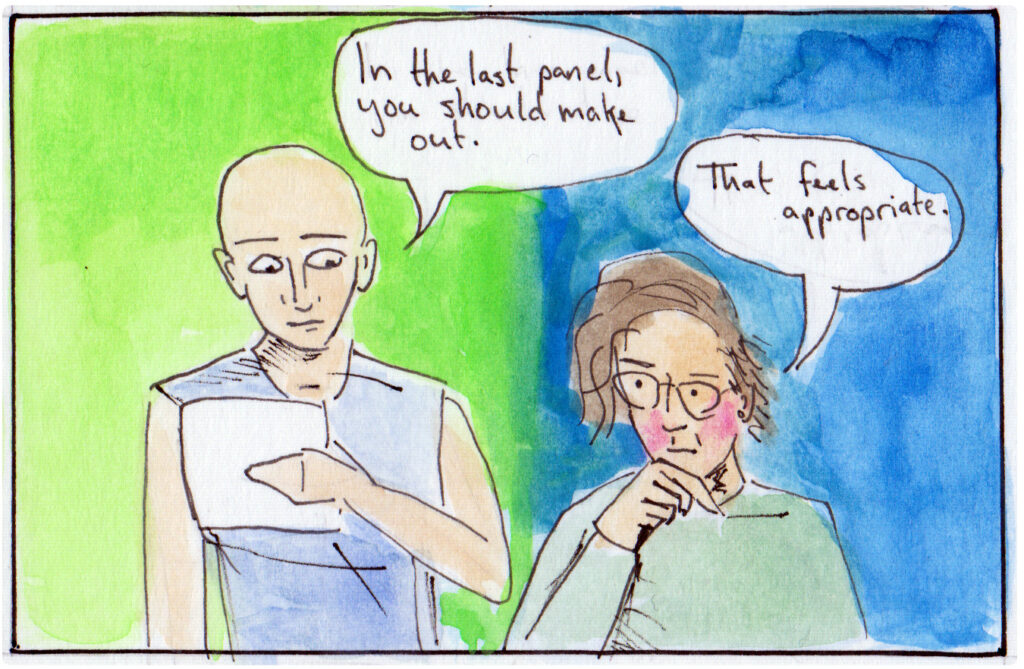
Bryan: In the last panel, you should make out. Em: That feels appropriate.

(In case you haven’t read it, Mary Oliver references this poem. Nietzsche dressed as the Overman first debuted here.)

In case you missed it, Dionysus in Wisconsin got shortlisted for the Lambda Literary Award in gay romance. The ceremony isn’t until June, so I get to spend the next few months either being anxious or being fêted, depending on who you ask. The other nominated works (you can check them out here) are also tremendous, which is awesome and intimidating all at once. In a very good article on being nominated for things, John Scalzi refers to all the works nominated together as a peer group. It’s hard to conceptualize myself up next to those other writers as peers, because their books are so good.

Awards are weird. On the one hand, they can draw attention to works that otherwise have been overlooked, create critical conversation, and recognize people who do work very, very hard and often receive very little. On the other hand, as an outsider, they can often seem to reinforce mainstream, middle-class values and recognize works that have already received recognition. Not for nothing, the Pulitzer board declined to award a prize for Gravity’s Rainbow the year it was released, because some of the board believed it was obscene and unreadable. (Which it is, but not in a bad way.)

That is to say, in a certain sense, it doesn’t matter if the Barbie movie gets an academy award (or even a nomination); it’s already proved its point by grossing a billion dollars worldwide. It’s already won.

For every book I’ve read that had justifiably won the award it was nominated for, I can name one that wasn’t very good and made me wonder what the judges had been thinking. And of course, there’s the terrible conundrum of the writer who wins a major award early in their career and then never quite achieves that high again. 

Anyway, as of this writing, my biggest feeling right now is just…happiness. As someone who was always kind of a weird kid, who wandered for a long time without much acknowledgement that my writing was what anyone wanted to read (remember this comic? yeah, bleak times), it’s nice to feel like, hey, actually, someone did like it after all. More than one someone.

I just want to take this moment to thank everyone who’s read the book already, or who heard the news and is reading it now. You guys are the best. If you ever get to Madison, let me know. I’ll make cookies.

Gonna file this under BF608 L86 2024 for Philosophy, Psychology, Religion–Psychology–Will. Volition. Choice. Control. (Feel a little bad for psychology, which still shares BF with parapsychology and occult sciences. That feels like a statement at this point.)

Em oi! #435: The Consolations of Philosophers


It turns out that there are now Em oi-canonical ways to draw some philosophers, since they have appeared a few times in the comic:

Also it turns out I have drawn a lot of comics about anxiety. Hmm. This one will be filed under B808.63 L86 2018, for Philosophy  (General)–Modern (1450/1600-)–Special topics and schools of philosophy–Anxiety.  (If you’re just here for the philosophy, feel free to peace out here.)

As I was scanning this comic, I was wondering what I was going to write for my little essay here. The time between initially writing this and finishing it was so long that if I initially had any additional thoughts, they have now gone away. But in the meantime, it is young Hal’s birthday!

Isn’t he adorable?

Anyway, I have been trying to think of some things about having a kid that I wish I had known before he was born. Honestly, most of the things that are coming to mind are not necessarily things you can know beforehand. Like no matter how good you are at putting your baby to bed, you’ve only learned how to put your baby to bed–you can’t know ahead of time how to do it, because your baby has his own personality and likes and dislikes, and you can’t help anyone else, because all babies are pretty different. But here we go.

1. Be careful when sneezing after a c-section. I don’t know why, but although I started back to running about five weeks post-op and was fine, I pulled a muscle or something sneezing just before six weeks. That was weird. And uncomfortable. I also managed to pull a muscle in my trapezius muscle while lifting the baby, and that hurt on and off for weeks. And occasionally my wrist and thumb have been angry. So maybe I should say just be careful generally–lifting a tiny cannonball four hundred times a day turns out to do a number on you. It wasn’t until I stopped pumping that my body actually started to feel like it was totally normal again (and that lasted for a few days before I started training for a marathon, so, uh).

2. Convert distances from kilometers to miles before you sign up for a race and don’t sign up for a 10 miler eight weeks after your c-section. This goes without saying, I think. I think I did the actual signing up in early September (so two or three weeks post-op), meaning I was off any drugs…so we’ll blame this on sleep deprivation.

3. Emotional labor is for suckers. Emotional labor is the process of using your emotions in order to provoke or prevent a particular emotional response from people. And it’s just not worth it–you can’t tell someone news that will upset them in some perfect way so as not to upset them. You cannot hint at things you’d like people to do. Don’t say, “Um, do you think it’s time for the baby to take a nap?” Say, “I need to put him down for a nap now.” Don’t say, “Well, it was nice of you to come.” Say, “Get the fuck out of my house now, I’m tired.” (J/k, maybe don’t say that.)

4. You will become the expert on your baby. This is the best advice I got before Hal was born (it came from my sister-in-law and friend Claire Wahmanholm, doctor of poetry). So when you figure it out, feel free to (assertively, if need be) show the various grandparents/sitters how to put your baby down for a nap, feed him the way he likes, whatever. Do remember that over time, they will develop their own relationships with him and figure out what works for them in that context, but at the beginning they may need to be told.

5. As my mom put it, women don’t largely get to debrief after giving birth. I’m not a trauma theorist, but it doesn’t take a ton of psych to realize that when you go around talking to people about their kids and birth stories, you’ll sometimes get this sense that they are retelling their story in a way that is mean to make them feel better about whatever happened to them. Similarly, people get very insistent on the things they can control, like what they feed their infant or what kind of diapers they use, because it makes them feel better about all the millions of things they can’t control. This can lead to people saying things that sometimes come off as quite shirty about how their “thing” (exclusive breastfeeding for two years, cloth diapering, attachment parenting, whatever; not vaccinating is one of the more extreme and harmful examples of this) is so much better than whatever else. The best thing to do is not get involved.

6. The reason people fall into more sexist roles after having a baby is that the only people anyone has watched parent up close is their own parents, and thirty years ago it was a lot less typical for men to take on 50% of the parenting. If this works for you, fine. (It doesn’t work for me.) But at least be conscious about what you’re agreeing to.

7. Like most experiences, it’s hard to appreciate how amazing having a baby is until you’re not inside the experience anymore. Just smile as best you can at the old lady who corners you at the cafe. And when you see other people who are earlier in the process than you are, just reassure them that it gets better.

8. It is okay to buy some earplugs and wear them while you’re doing time holding a fussy/colicky infant. You’ll be more relaxed, and everyone will be happier because of that.

9. When in doubt, make art. Any type, doesn’t matter. It’ll make things better.

Em oi! #432: You’re going to be Mister Finn again

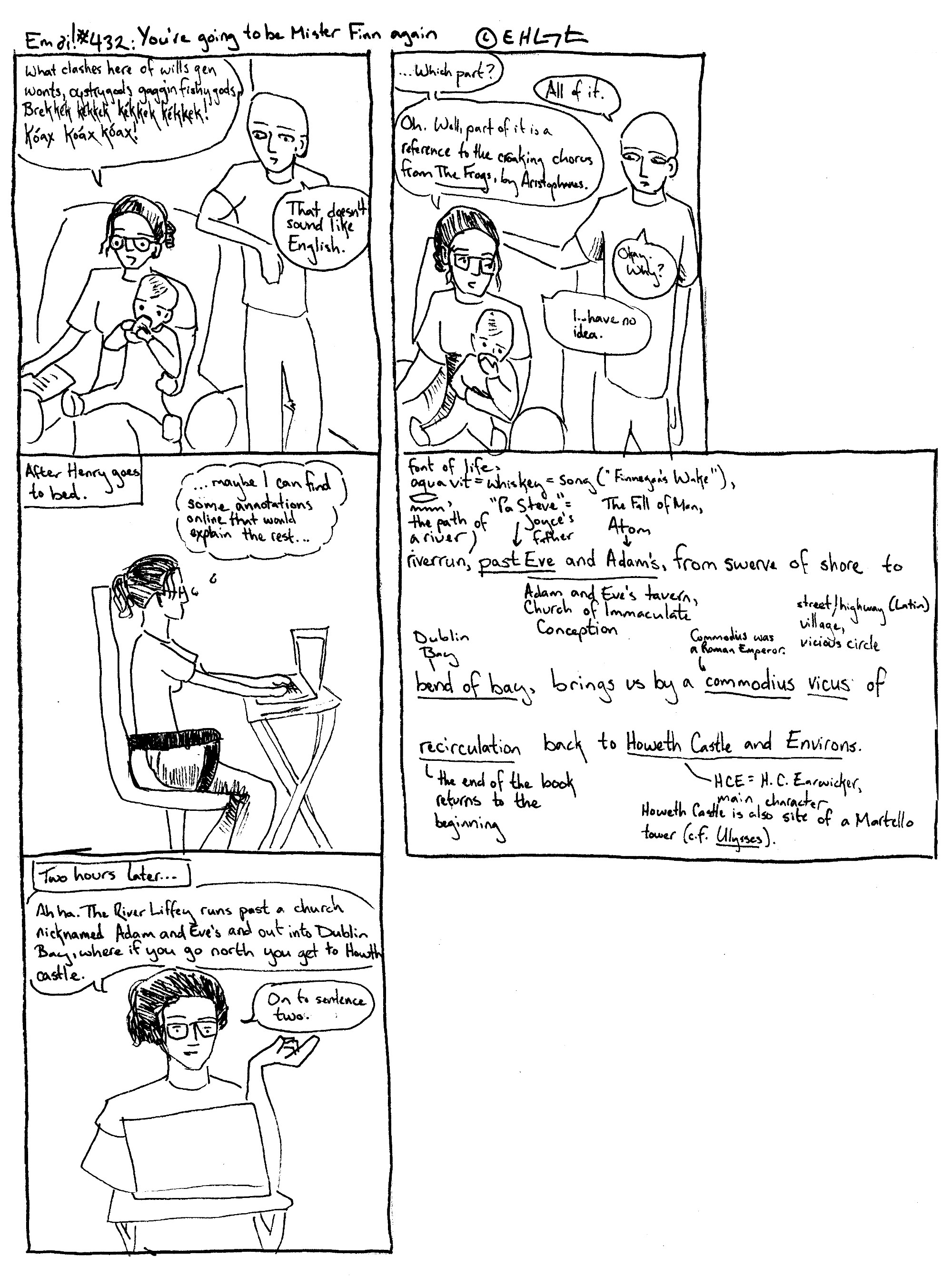
During a rather wide-ranging talk with a friend, it was suggested to me that I should try reading Finnegans Wake aloud to young Hal. Of course I tried it the next night. Much of Ulysses reads aloud very well, and I have gained a new appreciation for the Telemachiad that way. And I have heard it said that reading the Wake aloud is also a great way to catch the double meanings. But. Um.

Honestly, reading FW aloud feels a little like developing some type of aphasia. And the double meanings (I hesitate to call them puns) are, well–

Sir Tristram, violer d’amores, fr’over the short sea, had passencore rearrived from North Armorica on this side the scraggy isthmus of Europe Minor to wielderfight his penisolate war…

The word I’ve bolded here is extremely typical of the type of reference that’s supposed to become obvious when the text is read aloud. “Passencore” = “pas encore” = French for “not yet.” Sir Tristram had not yet returned from North Armorica. (Armorica is one of those words that makes you feel like you’re having a stroke–it’s really an ancient term for part of northern France, but I think it is used intentionally to also seem to reference North America, since later in the paragraph there are references to the city of Dublin, Georgia, USA.) Anyway. If you read the text aloud with the proper Dublin accent (not a secondhand attempt to mimic some great aunt’s County Down accent), and possibly also you knew what you were looking for, you might make sense of passencore. Or, as mentioned in the comic, “ostrygods gaggin fishygods” = Ostrogoths gagging (fighting with) Visigoths. But you’d probably have to figure that out from context as much as anything else.

I have started slowly picking my way through a few good books on the subject (A Skeleton Key to Finnegans Wake by Campbell because I recall my dad having a copy…and A Reader’s Guide to Finnegans Wake by Tindall, because it was recommended by one of the websites that came up while I was researching this). They are helpful and put things in some context–more so than, for example, this site, which aside from having been designed in approximately 2003 contains more information than can ever possibly be useful. Anyway, the short answer to the question you’re all probably asking (“What on Earth…?”) is that the book depicts a man (probably HCE? although I don’t know if there’s a good reason to assume the character inside the dream is the same as the one outside) who falls asleep and dreams the history of the Earth and its repetitions as described by Giambattista Vico in The New Science.[1] The fall of Tim Finnegan and his revival, as depicted in a Dublin street ballad (“Finnegan’s Wake“[2]), becomes the prototype of every fall (the fall of man, e.g.). HCE becomes the Duke of Wellington, Adam, Osiris… (Yeah, another significant influence was the Egyptian Book of the Dead, which leads to my new PhD thesis, Colonialism, Orientalism, and Intercultural Mimesis in the Works of James Joyce.[3]) Other characters (HCE’s wife and sons) are similarly used symbolically to represent recurring figures throughout history. If you’re confused, you might want to check out The Skin of Our Teeth, by Thornton Wilder, which does basically the same thing except not in dream language.

One other fact I recall: Joyce spent a good portion of his life on this book. So while he was working on it, his daughter Lucia (who was fairly ill-used in many respects) was going mad. Carl Jung, who treated her, apparently observed that while both Joyce and his daughter were “submerged in the same water,” “…where [he] swims, she drowns.” So there’s that.

We’ll file this under PR6019.O9Z5 L86 2018, for English literature–1900-1960–Individual authors–J–Joyce, James, 1882-1941–Biography and criticism–General works. Also please note that this is one place where the classification falls a bit flat–this is the English literature category; there’s also an American literature category, as well as Canadian literature. During Joyce’s lifetime, Ireland went from being a colony of England to an independent country. But there’s no Irish literature category. And yet Joyce is inevitably defined as an Irish writer. (Also/however, c.f. the following quote from Ulysses.)

–I am a servant of two masters, Stephen said, an English and an Italian.

–Italian? Haines said.

A crazy queen, old and jealous. Kneel down before me.

–And a third, Stephen said, there is who wants me for odd jobs.

–Italian? Haines said again. What do you mean?

–The imperial British state, Stephen answered, his colour rising, and the holy Roman catholic and apostolic church.

Haines detached from his underlip some fibres of tobacco before he spoke.

–I can quite understand that, he said calmly. An Irishman must think like that, I daresay. We feel in England that we have treated you rather unfairly. It seems history is to blame.

Notes:

[1] I used to reject the idea that history was at all cyclical. Then we elected Nixon II as president. (I am sure this has something to do with Nixon becoming a somewhat funny pop-culture figure rather than an evil motherfucker in the meantime, but–first as tragedy, then as farce, right?)

[2] The Gaelic word they mention, “uisca beatha,” comes from the Latin word “aqua vitae” translated into Gaelic in the Middle Ages.

[3] The extremely genius part of this is that most people haven’t read the Wake and aren’t going to, so you can make almost any claim you want about it and people will believe it. C.F. this blog post.

2017 by the Numbers

Some numbers that defined the year:

  • Books read: 12
  • Plays seen: 14 (this number includes musicals and operas)
  • Pounds gained / lost: +27 / -42
  • Miles run: 1,634.21 (because of the way I track my running, this also includes walking intentionally for exercise and elliptical use)
  • Total mileage since I started tracking in 2012: 13,402.92*
  • Yards swum: 46,500 (almost all after I was six months pregnant)
  • Miles biked: 0
  • Races started in 2017: 10
  • DNFs / Finishes: 1 / 9
  • Longest race: 10 miles (Black Hawk Ridge 16k, Oct 22, 2:02:41)
  • Shortest race: 5k (Freeze for Food 5k, March 4, 29:15; Berbee Derby 5k, Nov 23, 29:39)
  • Highest place in a race: 5th (Freeze for Food 5k)
  • Worst place in a race: 19 of 19 (Black Hawk Ridge 16k)**
  • Babies had: 1
  • Comics drawn and published on blog: 9 (yeah, there were others that were sketched but left unfinished for various reasons)
  • Concerts attended: 1 (Foo Fighters)
  • Quilts completed: 1.75 (still putting the finishing touches on the second one)

* Table of running:

Year Miles
2017 1,634.21
2016 2,313.02
2015 2,388.25
2014 2,384.58
2013 2,163.86
2012 2,519

** This is actually a bit hard to calculate–is 19/19 worse than 25/28?

Finishing the 2018 New Year’s Day Dash at -5 degrees F. Never again.

Numerical Goals for 2018:

  • Running: 2,300 miles
  • Races: at least 6 (currently I have completed one and am registered for one in May), with a sub-2 half marathon in the mix. Hopefully this would be the IAT half, but that’s a pretty tough course, and I don’t think I’ve ever run it that fast, so we’ll see.
  • Books to read: 15
  • Lifting: get the deadlift to 200 lbs, squat 185 lbs (with reasonable depth I guess), bench press over 100 lbs.
  • Comics: 10
  • Quilts: 1.25 (gotta finish the aforementioned one)

Bonus: I talked to this guy and he gave me a few of his resolutions!

  • Laugh more, scream less.
  • Grow some teeth. Not too many, maybe four or five.
  • Figure out some mode of personal locomotion, such as walking or crawling.
  • Spit up on people other than Mom.

Maybe the last one is just a pipe dream of mine.