So I came across Seneca (founder of the Stoics) the other day and immediately realized I was dealing with a kindred spirit. Seneca actually did advocate spending some time every day meditating on what could potentially go wrong in your life, because then if it did go wrong, you’d be psychologically prepared for it. Alain de Botton implies that this philosophy grew out of the fact that Seneca lived among the Roman elites, who were a fairly angry and unstable group from the emperor on down. And I actually do this quite a lot, though I refer to it as “reining in my expectations.” For example, if I had a job interview that went really well, I tell myself that they are not only not going to give me the job, but they will probably come and burn down my house for wasting their time. Then if they actually give me the job (please give me the job–you know who you are), I am surprised and happy, and if they reject me, I am less sad.
Anyway, despite all that, I couldn’t resist making fun of him a little. It could be worse, I guess–Schopenhauer advised his readers to swallow a toad every morning, so that would be the worst thing that happened to them all day…
We’ll file this under B618.L86 2013, for Philosophy (General)—Ancient (600 B.C.-430 A.D.)—Occident—Greco-Roman philosophy—Individual philosophers—Seneca, Lucius Annaeus, ca. 4 B.C.-65 A.D.—Biography and memoirs. Criticism and interpretation—General Works.
I should point out that in the time between when I drew this and when I inked it, my hair streak was dyed over (so I could look respectable for job interviews). You can check it out in the below photo, in which I failed to do it and maybe I didn’t even brush it this morning? And also I look a little cranky. (Hah. Take that, Cameron Russell?)
Dog photobombed me.
There have been so many good, philosophical articles in the news lately, from the issues of justice and punishment versus rehabilitation raised by the conviction and sentencing of Malik Richmond and Trent Mays, to the question of deciding when someone becomes a person raised by the North Dakota Personhood amendment to all sorts of interesting problems raised by SCOTUS hearing arguments on Proposition 8 and DOMA. But then Bryan posed me a fascinating problem about epistemology and free will, so I’m going to write about that. Actually, I’m going to write down the problem as posed to me now, and then next week I’m going to write about my thoughts on the issue.
Here we go: Bryan doesn’t believe in free will. His proof for this goes thusly:
Bryan is a materialist, which means he believes that there is no mind/brain dichotomy–the mind is just our perception of the workings of the brain. The brain is controlled by various chemicals.
Because the brain is made up of particles, if we really understood the brain (and quantum physics), we could build a computer that could predict what someone is thinking.
So now that we know what someone is thinking, given a set of initial conditions, we can predict someone’s behavior.
Since all choices can be accurately predicted, there is no free will. We are essentially controlled by chemicals. Free will is just an illusion we have because we ourselves don’t entirely understand the workings of our brains. But we might as well live with this illusion, because we can’t build a computer that can predict things like that.
(Bryan, you will have to let me know if I have misconstrued your argument.)
So I have been reading and thinking about quantum physics, Gödel’s incompleteness theorem, Newcomb’s problem and meta-Newcomb’s problem (even rereading my senior philosophy thesis), and also looking into the works of a lot of theorists from about 1950-present. It has been quite a knotty problem, I will tell you. If you have any comments on it, please feel free to post them in the comments section here, on FB or G+, or email them to me at ehlupton(at)gmail(dot)com. I will try to address any worthwhile opinions I receive.
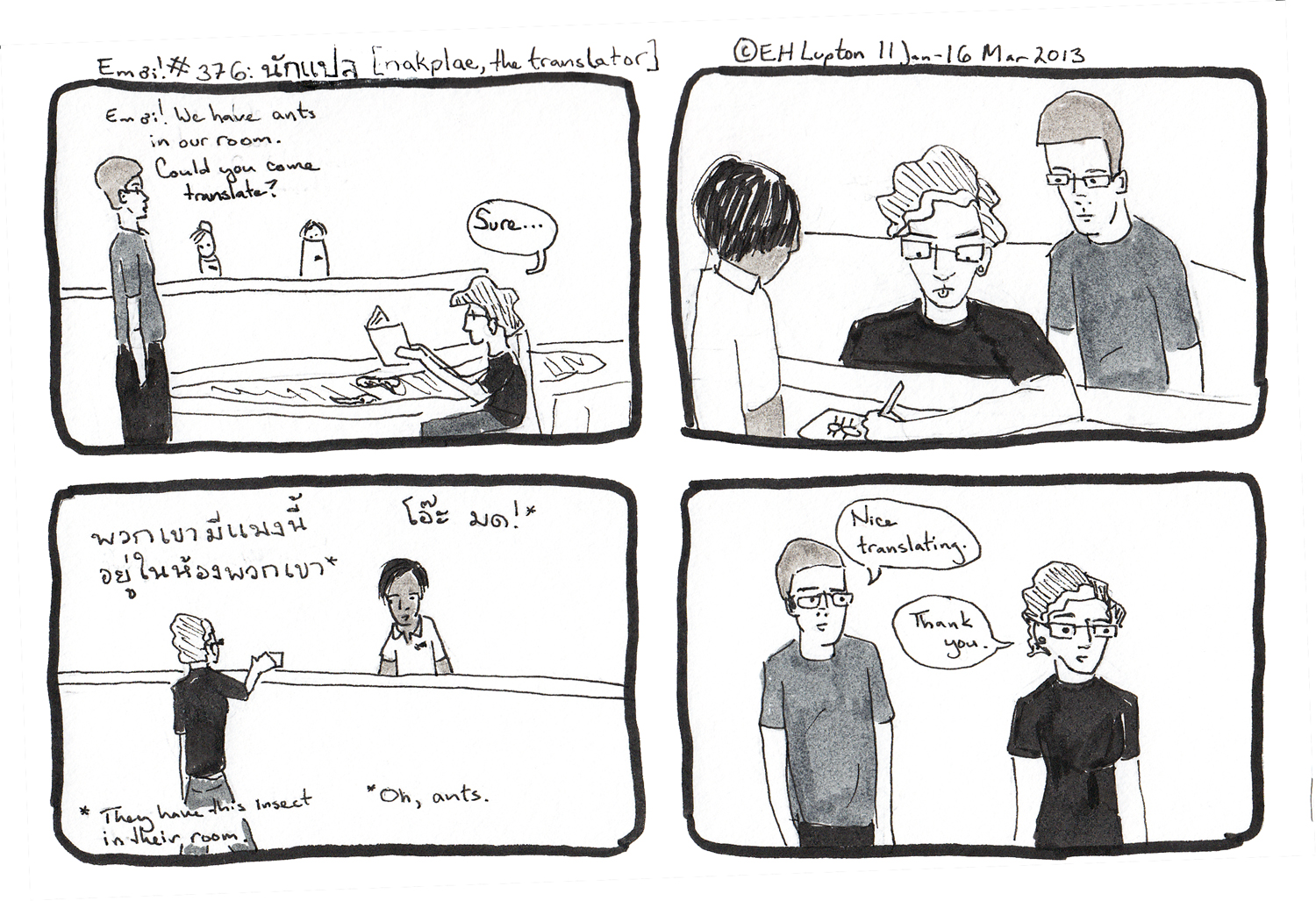
Another sketch from our trip to Thailand. This actually happened at a down-at-its-heels hotel in Chiang Mai. Eventually Andy and Sara got to move to a slightly better room…but they didn’t manage to get one with a double bed. At the time, I complained that we had landed in the Chiang Mai version of Pham Ngu Lao, a street in Ho Chi Minh City known for cheap/seedy backpacker hotels. I think, having looked at a lot of other hotel reviews, that most places in Chiang Mai are like that. It wasn’t a bad hotel, exactly…well, it was. But it was clearly a nice hotel about ten or fifteen years ago when it was built. And then nothing was updated again.
My nemesis
There was a fiendish device on the bedside table. You can see it in this photo to the right (and now you all know the name of the hotel, oops.). You push a button and the lights turn on or off. Somehow we managed to push the buttons so that around about five o’clock in the morning, the lights started to turn on and off by themselves. You can imagine, given how jet lagged I was, how well that went over. I thought the place was haunted. I guess this was state-of-the-art in like…1980.
I’m maybe a bit bitter because the room smelled like smoke. But later on that day, after our freaky awakening, B got sick and basically slept in the room for 12 hours. I figured at least the sheets were clean and the AC worked.
A few trial sketches of Andy.
These are my preliminary sketches of Andy, done to prep for this comic and Em oi! #374. I guess he’s lost a fair amount of weight since he got back to Texas, so these are not entirely accurate.
Today we went to see Oz the Great and Powerful, Sam Raimi’s prequel to The Wizard of Oz. I found that in the years since I first saw the original, the details of the land of Oz have gotten tangled up in my head with other fantasy places, like Wonderland, Middle Earth, and Australia. There were some details that struck me as kind of bizarre–why would you have a field of poppies that can cause everlasting sleep right next to the Emerald City? Isn’t that a liability case waiting to happen? The witches were also interesting, although I was sad that they went with the old trope of “dark hair bad, blond-y good-y.” Glinda the good witch, played by Michelle Williams, reminded me of Galadriel (blond hair, long white gown, kind of ethereal expression). Then I remembered that amazing scene where Galadriel almost takes the ring, but doesn’t. Wow, she’s a really interesting character in that scene. Too bad Glinda was just blandly kind. Of course it is nice to have one character who is kind, but… Also I am not sure how I feel about the turning-green-as-externalization-of-internalized-self-loathing? And of course no one can out-evil Margaret Hamilton.
There was a lot about families in it though, and a kind of magical scene where Oz (played by James Franco) glues a little china doll’s legs back on. I maybe got a little verklempt.
Now that I think about it, maybe Glinda was a bit more manipulative in the first film, since she doesn’t tell Dorothy how to use the slippers to get home until the very end of the book…
Today I got up and ran 18 miles (well, 18.25). It was an interesting run. I was up in the night with indigestion (from 2:30-4 am) and only got out of bed around 8:30, an hour later than my alarm was set for. Actually, at 8:15, Bryan rolled over and said, “Why are you still here?” I took some drugs and set out, going easy, waiting to see if anything bad would happen…but nothing did. I got tired, since I did the whole run on only 190 calories (two gels, one 90 cal, one 100 cal) plus the glycogen stored from yesterday’s overeating (the thing that caused me so much trouble). Anyway, I mostly shuffled along at 10:30-10:40 minutes/mile, more than a minute slower than my planned race pace. Toward the end, I tried to pick things up and ran a 9:54, but then my stomach started to ache and said, “Don’t ever do that again,” so I finished slow. (I wasn’t going to call B to pick me up with two miles to go.) At least I finished.
This is wandering, probably because of my weird interrupted sleep. I’d better bring things to a stopping point.
This comic will be filed under P306.94 .L86 2013, for Philology. Linguistics—Language. Linguistic theory. Comparative grammar—Translating and interpreting—Translating services. In case you were curious, if you search for the heading “translation,” all you get is class numbers related to specific translations–translating the bible, translating Emile Zola into English, etc. The correct subject heading for translation as the subject of a work is “translating and interpreting.” I had to look it up.
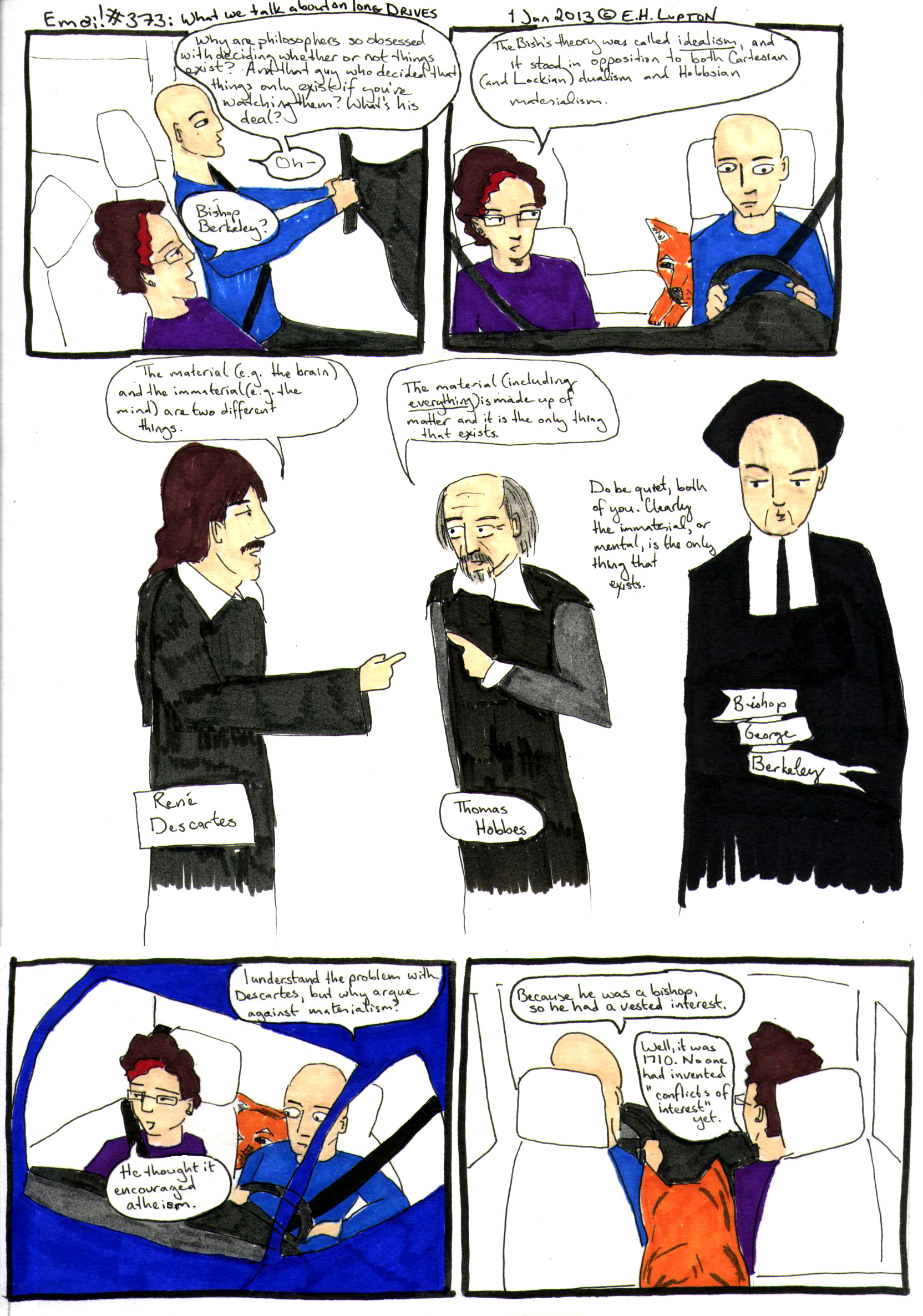
This was drawn from a conversation we had on our drive back to Madison on Xmas Day. I had the comic 80% done before we left for Thailand, but I didn’t manage to get the last two panels colored and the whole thing scanned until just now. I should add that I know Berkeley was really refuting Locke more than Descartes, but I understand the objections to Descartes much better, so I drew him.
This is hardly the first time I’ve touched on Berkeley’s philosophy in the comic. He has long been an obsession of mine, given that immaterialism (also called idealism) is so damn weird.
The gentleman with the wig there is Samuel Johnson. According to legend (and Boswell), Johnson had this to say about Berkeley:
After we came out of the church, we stood talking for some time together of Bishop Berkeley’s ingenious sophistry to prove the non-existence of matter, and that every thing in the universe is merely ideal. I observed, that though we are satisfied his doctrine is not true, it is impossible to refute it. I never shall forget the alacrity with which Johnson answered, striking his foot with mighty force against a large stone, till he rebounded from it, ‘I refute it THUS.’1
Of course, Berkeley would not have accepted this as a refutation, because both the stone and Johnson’s foot exist in Johnson’s mind.
Finally a comic dating from Ly’s tenure in the Czech Republic. If you happen to be an atheist or agnostic, Berkeley’s philosophy becomes very strange, because whose intellect is watching the entire world? It’s troubling. Having just come from Thailand, I suppose I’m pretty sure that it still exists, or at least I’ve got friends there who might tell me if it ceased to exist. But I can’t be sure.
For simplicity’s sake, we’ll file these under B1348 .L86 2013, B1348 .L86 2007, and B1348 .L86 2007b, for Philosophy (General)—Modern (1450/1600-)—By region or country—England. Ireland. Scotland. Wales—18th century—Individual philosophers—Berkeley, George, 1685-1753—Criticism and interpretation.
Yesterday we came back from Thailand. Yesterday was Friday, but we actually got on a plane in Chiang Mai at 17:30 on Thursday to fly to Bangkok. From Bangkok, at 23:30 we got on another plane and flew to Incheon airport in South Korea (a very nice but intensely baffling place). We’d all been up since about 7:00 on Thursday (although we dozed on the plane, it was that weird fugue sleep you slip into on an airplane), so when that plane landed we were a bit loopy.
We got breakfast. I took some photos:
B’s strawberry cream cheese waffleSara’s blueberry bagel. I think the other available flavors were “garlic” and “plane.” When I saw the flavor list is when I began to suspect that something about Korea is a giant joke being played (on me, I guess?).This was called “stick pie.” It was crispy.
Those are the only photos I took in the airport. I took lots of photos in Thailand, though (about 300 I guess). Here are a few:
Various Thai Fruits!ผัดพักบุงไฟแดง, or stir-fried morning glory. In Vietnamese, the plant is called “rau mung.” (Please excuse my lack of diacritics.)Sara makes a friend at the place we studied cooking.Cooking the morning glory with Maew’s instruction.
I also took photos of wats, monks, that sort of thing. I’ll upload those later.
Anyway, I started training for my upcoming 50 km races this morning after I got up. The first is April 30th and it’s about 14 weeks away, which also means I have about 14 weeks until my birthday and until my THESIS has to be done and and and. So the 50k is really what I am focused on, since it is a lot less frightening. I thought running was going to be terrible because it is cold out (about 46 degrees colder than Chiang Mai was). But in fact I had a great run. I hit my planned tempo for the majority of the miles, had a runner’s high all day, and felt very strong. I stopped at 14.4 miles, but I could have gone much farther, I think. The only way it could have been better is if I’d remembered to bring water. Whoops.
Well this entry is already treatise-length, so I’ll leave off here. Hope you are all having a good winter/January!
1 Boswell, James. Boswell’s Life of Samuel Johnson. Abridged and edited, with an introduction by Charles Grosvenor Osgood. Project Gutenberg, 2006. Retrieved from http://www.gutenberg.org/files/1564/1564-h/1564-h.htm. 12 January 2013.
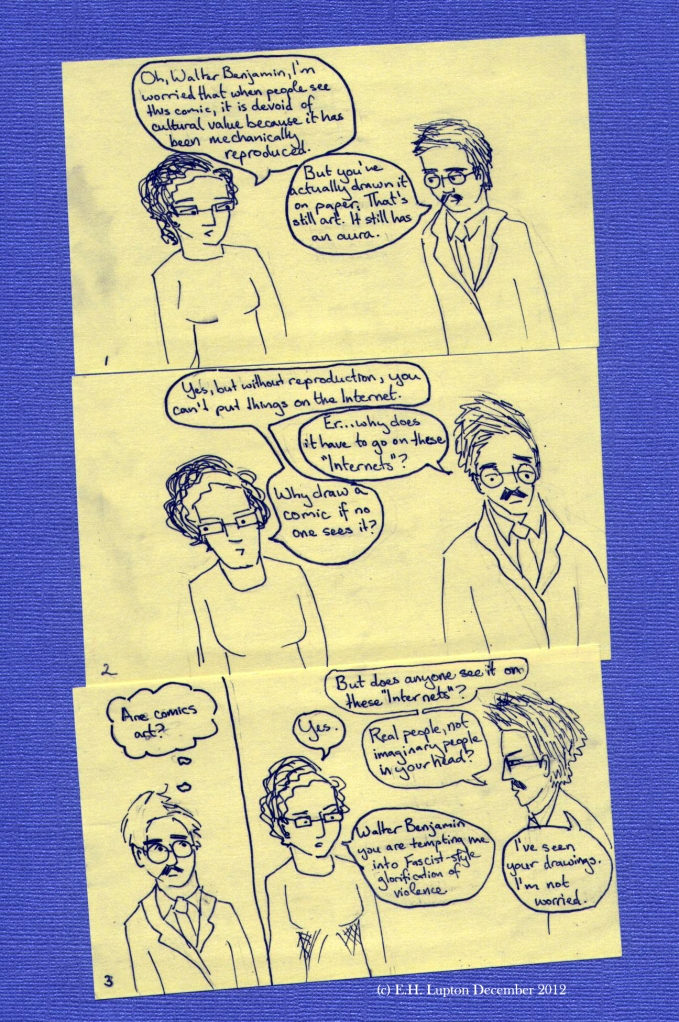
Comic to be filed under: B3209.B583W6 L86 2012, for Philosophy (General)—Modern(1450/1600-)—By region or country—Germany, Austria (German)—By period—Later 19th and 20th centuries—Individual philosophers—Avenarius – Brauer—Benjamin, Walter, 1892-1940—Separate works, A-Z. What a mouthful.
I have been trying to find a good summary of Walter Benjamin’s (say it like an academic: Ben-ya-mean) “The Work of Art in the Age of Mechanical Reproduction” (or, alternatively, “The Work of Art in the Age of Its Technological Reproducibility”) essay. Because it is the most oft-quoted essay of the 20th century (maybe), there are a few available. Wikipedia has a very bare-bones, straightforward summation. Yale’s Modernism Lab (perhaps unsurprisingly) has a much better, more detailed explanation. Finally the (much beloved?) Stanford Encyclopedia of Philosophy offers some critical notes, not just on that piece (or rather the two pieces, since he wrote two versions of the essay) but on the themes of art and aura in Benjamin’s work.
Basically there are two things you probably need to know in order to understand the essay: The first thing is that Benjamin is worried about methods of reproducing art–specifically, methods like photography and film–and how they change the original. For example, when I was in college, I had a poster of the Creation of Man (by Michaelangelo) on my wall:
And G-d said, “Let there be naked people!” And lo…
Philosophically speaking, there are a lot of differences between the poster and the original version on the ceiling of the Sistine Chapel. I mean, one is a fresco and one is a photograph printed on (high quality) paper, but also, as Benjamin puts it, “reproduction…[places] the copy of the original in situations which the original itself cannot attain” (21). In other words, the Sistine Chapel would never fit in my dorm room, while the poster will. So reproducing the image creates this loss of authenticity, or what Benjamin refers to as “aura.” In his words,
It might be stated as a general formula that the technology of reproduction detaches the reproduced object from the sphere of tradition. By replicating the work many times over, it substitutes a mass existence for a unique existence. And in permitting the reproduction to reach the recipient in his or her own situation, it actualizes that which is reproduced. These two processes lead to a massive upheaval in the domain of objects handed down from the past–a shattering of tradition which is the reverse side of the present crisis and renewal of humanity. Both processes are intimately related to the mass movements of our day. (22)
By “the present crisis,” I believe Benjamin means the rise of fascism, specifically in Germany. And by “mass movements” he means both fascism and Marxism. That’s the second thing you have to understand about Benjamin: he was a German Jew who escaped to Paris in the early 1930s, from whence he published this essay; eventually, he committed suicide while trying to escape France to the US via Spain when the situation looked grim [edited to add: or perhaps he was killed by Stalin’s agents in the area!]. He had a brother who was killed in the Camps. Beyond this, he was a Marxist. So while his discussion of aura, as the Stanford Encyclopedia suggests, has been accused of being overly nostalgic, I don’t think that’s really the case–he doesn’t seem nostalgic about the changes he’s describing, more just trying to explain how he thinks art has changed since the advent of (specifically) the moving picture.
So as a good Marxist, Benjamin when confronted by film suggests that it is the masses who essentially control film–more than perhaps any other art, it has a clear economic driver behind it. “While [the screen actor] stands before the apparatus [camera], he knows that in the end he is confronting the masses. It is they who will control him” (33). This changes the relationship between the masses and the art (36). Here he leans heavily on some psychological theory (Freud among others) to suggest that because of the way film acts on the mind (conscious and unconscious), it can act as an “immunization against…mass psychoses” (38). However that means, in a sense, that film can also brainwash people.
Now, fascism (which Benjamin views as Marxism without the dissolution of property/class), is not the first political movement to have used that old lie, “Dolce et decorum est pro patria mori.” Sparta comes to mind, and Rome (that phrase comes from Horace), and the Vikings/Norse all glorified death in battle, to say nothing of the Crusades, the Samurai, WWII-era Kamikaze units (maybe?)… However, fascism’s “logical outcome…is an aestheticizing of political life” (41) which results in war. “War, and only war, makes it possible to set a goal for mass movements on the grandest scale while preserving traditional property relations” (ibid.). In essence, the fascists create an aesthetic glorification of war in order to promote this agenda. If you have ever seen Triumph of the Will, you will know exactly what Benjamin was talking about.
Benjamin concludes, famously:
“Fiat ars–pereat mundis,” [Let art flourish and the world pass away] says fascism, expecting from war…the artistic gratification of a sense perception altered by technology. This is evidently the consummation of l’art pour l’art [art for art’s sake]. Humankind, which once, in Homer, was an object of contemplation for the Olympian gods, has now become one for itself. Its self-alienation has reached the point where it can experience its own annihilation as a supreme aesthetic pleasure. Such is the aestheticizing of politics, as practiced by fascism. Communism replies by politicizing art. (42)
I have occasionally had reason to read Benjamin–his essay “The Task of the Translator” is another classic–and I often have this problem where I will have issues with the particulars of his argument but on the whole, I cannot refute his overall point. After reading this essay, I wondered if I could justify watching films that continue to glorify war.
I’m still going to see Skyfall. But one interesting problem to address in my own writing (as I think the more recent Bond writers have tried to do) will be to examine the non-glorified outcomes of violence.
References
Benjamin, Walter. “The Work of Art in the Age of its Technological Reproducibility.” In The Work of Art in the Age of Its Technological Reproducibility, and Other Writings on Media, edited by Michael W. Jennings, Brigid Doherty, and Thomas Y. Levin, translated by Edmund Jephcott, Rodney Livingstone, Howard Eiland, et al. (19-55) Cambridge, MA: Belknap Press of Harvard University Press, 2008. (Also found here.)
Owen, Wilfred. “Dolce et Decorum Est.” The War Poetry Website, edited by David Roberts. Last updated 2011. http://www.warpoetry.co.uk/owen1.html. Retrieved 26 December 2012.
I took this picture at the Mormon Holy See in SLC a few weeks ago. Tonight my brother Daniel helped walk me through the process of making it “less red” (per B’s request). I think it looks pretty good now.
Say what you will about the Mormons (and I’m sure you will), they certainly have some nice gardens in Temple Square.
I grew up with cats, although I spent much of my youth desperately wanting a dog (specifically, a cocker spaniel I would name “Wolfgang,” precocious little shit that I was). In retrospect, it’s a good thing I didn’t get one, since I would never have suspected how much work dogs require in order to keep them happy.
Almost as soon as I got my first apartment, I got my first personal cats. It wasn’t until last March, over ten years after moving out of my parents’ house, that I finally got the dog I’d longed for (not a cocker spaniel, thank goodness). There is still one resident cat in the household, and I like it that way. I would not define myself as either a cat person or a dog person—someone who prefers one animal to the exclusion of the other—but more of an animal lover in general.
(Full confession: As I write this, the cat and dog are wrestling, an activity that provokes a lot of yowling, and I am rethinking my desire to have pets.)
Anyway, at my age everyone has either a dog or an infant, or (in the case of some unlucky souls) both. I find infants tedious*, so it’s nice to have a good reserve of dog facts in case I need to one-up some oblivious acquaintance who persists in explaining how intriguing her spawn actually is.
Alexandra Horowitz is an unabashed dog person, and also a Ph.D.-holding cognitive scientist with experience studying a variety of mammals, including humans, rhinoceroses, and dogs. In Inside of a Dog, she gives a brief overview of research on dog cognition, behavior, and umwelt—the “subjective or ‘self-world’” (20). For example, humans are primarily visual creatures. Dogs are far and away primarily olfactory-dependent. What does this mean for how they perceive the world in which they live?
In exploring these and other questions, Dr. Horowitz gives a comprehensible but not overly complex review of the current literature regarding dogs. Her tone is conversational and lightly humorous (no surprise to anyone who recognizes the source of the book’s title as that old Groucho Marx line, “Outside of a dog, a book is a man’s best friend. Inside of a dog it’s too dark to read.”). While a few of her sentences fall short (in particular, one retelling of an old Woody Allen story made me wish for my red editor’s pen), she’s a competent writer on the whole and the book is a quick and delightful read.
As an academic, I’m used to making my way through somewhat more complicated works—the stuff published by university presses with a hundred pages of bibliographic notes and a full index in the back, to say nothing of analysis of the statistical data in the referenced studies. Here, there is none of that—although some (probably most) papers and books she referred to are listed by topic at the end, there are no in-text citations or notes. Don’t misunderstand, I’m not leveling accusations that something vital has been omitted, but I could have handled (and would have enjoyed) a slightly more scientifically rigorous book.
Horowitz’s book is not about dog training, but it does contain some information on how to train a dog. Ms. Horowitz here differs from the majority of trainers in that she feels that teaching too many commands to a dog somehow loses part of the dog’s dogness: “When come here has been learned, a good argument can be made that there is little else by way of commands that an ordinary dog needs to know” (286). She also does not approve of punishment (much like B.F. Skinner, the father of operant conditioning) and suggests that inappropriate behavior should be allowed to die out through ignoring it—what Skinner called extinction. There are problems with this, however. For example, when one’s dog is playing too rough with the cat, simply ignoring the behavior is not sufficient, since the cat’s response to the behavior is rewarding to the dog (not to mention that, depending on the size of the dog, the cat may risk physical harm from unrestrained play). Some better way of terminating the behavior is necessary. However, Dr. Horowitz makes a good point when she says that we have to allow
for the dogness of a dog in training it, and recognize that regardless of how well trained a dog is, it’s still a dog, not a tiny furry human.
An anecdote: My dog, a shiba inu got from a rescue in northern Illinois, knows fewer than ten commands. She does the usual sit, stay, prone [i.e., “lie down”], down [i.e., “off the sofa”], and up [“jump into the car”]. More interestingly, despite not being formally taught that the cat is referred to by the word “cat,” and despite not having any herding instincts (I mean, shibas were originally bred for hunting small game), when we say, “Maya, where’s the cat?” she will run and find the cat and herd her to us. So how does that happen? Horowitz offers a few clues: When sheep dog puppies are raised with sheep (which they have to be, in order to become good sheep dogs), they come to believe that the sheep are essentially other dogs. So the dog may believe that “cat” is just a name applied to this other dog in the household. After all, they both have pointy ears and whiskers. She had also seen us go through the motions of looking for the cat (and of evicting the cat from the bedroom, where she is not allowed to go). The first time Maya noticed the cat trying to go into the bedroom, she herded her away from the dog. Our laughter and periodic praise for this kind of behavior probably led to her understanding, in some way, that we like it when she responds to our inquiries about the cat by finding the cat (dogs are keen observers of human behavior; while Derrida felt discomfort at his cat’s gaze reminding him of “the animal that therefore I am,” the gaze of a dog is more of an inquiry into our humanness, an evolutionary attempt to bridge a gap between two species that have long lived together). So without conscious effort on our part, we suggested to the dog that her assistance in surveilling the cat would be appreciated. If only we could train her to bark when she wants to go outside or something.
Dr. Horowitz brings the book to life with little drawings and descriptions of life with her dog, Pumpernickel. Somehow these descriptions wound up being really touching, instead of just illustrating various points she was trying to make. I’ll admit it, at the end of the book, when she talked about Pump’s inevitable old age and death, I cried. I’m a soft touch when it comes to animals, though. I can’t help but take this as an important warning delivered in an almost Daoist way: over and over again, Horowitz implores us to pay attention to our dogs. Look at them, really see them. Apart from the benefits in understanding canine behavior, it really drives home the point that, although now you have a partner, a dog, a cat, a child, eventually things will change and you will not have these beings anymore. So pay attention–they’re standing right there. Do you really see them?
At the end, Inside of a Dog has at best whetted my appetite for more information. I have a lot of questions about the evolution of companion animals, both dogs and cats, and what we can expect to see in these terms in the future. But unfortunately, neither this work or others is likely to answer my questions regarding my dog—Why does she bark at cardboard boxes? Why the phobia of paper towel rolls? As Dr. Horowitz points out, there’s a lot of individual variation among dogs, things that cannot be accounted for on the basis of breed or genetics. Just because there are some dogs out there that understand more than 200 words doesn’t make my dog a genius. It just means that some dogs are really smart.
* Also ugly. I am vaguely acquainted with one woman who seems to spend an incredible amount of money getting professional portraits of her infant every few months, and it’s not helping. I assume that parents are compelled to post photos and declare how adorable their offspring are on various social networking sites almost from the moment of birth by the twin demons of sleep deprivation and oxytocin, because really there’s no other explanation. I should also add that if you’re reading this and you have kids who are over the age of, say, two or three, I do find them pretty interesting and you shouldn’t take this personally.
Whether you are a Democrat or a Republican, I think we can all agree that last night’s gubernatorial recall here in Wisconsin was a total travesty and a terrible insult to all women, LGBT persons, union workers, and all thinking persons more generally.
Have I missed anyone?
B and I have long joked, with minimal seriousness, that if candidate x (initially John McCain, but Walker in the most recent election and Romney in the upcoming presidential one) were to win, we would head for country n (Canada, Sweden, or France, take your pick). When hearing of this plan, a relative quipped, “You’d leave us all to suffer, and not try to help defeat candidate x?” To which we’d replay, “Well, no,” because typically in the US these candidates have a lot of money and power, while we have (comparatively) little, so what the hell can we do, anyway?
But that got me thinking–what is the obligation of a citizen when her government has ceased to represent her interests? (And I do feel, for a variety of reasons, that the government of Wisconsin and the Republican party more generally are not governing with my best interests–which are to say the interests of a woman academic–in mind, and that given the opportunity they would prefer for me to drop out of the workforce entirely and stay home and have babies.)
Unrelated photo of my dog and cat, because really, with what could I illustrate this post?
John Locke says that if you don’t like it, you can lump it: “But since the government has a direct jurisdiction only over the land, and reaches the possessor of it, (before he has actually incorporated himself in the society) only as he dwells upon, and enjoys that; the obligation any one is under, by virtue of such enjoyment, to submit to the government, begins and ends with the enjoyment; so that whenever the owner, who has given nothing but such a tacit consent to the government, will, by donation, sale, or otherwise, quit the said possession, he is at liberty to go and incorporate himself into any other commonwealth; or to agree with others to begin a new one, in vacuis locis, in any part of the world, they can find free and unpossessed: whereas he, that has once, by actual agreement, and any express declaration, given his consent to be of any commonwealth, is perpetually and indispensably obliged to be, and remain unalterably a subject to it, and can never be again in the liberty of the state of nature; unless, by any calamity, the government he was under comes to be dissolved; or else by some public act cuts him off from being any longer a member of it” (Locke, section 121, italics in original, bolding mine).
Of course, Locke also says later that if legislators act “against the trust reposed in them,” then the people living in that society are within their rights to change the government: “[R]evolutions happen not upon every little mismanagement in public affairs. Great mistakes in the ruling part, many wrong and inconvenient laws, and all the slips of human frailty, will be born by the people without mutiny or murmur. But if a long train of abuses, prevarications and artifices, all tending the same way, make the design visible to the people, and they cannot but feel what they lie under, and see whither they are going; it is not to be wondered, that they should then rouze [i.e., rouse] themselves, and endeavour to put the rule into such hands which may secure to them the ends for which government was at first errected…” (Locke, sections 222-225, italics in original, bolding mine).
To what issue will this come? It seems inconclusive. The addition in the first quote of the parenthetical notation “before he has actually incorporated himself in the society” and the phrase “tacit consent to the government” make me worry that Locke was in fact referring to a situation such as: You are living in the middle of an ungoverned place (i.e. in the state of nature). Suddenly some people come along and start up a government. You didn’t ask for the government, therefore you’re allowed to leave. Which seems okay in theory, but go tell that to the American Indians and see how hard they laugh.
The first quote, even taken at face value, raises a larger problem of privilege. We could probably afford to sell our house and move to Canada. I think we have a sufficient amount in savings to get green cards and B has a job that he can do in Canada, which would also be a big plus for immigration officials. Also, I speak French, the result of a long and expensive education that allowed me time to focus on relatively useless things (like learning multiple foreign languages) instead of getting a job. There are a lot of Americans who don’t meet any of these qualifications; in fact, a lot of people have underwater mortgages and can’t afford to sell their houses at all, let alone have the necessary savings to immigrate to a different country. If all liberal, upper middle class Americans start migrating to other countries, America is left with the poor (both Dems and Repubs) and the Wealthy Republicans who, let’s face it, don’t really have economic incentive to make the country a great place for the working class. So in the same way that we have a responsibility to fight for rights because we might need them “someday” (e.g., healthcare, abortions) or because people we know might need them (e.g., gay marriage and associated rights), we could say that there is a responsibility among those who otherwise might leave to stay and provide a balance to those who would choose to exploit those who cannot leave.
I’m uneasy with this responsibility idea. It smacks of “white man’s burden”-type bullshit–surely the people who remain in the US after this purported exodus can look after themselves! And yet citizens have a responsibility to vote, don’t they? To voice their opinions at least when society requires the selection of a new government. So perhaps I’d restate this a different way: to abandon the US would require not just becoming an expat but a naturalized citizen of another country, since to retain the advantages of US citizenship while living abroad would enable one to shirk the responsibility one has of being an active participant in society, essentially the responsibility (at minimum) to vote and protect both one’s own rights and the rights one believes others deserve.
The second quote is suggestive of the conclusion that one should not quit the country; since rebellion (or call it simply changing the status quo) is permissible when one feels the government is no longer working, and there is some inherent responsibility citizens have to take part in society, it is better to stay and fight than to flee.
[I wish to add belatedly, footnotedly, that Locke’s use of terms like “the people” suggests that he sees all individuals in a society as agreeing on what the correct course of action is, in opposition to their government. In the absence of unison, which is certainly the case in WI presently, I suspect he would accede to the majority’s opinion and tell me, as a member of the minority, that I cannot go about instituting rebellions just because I feel slighted. However there is always something to be said for being the loyal opposition, because when the majority is making choices that are (morally, ethically) incorrect or unsound (as arguably they are), someone needs to speak up for the oppressed–see, for example, the abolition movement before the Civil War.]
My other favorite political theorist, the late, great Robert Nozick, does say, when speaking about a replacement for society that would be, essentially, small communities of individuals under minimal government, that, “After a person has spent much of his life in a community, sent down roots, made friends, and contributed to the community, the choice to pick up and leave is a difficult one. Such a community’s…seriously changing its character, will affect its individual members in something like the way in which a nation’s changing its laws will affect its citizens” (Nozick, 324, italics his) and that “Anyone may start any sort of new community…they wish. For no one need enter it. Modifying an already existing community is held to be a different matter” (ibid.). His suggestions–that people who disagree with a proposed change should be compensated in some way, e.g. (this is very particular to the libertarian project he is working on)–are impracticable in US society as it stands, but he does seem to argue strongly for the “if you don’t like it, you can lump it” point of view.
Nozick’s work on communities does suggest one other solution: flight need not be international. If one’s state has changed politically, one is welcome to move to a state more in line with one’s views. There are fifty of them, plus several protectorates/colonies; surely one will match one’s views. This is a slightly less privileged action (though it still requires some liquidity of funds that not everyone has at hand) and allows residents of a divided country to assort themselves in ways that please them.
But after all of this reasoning, I still feel conflicted. There are reasons beyond the political to stay in Wisconsin, and reasons beyond the political to go. Ultimately, I think Nozick is right when he writes that the goal of a society is to allow its members to “individually or with whom we choose, to choose our life and to realize our ends and our conception of ourselves, insofar as we can, aided by the voluntary cooperation of other individuals possessing the same dignity” (334). Wherever I go, or if I remain, if I can do that, I’ll be satisfied.
Bibliography
Locke, John. Second Treatise of Government. Edited by C. B. Macpherson. Indianapolis, IN: Hackett Publishing Co., 1980. (The unedited text is online here.)
Nozick, Robert. Anarchy, State, and Utopia. [United States]: Basic Books, 1974. (A previewable version is available at Google Books here.)
This is not the first comic about me fainting in public. I’m not writing this from home, so I’ll have to update this post later on tonight with the previous one. At any rate, this happens periodically (at least two major times since I’ve known B., every couple of years before then, and a few other times where I started to pass out but then managed to stave it off). I don’t know why it happens–I can tell you that the technical name is “syncope,” which as a word sounds delightfully Victorian, like “apoplexy.” I can also say that from my research, it’s either something or it’s nothing. But it’s such a vague symptom I think it would only annoy a doctor to try to get it checked out. SO. I promised B I would get it checked out if it happened for a third time within six months (I had a dizzy/nearly passed out episode in October, so I guess I’m safe after next month).
Let’s file this one under RB150.S9 L86 2012 for Pathology—Manifestations of disease—Other manifestations of disease, A-Z—Syncope.
While I was working on this post, I started looking around for the last comic I drew about my syncope. I couldn’t find it (it must be on the computer I haven’t checked; I’ll set it up this weekend and pull it off). But I did find the best comic I’ve ever drawn:
We’ll file this retrospectively under PN56.A24 L86 2008 for Literature (General)—Theory. Philosophy. Esthetics—Relation to and treatment of special elements, problems, and subjects—Other special—Topics, A-Z—Absurdity.
Finally, here are three photographs: two of my new haircut (taken by B) and one of my dog.
One of the things that interests me about Paula Deen’s recent revelation that she has diabetes (and is now a spokeswoman for Novo Nordisk) is how personally people seem to be taking it. A number of people on my friends’ list on Facebook (I know, the source of all truth) seemed very upset and seemed to view her diagnosis as comeuppance for the way she lives her life/cooks. Anthony Bourdain, who can always be counted on to say something mean if he is allowed to speak, calls her cooking habits “in bad taste” in light of her diagnosis. A number of people have implied that by cooking dishes with high quantities of butter, sugar, and salt, she was somehow intentionally raising the diabetes rates in this country so that she and Novo Nordisk could cash in.
Well, perhaps that’s a bit drastic as a characterization, but I have to say I’m surprised for two reasons:
Her cooking is, I think, getting slammed unfairly.
These rants very much absolve her viewers/followers of personal responsibility. If someone got diabetes from cooking a la Paula Deen every day, “It’s not your fault, Paula Deen said it was okay.”
I have to admit I’m a bit of a cooking show junkie, so when I say this about point #1: Paula’s meals are quite fattening, but overall I don’t think the so-called “Queen of Butter” uses more butter than Julia “Butter is Better” Child ever did. In fact, while it’s true that Paula never met something she couldn’t deep fry, Julia certainly matches her with butter, heavy cream, and wine. The major difference between the two of them is in the sophistication of their cooking—Paula Deen gets paid to cook “traditionalesque” southern food, while Julia Child was doing French.
Put this way, the opposition to Paula Deen’s method of cooking smacks of snobbery. It’s okay to use cream and butter if you’re making quiche—Julia’s recipe calls for over two cups of cream, as it happens (a mere 1,642 calories—as Julia once said, “If you’re afraid of butter, use cream.”)—but if you’re making Twinkie Pie, go to hell (for the record, Twinkie Pie uses neither cream nor butter). Of course Julia Child practiced portion control (she talks about it in her book My Life in France, anyway; I don’t think I’ve seen her mention it on her show). Oh, but Paula Deen says she doesn’t suggest anyone should eat the way she cooks every day (or she’s said that in interviews, again I don’t think I’ve seen her mention it on her show). But certainly I think it’s difficult to tar one of them on this count without hitting the other.
As for the second point, well… There is the matter of personal responsibility, certainly, and freedom of thought. I rarely make a recipe without halving the sugar, replacing some butter or oil with margarine or yoghurt, and generally trying to lighten things up. (I make béchamal sauce with skim milk. Julia would be ashamed to be in the same room with me.) But my point is that no one is forcing anyone to make Deen’s recipes or to make them as written. If we are going to claim that cooking as she does is somehow irresponsible, then can we follow it by saying it is irresponsible for a restaurant to serve fried cheese curds (a Wisconsin favorite) to an obese person (there are plenty here)? Don’t people have a right to make their own choices on what they eat? In fact, isn’t this one of the earliest rights that people claim for themselves as children barely removed from infancy?
One thing that struck me as interesting about all these interviews Deen has done is that she mentioned that initially, she didn’t really understand what diabetes was or what it meant that she had it. Recall that we are talking about a woman who grew up in a small town in the South, a place that does not have an awesome educational system, and she did not go to college. I know about diabetes because my mother is an endocrinologist. It’s possible that Ms. Deen did not grow up with these privileges and actually didn’t know, or at least didn’t understand, that this could be the outcome of her lifestyle. From my understanding, it is not unusual for people to go through a period of adjustment and denial when diagnosed with diabetes. Plus, people should be allowed to keep their medical problems to themselves, even if they are public figures.
That said, signing on as spokesperson for Novo Nordisk is opportunistic. I have to admit I don’t like drug companies (because of patenting issues, primarily—I’m not a conspiracy theorist). But it may be the case that she genuinely thought she could help reach out to her audience—people who, like her, may not know much about diabetes—and educate them. And make a tidy sum in the process; she’s a shrewd businesswoman. But I don’t think anyone, least of all Deen herself, is suggesting that with diabetes you can do what you want, then take a pill that makes it all better. Novo Nordisk is suggesting that they approached Deen because they thought it could be cool “to change some of her famously tasty, and butter-rich, and really unhealthy recipes.”
I won’t imply that all cooking shows are created equal when it comes to matters of health, but look at some of the things on Food Network’s lineup:
Diners, Drive-ins, and Dives: The overweight Guy Fieri goes from place to place and is filmed stuffing his maw with giant piles of meat, cheese, and fried things.
Sugar High: Duff Goldman, much as I love him, is another chubby guy carting from place to place EATING, in this case, CAKE.
Hungry Girl: Lisa Lillien really rubs me the wrong way. Never has “healthy” eating seemed less appealing (probably because instead of cooking genuinely healthy food, she takes all kinds of shortcuts so people can still eat their greasy terrible meat by-products without the guilt).
30 Minute Meals: Rachel Ray has a terrible smile, and smiling terribly is all she’s good at. But although her food doesn’t seem awful, she doesn’t exactly cook with the precision needed for really healthy cooking. Know what’s the difference between one tablespoon of “EVOO” and three? About 240 calories. That’s the difference between measuring things and approximating.
Pioneer Woman Cooks: Ok, I happen to like Ree Drummond, and I have cooked stuff off her website…usually cutting the sugar and butter by quite a lot. She lives on a cattle ranch and never met a stick of butter she didn’t love.
Robert Irvine: I only ever see him on Dinner: Impossible, and most of what he does is yell at people. I’m just pointing him out because he’s the only really ripped chef. In the world.
Sandra Lee: While Sandra’s Money-Saving Meals is usually fairly healthy, Semi-Homemade sacrifices that for convenience. And while she’s willing to cut calories in food, she spends them on alcohol. I’m convinced she’s not fat only because she doesn’t eat and lives on breath mints and water when she’s not being cryogenically frozen prior to her next taping.
And looking at non-Food Network cooking shows I’ve enjoyed:
Two Fat Ladies: Exactly what it sounds like. Two fat, elderly women drink and smoke their way across England on a motorcycle, cracking nasty jokes about vegetarians all the while. I love it.
So what’s my point? First of all, it’s not unusual for cooks to be both personally rotund and cook unhealthy food. Second of all, this industry is ALL ABOUT cashing in on people’s love for highly caloric, fried, cheesed, delicious food. Third, Paula isn’t alone in cashing in on the latest health scare: FN announced a new series called Fat Chef which premiers 26 January. I can only assume that this is a less abusive version of Biggest Loser.
Finally, to blame Paula Deen for advancing the cause of diabetes through her cooking is to miss the whole tragedy of the cooking show. While record numbers of people are overweight, and cookbooks sell well and cooking shows are super popular, most of these people don’t cook. As Michael Pollan puts it, the Average American spends 27 minutes per day on food preparation, and cooking from scratch is all but dead (officially, “cooking” means you have to assemble elements—heating up a pizza, for example, doesn’t count, though making a sandwich does). That makes me a statistical anomaly, since I cook from scratch (I make sauces! I bake things without mixes! I make non-instant rice and lentils!) at least 3-4 times per week. People are not getting fat off of Paula’s deep-fried ham (or haa-yam, y’all) because they are not cooking it. They’re watching her cook, then having dinner at McDonald’s.
So rage against Paula Deen all you want. Unfortunately, it’s not going to help anything.
It is hard not to observe that the average American these days enjoys a good meal. Food is everywhere, cookbooks are bestsellers (despite the demise of cooking), and there are even two full cable networks devoted to cooking shows. Cruises, as the phenomenal Dave Barry has pointed out, exacerbate the problem, since there’s an actual rule that you cannot be on a cruise ship and not eating. Still, when I get stuck standing in line for a sandwich behind a man who is in his left hand holding the crust of a pizza he just finished consuming before lumbering up to the deli window to order something with extra cheese and extra mayo. And then, before leaving the window, to see the man just leave the pizza crust on the counter instead of turning around and putting it in the waste basket five feet behind him. Well, I start to feel a little snappish toward other human beings.
It’s true.
This particular cruise had all of the rooms named for Impressionist painters. I am damned if I know why. All of the Impressionists were male and white, of course; the only room named after a woman was the Cassatt Lounge and no one went in there. That was weird. The restaurant on the Lido deck (the buffet) was named The Cezanne. It had this painting hung several times on its walls:
That was weird because it was hung at irregular intervals, as though the decorator of the ship had assumed that either no one would notice that there were several iterations of the painting or perhaps was unable to get more than three different Cezanne paintings to cover the entirety of the large room, thus necessitating the repetition. Bryan and I, working on our various projects, sat at a table for an hour or so and contemplated the judgmental features of this particular lady.
This comic is filed under: NC1763.V3 L86 2012b, for Drawing. Design. Illustration–Caricature. Pictorial humor and satire–Special subjects, A-Z–Vacations. For more comics from this trip, check out: Vacation, Day 1.
To finish things up, here is another photo. This one was taken in Mexico, but I guess it could have been about anywhere. It reminds me of an important principle in my photography, which is that photographs tend to turn out better if I get as close as possible to the subject. Also, they turn out better if I use autofocus, since my poor eyesight means that I sometimes manually focus the lens into fuzziness. Oops.