Em oi! #388: The New Guy

em_388
Edgar came to live with us close to four weeks ago. I think it will be four weeks tomorrow, actually. It’s actually surprising how much about him has changed since we brought him home:

  1. He will walk on a leash and not freak out.
  2. He will go up and down stairs by himself, although he’s a bit clumsy.
  3. Weighs 46 lbs rather than 42.
  4. Is willing to walk past cars that are parked as well as cars that are turned on but not moving. Still terrified of moving cars though.
  5. We are reasonably sure he is flat-coated retriever and Aussie rather than part Newfie.
  6. I have decided on the best way to draw him. As you can see in the comic above, there was some experimentation.

At first Edgar was very shy and stayed in his crate most of the time, even though we left the door open so he could come and go as he wanted. I think he appreciated having the little cave to hang out in, because re-homing is incredibly stressful and confusing. And that’s for people; imagine how the dogs feel. Anyway, Edgar is a rescue dog and he had spent a lot of his life in to a shelter before entering the foster care system and then coming to us, so we knew that it would take him longer than it took Maya to warm up to us. After all, Maya was 12 weeks when we got her, versus Edgar at six or seven months–much more life to have traumatized him thus far. However, I am happy to report that he is thriving. I drew this follow-up comic to demonstrate Edgar hanging out in the atrium every morning while I eat breakfast:

breakfast comic

I’ll file this comic under SF427 .L86 2013 for Animal Culture–Pets–Dogs–Culture and care. Sadly, there was no entry for “doggy personal ads.”

And here’s a photograph of him I took earlier this afternoon:
Majestic as Fuck

And a picture of Edgar and Maya playing in the snow:
20131210_153913

So the reason we were able to get another dog is that we recently moved to a new house. I think I may have mentioned this before. But the thing is that we have been slowly going through a lot of stuff at the old condo that didn’t get moved, stuff that we should probably throw away so we can get the house on the market. Earlier this evening while doing this, I came across this piece of paper:
Found

If you can’t read, it says, “ทำงานทุกวันและเล่นไม่ได้ทำให้คุณจากคนไม่สนใจ,” which translates as “Working everyday and not playing makes Jack an uninteresting person.” Nowadays I would spell “Jack” as “แจก” rather than “จาก” I guess. But. I wonder what was going on when I made those notes? It also seems to say “Liz Bernstein–another Jew in Asia,” “มหา [maha] Ghosanada,” “CompLit,” and “No one is soverign [sic] in love.”

…It’s probably a good thing I’m finishing my thesis and graduating soon.

I should mention that the novella is due out at the end of the week. It will be available as a PDF and on all major ebook platforms (i.e., Kindle and Nook). So, uh, prepare to spend money on it? It should be pretty awesome. Here, in case you haven’t seen it yet, is the cover.

JoyOfFishesFinalCover96dpiRGB

Scott Walker and the Abortion Law

If you have read my comic for a while, you may have gotten the feeling that I am pro-choice. This is not something I have talked about much on the blog, because I think that it is a complex topic with many ethical gray areas that cannot really be well-discussed in a short amount of time. But recently, the republicans in the Wisconsin legislature began to push through some anti-abortion laws that made me very angry.[1]

I thought, when I was younger, that we lived in a pluralistic country founded on the principles of freedom of religion and separation of church and state. Increasingly, however, that seems to not be the case. But passing laws based on evangelical Christianity to govern a diverse country just isn’t cricket.

I only want to protest if there are sock puppets involved.

That isn’t to say that I feel like abortion is a straightforward question. There are certainly arguments to be made that there is a point in a fetus’s development where the ethicalness of an abortion (in most situations, but not all) tips to the “don’t do it” side. But I want this debate to be played out by bioethicists.

After all, there are things that doctors can legally do but they don’t, because it would be unethical (like the kinds of experiments Andrew Wakefield did). And there are other things that actually are unethical (like promising someone that they can be cured by homeopathic treatments) that are also legal. So why should abortion be singled out as the medical treatment that the government decides to legislate on? And why should legislators, who are not by and large doctors, nor are known for the depth of their scientific knowledge, be allowed to pass judgment on this?

I do understand why they’re doing it, sort of. In theory, evangelical Christians believe that abortion is murder (which I think is mostly wrong, but I’ll let the point stand for the sake of argument). If thought that people were being routinely murdered in the US, I would be against it (and I am–against the death penalty, and against uncontrolled, unregulated gun ownership). But laws like this ultrasound law don’t actually speak to the sense that murder may be going on–it just says, “There are reasons for getting an abortion, some of which are OK and some of which are not, and we want to police women’s sexual and reproductive agency by being the ones who get to decide what constitutes a reason.” It turns out that I have a problem with old white men telling me what I should do. In reproduction. In art. In life.

The problem is that the governor has repeatedly showed that he is motivated only by money, and is unwilling to listen to dissent or debate. There were protests about these laws, but–no one cared. Somehow during the 1960s and early 70s, there were enough people protesting the Vietnam War that the government had to take them seriously. But protesters in the US have not held that kind of sway since. In addition, Walker has been so outrageous on so many topics–busting collective bargaining, trying to disenfranchise huge numbers of voters, opening Wisconsin to environmental piracy and more–that most people are pretty tired of being angry. We’re just resigned. So I decided to write a letter to him to vent spleen.

Dear Scott,

I hope you don’t like me calling you Scott. I know it is not the preferred address for someone in your position, but I assume that because you feel it is acceptable to legislate about my internal organs, we must be on a first name basis. I also hope to come across as mildly condescending, because I believe that the recent bill requiring women to undergo a transvaginal ultrasound prior to receiving an abortion is predicated on the assumption that women are stupid, an assumption with which I take issue.
The bill, nicknamed the “Woman’s Right to Know Her Unborn Child Act,” seems to rest on the belief that women who go for abortions don’t really know that they have a fetus in their uterus. “So let’s show them the fetus!” the reasoning goes. But in fact, women who seek abortions are quite aware that there is a fetus in their uterus—that is why they are seeking an abortion. If there was ever a chance of there being something different in there—a new car perhaps?—I would not be as opposed to this procedure as I am.[i]

But in fact, the truth is that this bill is not designed to induce women to have fewer abortions. If you wanted to make it easier for women to raise children, you would consider projects that could reduce poverty such as making sure women get paid the same as men,[ii] increasing funding for daycare, or improving welfare payments for women with children. You could even offer a guaranteed paid leave for women and their partners.[iii] If you wanted to decrease abortions on the other side, you could increase funding for comprehensive sex education, make birth control more readily available, and offer family planning clinics to help women make informed decisions about when to have children.

I don’t believe the rhetoric about “every fetus is a gift” either. If you really believed that, why not move condoms behind the counter in the drug store or institute mandatory waiting periods for men seeking vasectomies? You could even require they undergo a trans-anal ultrasound to check the health of their prostates.

This bill is designed to shame women; that is its sole purpose. That is made clear in the exceptions allowed for cases of rape and incest. The truth is, they only make sense when you consider the bill in this manner. Perhaps a case study will further prove my point. Consider: Two women require abortions. Sally was raped. Molly had sex with her husband, but his vasectomy failed, and they have determined they cannot afford to raise another child (they already have two). Sally filed a police report and is as such exempt from the ultrasound. Molly is not—but isn’t she equally blameless for her situation?

Scott, I am tired of the rhetoric in the Republican Party that suggests that women are second class citizens who deserve to be treated as little better than gestational carriers who are capable of making sandwiches. I will not stand for such a message, and I hope that I am not the only woman who is hearing it. The next election is coming, and we will remember what you have done. 2014 is coming, and the people of Wisconsin will no longer tolerate your placing the “needs” of your rich donors above the well-being of our state’s people and economy. So enjoy your political career now. It is my dearest hope that it will not continue much longer.

Sincerely,


[i] That’s a joke. I would still be opposed.
[ii] You don’t care about this, either—remember when you repealed the equal pay act? I do.
[iii] Did you know that the US is one of the only countries worldwide that doesn’t require some amount of paid parental leave?

Walker is, for some reason, occasionally referred to as an up-and-coming republican wunderkind of some sort, possibly because he is good at 1) taking money and 2) kissing asses. I don’t really get it–he’s not presidential material (he didn’t finish college; even George W. Bush had a graduate degree), and he looks like a version of Paul Ryan where he slept on his face and it stuck that way, so he doesn’t have Dan Quayle’s reported appeal to FEMALES either. (Although, I just looked up a picture of Dan Quayle and all I can think is, maybe he looked better standing next to George H.W. Bush? Eech.)

Personally, I’m hopeful that someone even a little bit charismatic will come out of the woodwork for the 2014 elections and beat SW. In fact, I’m hoping to volunteer for whoever’s campaign that winds up being.

My letter was cosigned by nine people.[2] I was very grateful for the support. The letter is even now winging its way to the capital (well, it’s in the mailbox). I don’t expect a response, but writing it made me feel better.

Now to make everyone happier, here’s a picture of my dog being cute. Next time I’ll write about kittens.

When you're made of pillow, who cares where you sleep?
When you’re made of pillow, who cares where you sleep?

[1] The article only talks about the ultrasound law. There was also one allowing religious organizations to opt out of covering birth control on their health insurance.

[2] I won’t list their names here, because I make it a rule to not mention people in Google-able ways unless they give explicit permission.

Em oi! #375: Another Terrible Thing Done in Nietzsche’s Name

The age of specialization is over.
Have you heard of a madman who on a bright morning lighted a lantern and ran to the market place and cried incessantly, “I seek God! I seek God!”

Writing a thesis is simultaneously the best and most terrible thing I have ever done.

Anyway. Nietzsche! Has there ever been a philosopher with a cooler mustache? I think not. Other things Nietzsche had: Syphilis. But that’s not to say we should write him off. He grew up next door to a church–his father was a Lutheran pastor (who died when young Friedrich was four). That he later went on to propose some revolutionary ideas about man’s relationship to religion in the 19th and 20th centuries is not entirely surprising. He lived a quiet life in the mountains, because of health issues, and so he knew what he was talking about when he said that happiness comes from overcoming obstacles. That’s an older idea than him, actually; I believe it goes back to Aristotle. At any rate, Nietzsche is quite cagey and doesn’t say what he thinks the new morals he’s calling for should be like. He is pretty clear that he thinks hanging on to Christian morality is stupid and outdated. You can check out the famous passage on the death of God from The Gay Science here. (He talks about the death of God again in Thus Spoke Zarathustra.) He has a marvelous mode of writing, it’s very readable. What else? Philosophy Now magazine did a marvelous podcast about our fellow that you can listen to here. And philosopher Alain de Botton did a 24-minute episode of a longer series for the BBC about Nietzsche, and you can check that out here. It’s awesome both because the US would never air something like that (not enough desperate housewives) and because de Botton is very good at explaining the essence of Nietzsche’s philosophy.

Is that enough links? Can you tell I’ve been doing some research? I’m having an affair with Nietzsche; don’t tell M. Foucault, I fear he would sulk.

I wrote an article on running for a local running blog called Technically Running. You can read it here if you’re interested. You can check out the last comic I did with Nietzsche in it here.

This comic will be filed under B3317.L86 2013, for Philosophy (General)—Modern (1450/1600- )—By region or country—Germany. Austria (German)—By period—Later 19th and 20th centuries—Individual philosophers—Nietzsche, Friedrich Wilhelm, 1844-1900—Criticism and interpretation.

Em learns to ski

A few weeks ago we were in Lake Tahoe. Last time we went on a ski trip, I tried to learn to snowboard. It was not a huge success, involving as it did a lot of falling down, crying, shouting, bruises, and eventually a migraine. This time I decided to learn to cross-country ski, something I’d not done in easily 20 years.

Like a graceful blue bird, Em descends the mountain.

At one point, I asked the guy who was renting out skis to give me a brief overview of the trails. He was kind enough to point out good routes. One of them he said, “This one is very flat.”

It turns out “flat” is a relative term on a mountain.

I picked out a route, about 12 km round-trip, that was uphill on the way out and downhill on the way back. This let me tackle the problems of how to ski uphill and downhill one at a time, and I eventually got the hang of it. I went on to ski almost 20 km that day and gave myself a wicked blister. Anyway, I’m in love with skiing. I made a friend of mine go skiing with me at Elver Park here in Madison yesterday, and it was awesome.

I like ski trips because I get to do stuff like eat fancy food, drink fancy drinks, look at poorly proofed artwork, and think about how terrible the airport in Reno, NV is.
precious artwork

precious artwork2
Bryan was so impressed by the scare quotes on this sign he made me take a photo. I like a man who can get excited about inappropriate punctuation. That’s one of the reasons I married him.

drinks

menu

Reno, NV, you are a terrifyin
Reno, NV, you are a terrifying place.

Then we come home and I get to see dog again and feel more attached to reality instead of a jet-setting lifestyle.

For her part, dog is not overly attached to the ground.

My thesis proposal is done and handed in, so until I get some comments on it I’m in a bit of a lull. (Well, a lull that requires me to continue working all the time on various things.) I’m hoping to get caught up on some other projects–writing/drawing comics, blogging…My ankle and I have reached a détente, so I’m back to training. I managed eight miles on Friday, eleven on Saturday (plus skiing), then seven this morning, and I feel good. Tomorrow it’s back to the pool for a day off.

After a lot of thought, I’ve decided to take myself off Facebook for the nonce. Not totally–I’ll stick around to monitor the comments on comics and that sort of thing. But for a lot of reasons, I need to put some distance between me and FB for a while. Feel free to email me (ehlupton(AT)gmail(DOT)com) if you want to chat, or leave a comment here. I’d love to hear from you.

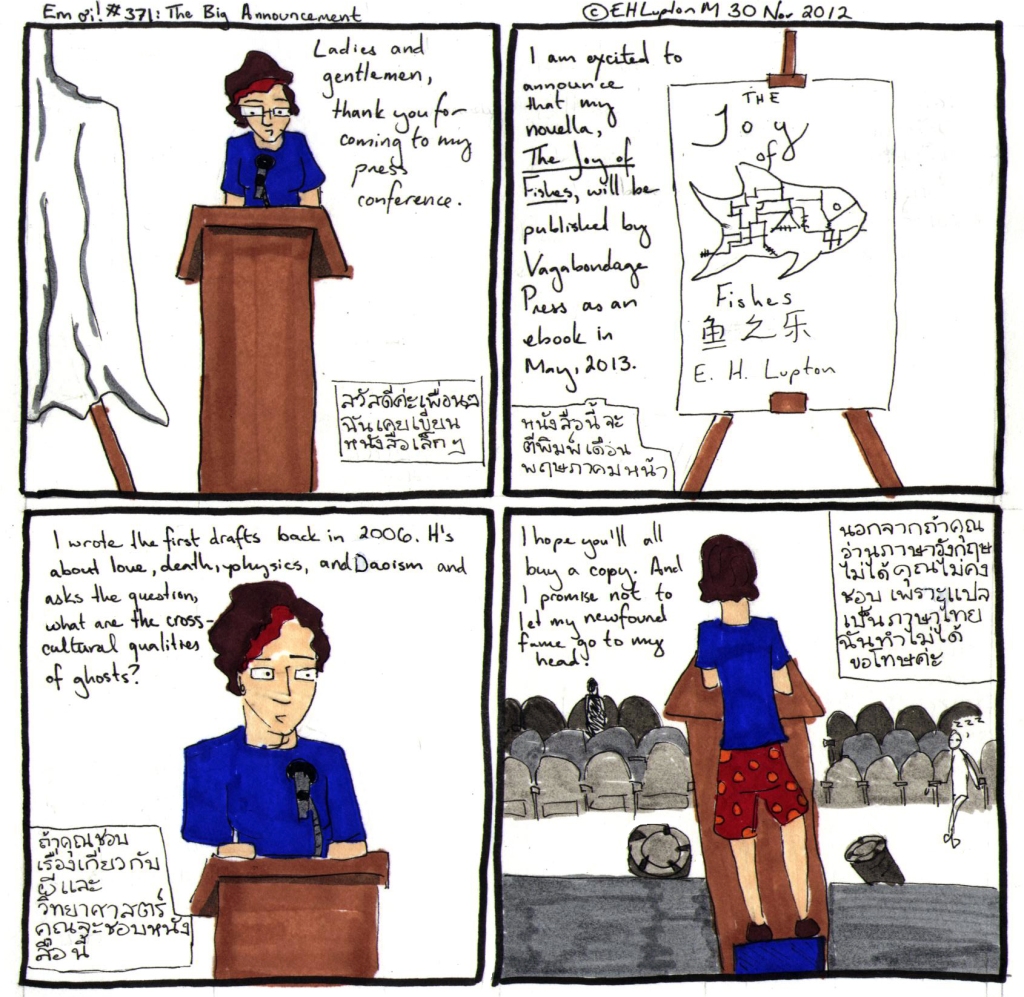
Em oi! #371: The Big Announcement

MAGNIFIQUE
This is absolutely true: Vagabondage Press will publish my novella as an ebook in May, 2013. I am very excited. This work was originally composed as my senior thesis for my English/Creative Writing degree in 2006. Since then, it has been through a number of rewrites (and will go through a few more before it is ready for prime time). More importantly, perhaps, I have begun to mature as a writer and I think I have been able to do the story justice.

This is a very brief summary of the story I wrote for my cover letter:

Mara Daniels is a physicist doing cutting-edge research into the nature of reality at the University of Chicago. She’s an astronomer. She’s an amateur student of Chinese philosophy. And she’s still recovering from last summer’s car crash that killed Benjamin Zhu, her fiancé. It’s a slow process; she can walk without a cane now but she still suffers from migraines, nightmares, and she’s seeing Zhou’s ghost everywhere she goes. The Joy of Fishes follows her through the day on which these threads begin to unravel.

To paraphrase Robert Persig, I will say that I am an expert on neither Daoism, nor astrophysics, nor neurology. However some of the bits about ghosts are pretty neat.

In honor of this being my first stand-alone publication, I’m going to file this comic under PS3612.U68 J69 2012, for American literature—Individual authors—2001-—L, subdivided on Table P-PZ40 under Separate works. By title.

To get you all thinking, I’ll add this: If you have a book club in the upper Midwest that would like to read the book and have me come and talk/answer questions, drop me a line and we can work something out.

(ถ้าคุณอ่านภาษาไทยในเรื่องนี้ ฉันต้องพูดขอโทษ เพราะฉันเขียนภาษาไทยไม่เก่งและไม่สวยด้วย)

Letting Saigons Be Bygones: Elvis, Jesus & Coca-Cola reviewed

Friedman, Kinky. Elvis, Jesus & Coca-Cola. New York: Simon and Schuster, 1993. 300 p. 0-617-86922-1.

Amazon.com.

I don’t know about writing prefaces to books. I used to just not read them. In academic books they are primarily a place to name-drop the other academics who served as your advisors, gave your tenure committee good reviews of your work, who had informal conversations with you that probably inspired part of chapter six, or toward whom you feel some sense of obligation since you teach in the same department. Once you start getting into a small sub-field (like Theravada Buddhist studies of Southeast Asia) you start to notice that there are groups who all thank each other in little cliques. When they all start thanking your professor, you’re in trouble.

Fiction being a bigger world, it’s unusual to see a name I recognize. But in the Acknowledgements, Friedman thanks Don Imus, referring to him as “my longtime friend and spiritual and sexual mentor.” Imus, you may recall, was the subject of a scandal in 2007 when he made some racist comments about the Rutgers women’s basketball team. It turns out that he’s done that on more than one occasion…he also runs a charity for kids with cancer, has been clean from drugs and alcohol for 20 years, and has been battling prostate cancer since 2009. He and his wife are vegetarians. I imagine that, like Kinky Friedman (who wrote the song “They Ain’t Making Jews Like Jesus Anymore” that contains pretty much every racial slur I’ve ever heard), Imus thinks of himself as someone who can deploy unsavory language as a way of drawing attention to our incorrect assumptions about the world, someone who in some sense fights to repair the power imbalance created through the use of racially charged language. Maybe he is, maybe he isn’t; maybe he doesn’t deserve to have his whole life tainted by one ill-advised remark. Or maybe he does. At any rate, when I saw Imus mentioned, I thought twice about reading the book.

But then I read it anyway, which is why I’m writing a review. Now you know.

So, Kinky Friedman. The Kinkstah writes books about himself and his friends and his cat, who is always referred to as “the cat.” Kinky’s friends have names like Ratso, Rambam, the Bakerman, McGovern, and so on—one name names, most of them. They solve mysteries. Frequently these books are set in New York, though a few of them are set in Friedman’s home state of Texas. They are written in the tones of Raymond Chandler or Dashiell Hammett and contain innumerable references to other works of detective fiction. Detectives referred to include Sherlock Holmes, Hercule Poirot, and Inspector Maigret. Other literary references abound—for example, he writes, “Emily once wrote, ‘Hope is the thing with feathers that perches in the soul.’ Well, hope was flappin’ like a November turkey at the moment” (78). Emily here being, of course, Emily Dickinson. On the previous page he introduces two dogs named Pyramus and Thisbe and makes some lewd references to the story of Lot’s wife. You could say I find these books amusing because they are a chronicle of my misspent youth in the humanities.

Kinky has his own language and his own rhythms. The telephone is a “blower” and it usually gets “collared” when it rings. A cab is a “hack.” A “Nixon” is…well, I won’t tell you, but it’s something a cat might do in the shoe of its enemy. All of one’s nutritional needs can be fulfilled with Jameson’s whiskey, espresso, and cigars. And like Nero Wolfe, he rarely seems to leave the apartment, letting the clues come to him. The other things you need to know to understand the Kinkstah is that he served in the Peace Corps in Borneo (Malaysia) in the 60s, that he was raised Jewish and toured with a band called “Kinky Friedman and the Texas Jewboys,” and that he once ran for governor of Texas under the slogan “How Hard Can it Be?” He also runs an animal rescue (I believe it is funded by a line of salsas he sells—the salsa is, to my recollection, pretty good).

Am I painting a picture here?

This is a book from another era in some sense: In 1993, no one has a mobile phone, so Kinky spends a lot of time “collaring the blowers” on his desk. He smokes everywhere, including in restaurants. The New York in which he lives has probably begun to undergo the decrease in crime written about by Malcolm Gladwell in The Tipping Point and by the Stevens Levitt and Dubner in Freakonomics, but it is still a tough, gritty, dangerous place. In short, he lives in a world that is very much divorced from the safe, politically correct, liberal city I inhabit. But while Friedman peoples his environment with gritty people who use unsavory language, I am continually attracted to his desire as a satirist to subvert everyone’s assumptions about the individuals they meet. For example, in one scene Kinky gets into a hack and remarks that the driver’s “appearance and brusque behavior clearly indicated that he came from a country that began with an ‘I’” (40). He believes the driver hates, him noting the way the man’s “curry-colored eyes [glare] at [him], shifting with evil intent like the sands of distant dunes” (40-41). On arrival, he asks the man where he’s from, and gets the response “Tel Aviv, man” (41). Kinky thinks, “Country did start with an ‘I’” (ibid.). This desire to show people how their assumptions may be incorrect is at the heart of all good satire, and it is what makes a book like this really different from off the cuff remarks made by people like Don Imus.

So, to this book in particular: At the Bakerman’s funeral, the guy’s father asks Kinky to find a documentary film about Elvis impersonators that Baker was working on when he died. Kinky promises to do this; however it seems that Baker’s assistant (Legs) had the reel and he’s not answering his phone. Meanwhile, a former girlfriend (Downtown Judy) comes back into his life just as another girlfriend (Uptown Judy) is kidnapped. Then Legs is found dead—in his apartment, as in Uptown Judy’s, was Kinky’s phone number written on a pad of paper. Kinky and the Village Irregulars will go through a few more murders (and one beating courtesy of a local mob boss) before they find the film and figure out how all these things are connected.

This book was less funny than the other Kinky Friedman novels I’ve read (Armadillos and Old Lace and The Mile High Club are the others)–Baker’s death at the beginning casts a pall over the fun, and one does come away with the (probably legitimate) sense that the book is less about the mystery than about the journey, the process of walking around NYC in the winter in a cowboy hat, mourning the death of your friend.

That feels a bit perfunctory—I have written now about 950 words of introduction to the series and only two paragraphs concerning this particular book. Maybe that’s because overall I enjoyed this book less than I recall enjoying The Mile High Club (which, if you’re looking for a hilarious book about cross-dressing Mossad agents, is the book you are looking for).

Anyway, the book is a good, quick read.

One other thing—a post-script on the book’s post-script, as it were: Friedman writes a very short paen to his cat (“the cat”); it seems her undisclosed name was Cuddles, and she was his companion for fourteen years. A macho, cigar-smoking, hard-drinking cowboy who names his beloved cat Cuddles is basically as good a summary of the inherent contradictions of Kinky Friedman as I can come up with.

Book Review: Inside of a Dog by Alexandra Horowitz

Horowitz, Alexandra. Inside of a Dog: What Dogs See, Smell, and Know. New York: Scribner, 2009. 978-1-4165-8340-0.

Worldcat. (This link may not work for everyone.)

Amazon.

I grew up with cats, although I spent much of my youth desperately wanting a dog (specifically, a cocker spaniel I would name “Wolfgang,” precocious little shit that I was). In retrospect, it’s a good thing I didn’t get one, since I would never have suspected how much work dogs require in order to keep them happy.

Almost as soon as I got my first apartment, I got my first personal cats. It wasn’t until last March, over ten years after moving out of my parents’ house, that I finally got the dog I’d longed for (not a cocker spaniel, thank goodness). There is still one resident cat in the household, and I like it that way. I would not define myself as either a cat person or a dog person—someone who prefers one animal to the exclusion of the other—but more of an animal lover in general.

(Full confession: As I write this, the cat and dog are wrestling, an activity that provokes a lot of yowling, and I am rethinking my desire to have pets.)

Anyway, at my age everyone has either a dog or an infant, or (in the case of some unlucky souls) both. I find infants tedious*, so it’s nice to have a good reserve of dog facts in case I need to one-up some oblivious acquaintance who persists in explaining how intriguing her spawn actually is.

Alexandra Horowitz is an unabashed dog person, and also a Ph.D.-holding cognitive scientist with experience studying a variety of mammals, including humans, rhinoceroses, and dogs. In Inside of a Dog, she gives a brief overview of research on dog cognition, behavior, and umwelt—the “subjective or ‘self-world’” (20). For example, humans are primarily visual creatures. Dogs are far and away primarily olfactory-dependent. What does this mean for how they perceive the world in which they live?

In exploring these and other questions, Dr. Horowitz gives a comprehensible but not overly complex review of the current literature regarding dogs. Her tone is conversational and lightly humorous (no surprise to anyone who recognizes the source of the book’s title as that old Groucho Marx line, “Outside of a dog, a book is a man’s best friend. Inside of a dog it’s too dark to read.”). While a few of her sentences fall short (in particular, one retelling of an old Woody Allen story made me wish for my red editor’s pen), she’s a competent writer on the whole and the book is a quick and delightful read.

As an academic, I’m used to making my way through somewhat more complicated works—the stuff published by university presses with a hundred pages of bibliographic notes and a full index in the back, to say nothing of analysis of the statistical data in the referenced studies. Here, there is none of that—although some (probably most) papers and books she referred to are listed by topic at the end, there are no in-text citations or notes. Don’t misunderstand, I’m not leveling accusations that something vital has been omitted, but I could have handled (and would have enjoyed) a slightly more scientifically rigorous book.

Horowitz’s book is not about dog training, but it does contain some information on how to train a dog. Ms. Horowitz here differs from the majority of trainers in that she feels that teaching too many commands to a dog somehow loses part of the dog’s dogness: “When come here has been learned, a good argument can be made that there is little else by way of commands that an ordinary dog needs to know” (286). She also does not approve of punishment (much like B.F. Skinner, the father of operant conditioning) and suggests that inappropriate behavior should be allowed to die out through ignoring it—what Skinner called extinction. There are problems with this, however. For example, when one’s dog is playing too rough with the cat, simply ignoring the behavior is not sufficient, since the cat’s response to the behavior is rewarding to the dog (not to mention that, depending on the size of the dog, the cat may risk physical harm from unrestrained play). Some better way of terminating the behavior is necessary. However, Dr. Horowitz makes a good point when she says that we have to allow

"Wait...inside of a what?"

for the dogness of a dog in training it, and recognize that regardless of how well trained a dog is, it’s still a dog, not a tiny furry human.

An anecdote: My dog, a shiba inu got from a rescue in northern Illinois, knows fewer than ten commands. She does the usual sit, stay, prone [i.e., “lie down”], down [i.e., “off the sofa”], and up [“jump into the car”]. More interestingly, despite not being formally taught that the cat is referred to by the word “cat,” and despite not having any herding instincts (I mean, shibas were originally bred for hunting small game), when we say, “Maya, where’s the cat?” she will run and find the cat and herd her to us. So how does that happen? Horowitz offers a few clues: When sheep dog puppies are raised with sheep (which they have to be, in order to become good sheep dogs), they come to believe that the sheep are essentially other dogs. So the dog may believe that “cat” is just a name applied to this other dog in the household. After all, they both have pointy ears and whiskers. She had also seen us go through the motions of looking for the cat (and of evicting the cat from the bedroom, where she is not allowed to go). The first time Maya noticed the cat trying to go into the bedroom, she herded her away from the dog. Our laughter and periodic praise for this kind of behavior probably led to her understanding, in some way, that we like it when she responds to our inquiries about the cat by finding the cat (dogs are keen observers of human behavior; while Derrida felt discomfort at his cat’s gaze reminding him of “the animal that therefore I am,” the gaze of a dog is more of an inquiry into our humanness, an evolutionary attempt to bridge a gap between two species that have long lived together). So without conscious effort on our part, we suggested to the dog that her assistance in surveilling the cat would be appreciated. If only we could train her to bark when she wants to go outside or something.

Dr. Horowitz brings the book to life with little drawings and descriptions of life with her dog, Pumpernickel. Somehow these descriptions wound up being really touching, instead of just illustrating various points she was trying to make. I’ll admit it, at the end of the book, when she talked about Pump’s inevitable old age and death, I cried. I’m a soft touch when it comes to animals, though. I can’t help but take this as an important warning delivered in an almost Daoist way: over and over again, Horowitz implores us to pay attention to our dogs. Look at them, really see them. Apart from the benefits in understanding canine behavior, it really drives home the point that, although now you have a partner, a dog, a cat, a child, eventually things will change and you will not have these beings anymore. So pay attention–they’re standing right there. Do you really see them?

At the end, Inside of a Dog has at best whetted my appetite for more information. I have a lot of questions about the evolution of companion animals, both dogs and cats, and what we can expect to see in these terms in the future. But unfortunately, neither this work or others is likely to answer my questions regarding my dog—Why does she bark at cardboard boxes? Why the phobia of paper towel rolls? As Dr. Horowitz points out, there’s a lot of individual variation among dogs, things that cannot be accounted for on the basis of breed or genetics. Just because there are some dogs out there that understand more than 200 words doesn’t make my dog a genius. It just means that some dogs are really smart.


* Also ugly. I am vaguely acquainted with one woman who seems to spend an incredible amount of money getting professional portraits of her infant every few months, and it’s not helping. I assume that parents are compelled to post photos and declare how adorable their offspring are on various social networking sites almost from the moment of birth by the twin demons of sleep deprivation and oxytocin, because really there’s no other explanation. I should also add that if you’re reading this and you have kids who are over the age of, say, two or three, I do find them pretty interesting and you shouldn’t take this personally.

Em ơi! #329: Pronounced “Lup*ton Me*trish”

Fuck you, Chase.  I didn't want the frequent flyer miles anyway.

This isn’t the first time this whole name thing has come up.  See also #307 and #294.

To say I have been somewhat conflicted on this issue is an understatement.  After way too much discussion B and I agreed that “Lupton Metrish,” with no hyphen (B doesn’t like hyphens, I don’t know why) would be a good way to style myself.  Well, that makes it sound like he had a huge say in it.  More like I said, “I’m changing my last name to this” and he said, “As long as you’re happy.”

I’m tempted to call Chase’s inability to get my name correct a form of racism — in many Spanish speaking countries, it’s normal to use two unhyphenated surnames.  Check out Gabriel Garica Marquez or Mario Vargas Llosa.  Even if Chase didn’t operate internationally (in fact, it’s part of J.P. Morgan Chase & Co., and operates in 60 countries), there are doubtlessly immigrants from Spanish-speaking countries in the US who want to maintain their names in the correct form on their VISA cards.  Anyway if it’s not out-and-out racism, it’s certainly obnoxious.

Fun Fact: Apparently Mario Vargas Llosa a) wrote his doctoral thesis on Garcia Marquez and b) later punched him in the face.  No one knows why.

By the way, if you were wondering where to find my second-ever published short story, wonder no more.  Just click to this link at GUD magazine and buy it for $0.50 (or get the whole issue in a nice PDF for $3.50).  It is totally worthwhile.

File this comic under: KF521.L8 2010a

First published short story: When I Ruled the World

You can find it here, if you’re so inclined.  Though I have another one that got picked up first, the folks at Wilde Oats got their issue out faster.  It was fun to work with them, and I’m so chuffed to be a part of their zine.  Do take a moment and look over the other pieces they’ve selected for your enjoyment and edification.

Bibliographic citation:

Lupton, E. H.  “When I Ruled the World.”  Wilde Oats.  5 (August 2010): Retrieved from the internet 9 August 2010.  http://www.wildeoats.com/When-I-Ruled-The-World-by-EH-Lupton.

Maybe a new comic tomorrow, too!  I’m excited.