February 2026: Six More Weeks

At least January is over. (Or, as I write these words on the 23rd of January, I hope that it will be over when I send this. I have faith that January cannot last forever.)

Living in the upper Midwest, never a picnic during the winter, has been especially stressful for the last couple of weeks owing to the ICE occupation of Minneapolis, a place where I have many friends and family members. I generally donate a book’s first day Amazon profits to a charity, and since I didn’t get that done in December for The Alignments, I wound up giving my money to the Immigrant Law Center of Minnesota. If you’re interested in making a donation to a Minnesota organization but don’t have any particular org in mind, you might like to look at this website that lists a whole bunch of good ones.

(Just to be clear, I don’t do this donation thing to goad people into preordering from Amazon or anything; it’s just the most popular single site people buy my books from. Amazon is patently not a good company, but also I respect them for the way they have made self-publishing both accessible and very popular. Business, it seems to me, is often about figuring out how to work with awful people and keep hold of your soul. This is my way.)

I can usually tell when I’m stressed out, because I read a lot more. Right now I am at six novels and two academic articles for the year, and we won’t even talk about the amount of fanfiction I consumed. I realize this isn’t that many comparted to many, but I do have a novel to finish. Part of my stress came from trying to finish Renaissance before sending it out for developmental edits. Then with it off my plate I didn’t know what to do with myself, so I read a lot, and eventually started revising the first draft of book 6. And now I’m revising Renaissance again before copyedits.

Thank you to everyone who has preordered Renaissance already, by the way. In less than a month, it reached the number of preorders The Alignments had during its entire preorder period (which, to be fair, was only slightly more than a month). This is a stat that means almost nothing, but also I’m extremely buoyed by it. It is wonderful to hear how many people enjoyed the previous books enough to take a chance on this one, and how excited everyone is for it.

Upcoming Events

Madison’s new mobile romance bookstore, WanderLust Mobile Books, will be having its grand opening on Valentine’s Day, and I’ve been invited to participate. I’ll be selling and signing books at Giant Jones Brewing Company, at 931 East Main Street in Madison, from 3–7pm. The bookmobile will be outside and we will be inside, so come by and say hi! We may also have little felted chickens in honor of Lupercalia Valentine’s Day.

On March 3rd at 6pm CT/7pm ET, I’ll be doing a zoom book talk with the Ashland, MA Public Library’s Romance Book Club. It doesn’t look like you have to be a MA resident to sign up. There’s also an option to order signed copies of books 1-4 through Tropes and Trifles in Minneapolis, MN. (I will be supplying them with signed Wisconsin Gothic book plates and they will mail the books, presumably around 3/3 or slightly thereafter.)

On March 11th, I’m participating in a romance panel discussion hosted by Forward Theater and the Wisconsin Book Festival at the Madison Central Public Library! Forward Theater is an exciting local theater company that does great work, and they’re presenting the world premier of Lady Disdain (by Lauren Gunderson!), which led to this event. I’m so excited to be a part of this evening. It will be at the Central Public Library from 7-8pm. I think this event is free and does not require a ticket.

Podcasts

We put out two podcasts in January—episode 98, on what the heck was wrong with Roman calendars, and episode 99, on authority! Stay tuned for episode 100 in February!

Book Reviews

I feel like I am in no way an early adopter on this, but Death in the Spires by KJ Charles was very good. It’s a mystery novel with a lot to say about bodies and liberation, about law and morality. There’s a relationship in it, but it is not a romance.

A Bloomy Head (cis F/trans M) by J. Winifred Butterworth was also delightful. It’s 1820 and the newly widowed Kate is trying to save her family farm by making cheese, her brother brought home his doctor friend who is recovering from a severely broken femur in the corner of her kitchen, and someone just found a decapitated body in the creek. You can order signed copies directly from the author if you are a lover of signed copies!

Finally, if you’re looking for something academic, I’ll recommend “Monster Culture (Seven Theses)” by Jeffrey Jerome Cohen. Come for the postmodernist theorist drinking game (take one drink if he mentions Foucault, Derrida, Kristeva, Bakhtin, Butler…maybe we better stop there, you’re looking wobbly), stay for the weirdly (annoyingly?) prescient things he says about outsiders, categories, and desire. It’s in a lot of places; I read the copy available here: https://www.qc.cuny.edu/academics/prod4/wp-content/uploads/sites/147/2024/08/FYW-Sample-Reading-B.pdf (warning, pdf).

That’s all for this month! Stay warm and fuck ICE!

Books of 2025

For those who are really interested in what writers read. This year, I read a lot of somewhat random romances because I swung hard into audiobooks. My library generally has crummy waiting times for queer romances, but when I sorted by “available now,” I found a few interesting ones.

Organized by genre.

Romance

  1. You Should Be So Lucky, by Cat Sebastian (m/m, both cis). I don’t care about baseball but this was good. (Reread.)
  2. The Secret Lives of Country Gentlemen, by KJ Charles (m/m, both cis). I read the second one first, so I knew how this ended, which was good because it was very tense there for a moment.
  3. The Sugared Game, by KJ Charles (m/m, both cis). Love Will Darling. (Reread.)
  4. Subtle Blood, by KJ Charles (m/m, both cis) (Reread.)
  5. True Pretenses, by Rose Lerner (m/f, both cis). I had a lot of problems with the use of some antisemitic tropes here. But the characters are compelling.
  6. Hither, Page, by Cat Sebastian (m/m, both cis). Another reread. Very lovely and quiet.
  7. Never Judge a Lady by Her Cover, by Sarah MacLean (m/f, both cis). Look, MacLean writes very particular stuff. I wish this one specifically had allowed the FMC to be less gender? And the implicitly gay viscount should have gotten a happy ending.
  8. Bombshell, by Sarah MacLean (m/f, both cis). Early Victorian feminist revenge fantasy rather than actual historical romance, but not in a bad way.
  9. Lord of Darkness, by Elizabeth Hoyt (m/f, both cis). A well-written excursion into definitely not my thing.
  10. Nine Rules to Break When Romancing a Rake, by Sarah MacLean (m/f, both cis). Also wish there had been a lot less gender in this one.
  11. Sailor’s Delight, by Rose Lerner (m/m, both cis). Another Jewish character, and it’s really well done! Closed door, I wish it wasn’t, just for reasons of closure.
  12. A Gentleman’s Gentleman, by TJ Alexander (m/m, both trans). There is one major historical…call it a choice that isn’t in accordance with reality, let’s say, and if you can get past that, I think you will enjoy it. More than that, I think it is worth trying to suspend your disbelief and getting to know this book, because there’s a lot of interesting stuff here (philosophically) and there’s a lot of fun stuff (the actual plot).
  13. The Queer Principles of Kit Webb, by Cat Sebastian (m/m, both cis, one of them is bi). The rare reread where I think I liked parts of it better and parts of it worse on the second go-round. It doesn’t really work on its own as well as I initially thought.
  14. The Perfect Crimes of Marian Hayes, by Cat Sebastian (m/ bi f, both cis). A reread where I came out loving it. Let Marian do crimes! She’s good at it. And she could use a treat.
  15. Wilde in Love, by Eloisa James (m/f, both cis). James doesn’t really care about historical accuracy, and no one has a problem that can’t be solved by having a lot of money and smiling winningly at people. This series would be better with a couple of queer characters in the mix to up the camp levels, but it’s already so silly and fluffy, I don’t know what to do.
  16. Too Wilde to Wed, by Eloisa James (m/f, both cis)
  17. Born to be Wilde, by Eloisa James (m/f, both cis)
  18. A Caribbean Heiress in Paris, by Adriana Herrera (m/f, both cis). I wish she had subverted some of the more problematic tropes she’s playing with (like protective man/weak lady in need of protection–girl never even got to shoot anyone despite carrying a pistol the whole time!), but the way it addressed race, class, and colonialism was tremendous.
  19. Mr. Collins in Love, by Lee Welch (m/m, both cis). Remember Mr. Collins from Pride and Prejudice? Remember hating him for proposing to Lizzy badly and being kind of a doofus? Turns out he’s an anxious wet cat. This is a really daring little novella, and Welch totally pulls it off.
  20. Seducing the Sorcerer, by Lee Welch (m/m, both cis). Um…does what it says on the tin. Read it while I was sick and up nights, and it was great. There was a magic horse made of an old burlap sack. In the way that horses aren’t just a mode of transportation for a historical story but a character, it really becomes a character, and I loved it so much.
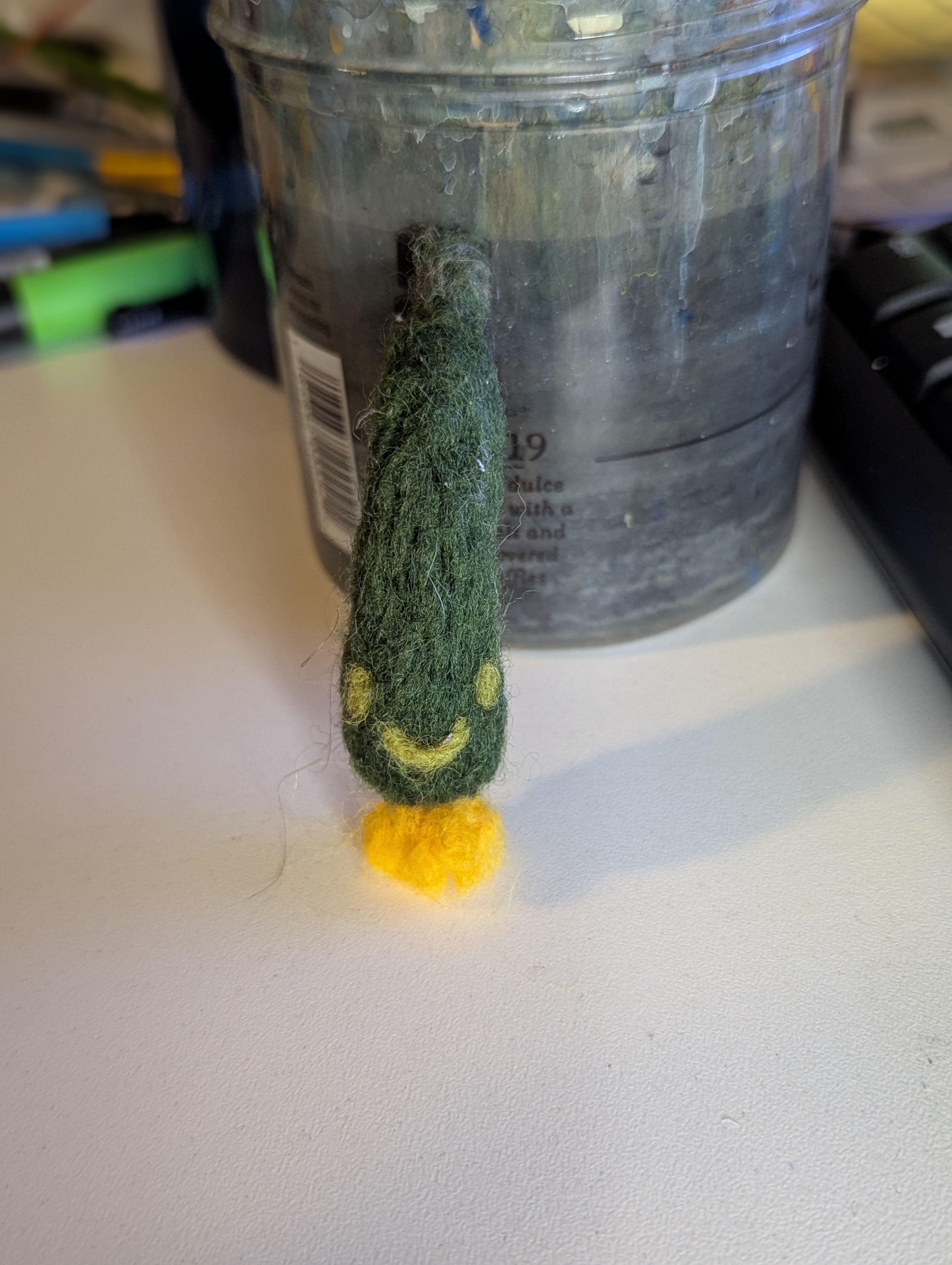
  21. The Barkeep and the Bro, by AJ Truman (m/m, both cis). A contemporary romcom, which was always going to be a hard sell, and indeed it didn’t work for me. This is an age gap, forbidden boss/employee, daughter’s ex-boyfriend, gay-or-possibly-bi-for-you book, and the tropes kind of took over. But because I read it and mentioned it to a friend, I was given a felted zucchini. (There is a scene in the novel in which a zucchini figures prominently.) So. Take that as you will.
  22. Paladin’s Grace, by T. Kingfisher (m/f, both cis). These books (yeah, I read all four) are all so fun and funny. The world reminds me a bit of Terry Pratchett.
  23. Paladin’s Strength, by T. Kingfisher (m/f, both cis). I liked this one the best. 
  24. Paladin’s Hope, by T. Kingfisher (m/m, both cis). I was disappointed that this is the shortest of the books.
  25. Paladin’s Faith, by T. Kingfisher (m/f, both cis). Probably the best plot of the four books in the series but my least favorite romance. Honestly I’m not sure these actually qualify as romances? They might be fantasy novels with romantic elements. 
  26. Husband of the Year, by MA Wardell (m/m, both cis). I still don’t really read contemporary, but this was nice–Jewish guy in interracial relationship gets married and adopts his husband’s nephew. More serious stuff than I expected from a romcom, but it tends to flinch away from any kind of real conflict; either you will like that or you won’t.
  27. Breakout Year, by KD Casey (m/m, both cis). A sweet Jew4Jew sports romance that was somewhat oddly shaped, story-wise. A little squishy in the middle, but Casey writes a delicious sentence, and ultimately it was enjoyable.
  28. Home Ice Advantage, by Ari Baran (m/m, both cis). A former NHL star becomes the head coach of his hometown team and winds up falling for the (Jewish) assistant coach who got overlooked for the job. I know even less about hockey than I do about baseball, but the emotional arc here was delicious and subtle.

A felt zucchini (green), with yellow blossom at one end. It is smiling.

Scifi/Fantasy/Horror

  1. Gideon the Ninth, by Tamsyn Muir. Lesbian space Jesus saves the planet with swords.
  2. Harrow the Ninth, by Tamsyn Muir. Ten thousand years is exactly the amount of time needed to develop the most toxic workplace in the universe.
  3. Nona the Ninth, by Tamsyn Muir. What if instead of gender, we had swords, ghosts, and spaceships?
  4. System Collapse, by Martha Wells. I think this is the one I got hit by a car while I was listening to the audiobook. So, uh. Distracting.
  5. All Systems Red, by Martha Wells. Reread. If I had Kevin R. Free dollars, I’d hire him to do my audiobooks. I also read this aloud to my 8yo. I read this book probably too many times in a short period. It impressed me more after having read through all the other books.
  6. Artificial Condition, by Martha Wells. Reread.
  7. Fugitive Telemetry, by Martha Wells. Reread.
  8. “Home, Habitat, Range, Niche, Territory,” by Martha Wells. Technically a short story. Also a reread?
  9. The Haunting of Hill House, by Shirley Jackson. Masterful. More queer than I remembered. Technically this was a reread but I read it the first time when I was maybe 20.
  10. The Masquerades of Spring, by Ben Aaronovich. I want to recommend this to everyone. Delightful and funny. Like Wodehouse but add Americans, race, queerness, magic, and jazz.
  11. We Have Always Lived in the Castle, by Shirley Jackson. Look, Merricat should be allowed to murder all those dreadful people. As a treat.

Plays

  1. The Bacchae of Euripides: A Communion Rite, by Wole Soyinka. He really gets Dionysus and creates a great, very dark, comedy.
  2. The Bakkhai, by Euripides, trans. by Anne Carson. Not as good as Soyinka’s. Sorry, tumblr. Get your “not for me…not if it’s you” out of here, Anne Carson.
  3. Father Comes Home from the War, by Suzan-Lori Parks. She’s one of the top playwrights of our modern times and this is a banger.
  4. We Bombed in New Haven, by Joseph Heller. Not famous for a reason.

Mysteries

  1. No. 1 Ladies’ Detective Agency, by Alexander McCall Smith. Is it a mystery? There’s a detective. But it’s a wonderful portrait of a time and place he clearly loved.
  2. Fer-de-lance, by Rex Stout. Very clever, a little racist and sexist.
  3. Fadeout, by Joseph Hansen. When I was getting sick in August, I spent a lovely rainy morning reading this in my brother’s sunroom while the kids ran around playing. Also it’s a nice California noir.
  4. Lavender House, by Lev AC Rosen. Rosen is way more about vibes than about creating a mystery that wraps up well. And the vibes are good! I was just left with a lot of questions.

Nonfiction

  1. Ghostland: An American History in Haunted Places, by Colin Dickey. Very interesting. 
  2. Hi Honey, I’m Homo: Sitcoms, Specials, and the Queering of American Culture, by Matt Baume. I had a lot of thoughts about how you get to see what they want you to see. But mostly I was left imagining showing Bewitched to Ulysses, and I couldn’t stop laughing.
    • No, okay, I guess I am going to talk about this. When you watch TV (and this is still true even with streaming), what you see is the shows they decided to make. Obviously. But why do they decide to make a show? It’s because they (they being network executives) do a complex calculation that boils down to “what will catch the public’s imagination such that we can make a boatload of dollars from this?”
    • And a lot of this is predicated on this idea of what “middle America” wants. (What is “middle America”? I feel like I live there? But also where I live, I have a lesbian mayor, a lesbian senator, and a gay congressperson.)
    • Anyway, whenever you’re asking, “Why weren’t there any gay main characters on TV before Will and Grace?” the answer is basically an exec thought that “middle America” wouldn’t like it. Even getting queer recurring characters or story lines that painted queer guest stars as sympathetic could be a stretch during some periods.
    • And now we have had a mainstream sitcom with a married gay couple who adopts a child and they’re main characters in the show, yay progress.
    • But if you think about this, and think about the world, and the vastness of the stories that are never being told because someone thinks they won’t be profitable stories, it gets very sad. I feel very tinfoil hat-y when I talk about it, but the censorship freaks me out. Not the “pulling your book out of a library” censorship, which is devastating, but the “we are going to ignore your ideas and not give you a chance” censorship.
    • Anyway, yay, self-publishing?
  3. “Appropriating the Golem, Possessing the Dybbuk: Female Retellings of Jewish Tales,” by Ruth Bienstock Anolik. Modern Language Studies, vol. 31, no. 2 (Autumn 2001): pp. 39-55.
  4. Alone, Unarmed, and Unafraid: Tales of Unarmed Reconnaissance During Vietnam, by Taylor Eubank. Engaging, but I don’t know if I recommend it.
  5. Three Men in a Boat (To Say Nothing of the Dog), by Jerome K. Jerome. Is this nonfiction? I don’t know. I had an abridged audiobook narrated by Hugh Laurie. I wish he’d done the whole thing.
  6. Things I Overheard While Talking to Myself, by Alan Alda. I’m not big on celebrity memoirs but this was good. Alda is an old school, fought-for-the-ERA liberal, and I love him.
  7. You Could Make This Place Beautiful, by Maggie Smith. A divorce memoir. I…wish she’d just hate him. Or talk more about craft, because she obviously wants to. But as it stands, it was good but felt a little like Swiss cheese?
  8. An Unfinished Love Story: A Personal History of the 1960s, by Doris Kearns Goodwin. I cried, even though I knew who died and when. For example, her husband Dick Goodwin was at the White House getting the East Room ready when they brought Kennedy’s body back from Dallas to lie in state. Everyone was so young and idealistic and they worked so hard. The audiobook has clips of the original deliveries of many of the speeches she talks about (including RFK [original recipe] talking about the death of MLK Jr. on the campaign trail in Indiana the night King died), which was amazing.
  9. A Swim in a Pond in the Rain, by George Saunders. Ultimately I disagree with him about the interpretations of the stories that he offers, and I only sort of like his ideas about how to write a story, but I liked the book. Make of that what you will.
  10. Manhood for Amateurs, by Michael Chabon. An older volume of essays, but one I really enjoyed. Made me laugh aloud at times.
  11. Entangled Life: How Fungi Make Our Worlds, Change Our Minds, & Shape Our Futures, by Merlin Sheldrake. Mushrooms are terrifying, and I’m 20 million microbes walking around in a human suit.
  12. Reading Selfishly: A Craft Journal for Writers, by KD Casey. I don’t think this is officially out yet, but she dropped a link to the first public version on Bluesky, and I think I’m officially a fan.
  13. Crochet Monsters: With more than 35 body patterns and options…, by Megan Lapp. I made four monsters out of this. All in all they were the biggest crochet projects I’ve finished to date. Even with a smallish hook (3.75-4mm), the monsters are all about 8″ tall or more. The book is well laid out, the instructions it offers are easy to parse even for a beginner-to-intermediate crocheter, and there are loads of photos. My kids liked flipping through it and coming up with new monsters, and I didn’t hate making them.

YA Novels I Read Aloud to My Children

  1. Wintersmith, by Terry Pratchett. It was good. I have no notes except that it felt like the main character has out-aged the kid I was reading this to a bit and I want to wait before I read him the next one.
  2. Over Sea, Under Stone, by Susan Cooper. Not as good as The Dark Is Rising. The child still really liked it.
  3. Greenwitch, by Susan Cooper. Very good.
  4. The Grey King, by Susan Cooper. Cooper is a powerhouse. I don’t know what to say. More creepy poems in fantasy novels! (Content warning! There’s a dog that gets shot in this one. I was a little shocked.)
  5. The Hobbit, by JRR Tolkien. Reads aloud well. (Not only was this a reread, this wasn’t even the first time I’d read this aloud.)
  6. The Halloween Moon, by Joseph Fink. If you want a middle-grade YA novel about a Jewish kid, you could do worse.

December 2025 Newsletter: Hazy Shade of Winter

I hope you all had a good Thanksgiving, if you celebrate it. We did. And then we got 9.3″ of snow (that’s 23.6 cm for the rest of the world). It’s not exactly common for this to happen in Wisconsin in November (and unlike the snowstorm I wrote about in Lazarus, Home from the War, it wasn’t melted the next day, which is something that happens a lot more). So we shoveled a lot. Come, winter, and welcome.

Anyway, happy December! The year is almost over. Time to break out your copy of the Mountain Goats singing “I’m going to make it through this year if it kills me.”

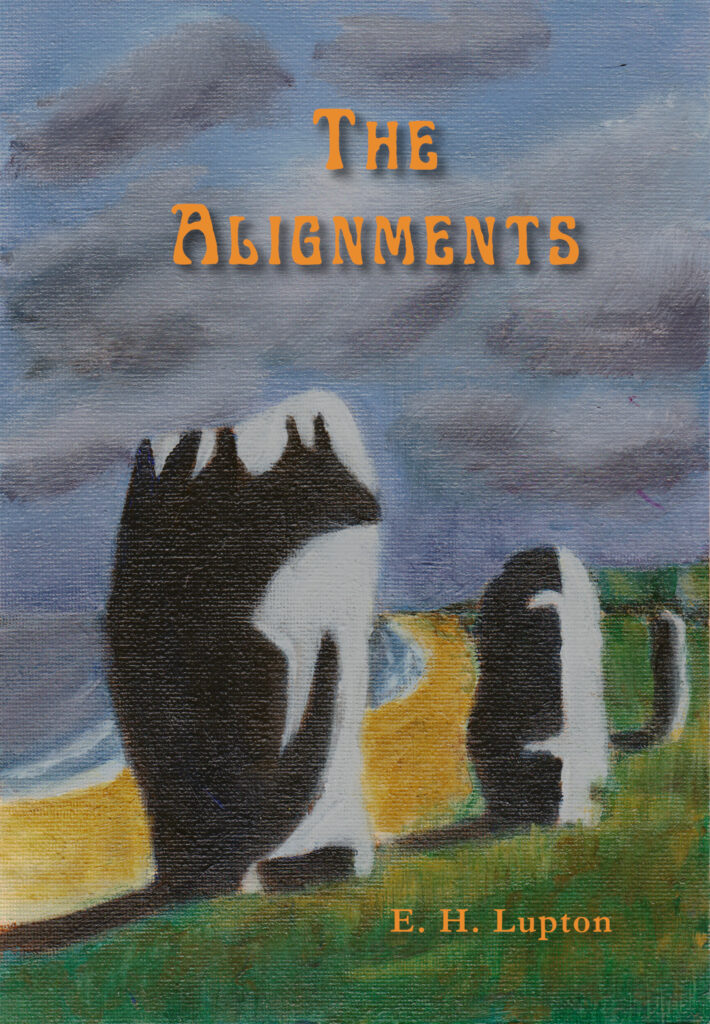
The big news this month is that I have put the top secret project (a novella about Sam and Ulysses’s honeymoon) up for preorder! It’s called The Alignments. You can get it here (Amazon), or here (itch.io). It will also be available on Kobo, Smashwords, Apple Books, etc., on launch day. (Not all these sites do pre-orders.)

I have answers to your frequently unasked questions, but first, let’s look at the cover!

Three standing stones on the shore of the ocean. A moody oil painting. The Alignments, by E. H. Lupton.

All right, questions! 

-Why was this top secret for so long?
I had originally planned to just release it without a preorder period, as though I were Beyoncé dropping an album. Just email you all on 12/21 and say “Bon appetit!” But the podcast Fated Mates named Lazarus, Home from the War one of their best books of 2025, so I decided I would try to capitalize on that and do a preorder.

Oh, that happened. Did I mention that? Laz is on the Fated Mates best books of 2025 list. I don’t really know what to say! I’m thrilled. And a little confused about why their affiliated bookstore decided not to carry my book. But whatever, you can order a paperback of Lazhere, or here, or from your local bookstore (give them the ISBN: 979-8988394433), or email me if you want a signed copy ($17, including shipping).

-What is The Alignments about?
Sam and Ulysses arrive in Carnac, France for their honeymoon. They’re thousands of miles from Madison and hoping for a little rest and relaxation. But when an academic rival of Ulysses’s reveals herself during Sam’s birthday dinner, they find themselves pulled into the investigation of an unexplained death that seems to be tied to the ancient, mysterious stones that litter the town.

-Is this another AU or missing scene?
No, this is canon. It’s on the series roadmap. It’s generally pretty silly, though. Except for the parts where…uh, spoilers. Suffice to say there is a plot, they do various investigatory things and have fun. And it’s set in France!

-Is there a sample?
You can hear me reading an (unedited) version of ch 6 here! I think it really gives the vibes of the whole thing—funny and a little creepy.

-Will it be published in paperback?
Eventually. I wanted to collect all the short fiction and publish them all together. But there’s at least one short thing in progress I haven’t released yet.

I know this is a little disappointing for everyone who would prefer a paperback! The problem is that the cover doesn’t match the other covers, and the book itself wouldn’t be long enough to print anything on the spine. People who like paperbacks tend to want the whole series to match. I have been working hard on the cover for Renaissance, and I will start on a black and ochre cover for all the shorts when I’m done with that book. But it’s taking a while. The cover of The Alignments (which I love) is an actual oil painting (done with water-miscible oils, which I just started using). None of this happens quickly.

In the meantime, if you absolutely don’t like ebooks, you can either get the book from itch, where there will be a pdf version available, and then print it out yourself, or send me an email and I’ll send you an ARC copy of the pdf. 

-Any trigger warnings to be aware of? (Skip this if you don’t want any spoilers.)
There’s some light bondage in The Alignments (bondage in pursuit of a good time, I mean). Separately, there’s a demon and a death.

-Anything else?
It’s always extremely helpful to tell your friends about indie authors, because advertising is hard and attention spans are short, but I did zero advanced marketing for this, so please spread the word! I actually estimate that most of my sales come via word of mouth (either in person or on social media), so you can make a big difference with relatively little effort.

Book Sale
My books are currently on sale on itch for 70% off. You can find those here. Starting next week, they will also be in the Smashwords semi-annual sale. I don’t have a link for that yet, but you can find them all on Smashwords here.

Upcoming Appearances
In December, we’ll be at the Big Gay Market on December 20th (note that this is only the second day of the market) from 10am-5pm. It’s being held at the Alliant Energy Center in Madison! We will have the usual assortment of cool stuff: books; poetry tarot cards; felted earrings, crows, and nazars; stickers and postcards. Come by and pick up last-minute holiday presents! Get a tarot reading for $5! Enjoy lots of other vendors! Details here.

For those who are also writers and are looking for a chance to meet other writers, maybe hear some informative presentations about different aspects of the writing process, maybe have a little retreat from the comfort of your homes, I will be presenting at Wholehearted Writers Week in January. This is sure to be a really great conference, and no matter where you are in your writing process I encourage you to come. Find all the details here.

Podcast
We released one episode in November: Non-Roman Calendars (ep. 97). We also announced that we are joining the Nerd and Tie podcast network. Nerd and Tie is a Wisconsin-based collective of independent creators making podcasts on a variety of topics, from true crime to witchcraft to (now) medieval history! This is a great move that we hope will bring us a bigger audience while allowing us to maintain our ownership and creative control of the show.

We made this move because I got to be a fan of the BS Free Witchcraft podcast and then met its host, Trae Dorn, at Booked Eau Claire back in September. And they knew who I was because their sister read my books! So hello, Trae’s sister, if you’re out there! BS Free Witchcraft is a podcast of the genre “guy [gender nondenominational] who knows a lot about a topic ranting into a microphone,” and I honestly really enjoy it. Trae is funny and they know a lot about their subject and have interesting things to say.

Book Reviews
This is the time of year when many people start to search around for gifts for children. Especially books, because it’s fun to give children something that’s going to stick in their head for the rest of their lives. In general I am skeptical of “best of” lists (excluding the Fated Mates one above–that’s 100% gold), so I asked my 8yo what his favorite books he read this year were, and what he would recommend for kids 8-12 years old. He said: 

  1. Lightfall, by Tim Probert. It’s a graphic novel series (3 books at present, with the fourth due out in 2026) about a young girl, whose grandfather is a pig(?), who along with a friend tries to save the sun. 
  2. Wings of Fire, by Tui T. Sutherland. Described to me as “Game of Thrones but with dragons.” Also Sutherland is a lot more prolific than George R.R. Martin–there are sixteen of these now. (Sorry not sorry, George; finish your book.) The 8yo prefers the novels over the graphic novels, which is an achievement. 
  3. The Dark Is Rising, by Susan Cooper. It’s a classic for a reason. 5 volumes.  

That’s it for today. Talk to you all on the 21st!

Em oi! #454: Sad Not SAD

Here are all the books I read in 2024. I’m not going to rank them, but I’ll give brief reviews. I usually try to read the abbreviation of the year in books, so my goal for 2024 was 24 books. I read slightly more than that across many genres, although romance was the plurality.

Children’s/YA books

  1. The Dark is Rising, by Susan Cooper. Read aloud; I don’t think I have to convince anyone that this is an amazing book.
  2. The Amazing Maurice and His Educated Rodents, by Terry Pratchett. Read aloud; at times we were laughing too hard to go on, and really, what other endorsement is needed?
  3. Camp Damascus, by Chuck Tingle. Some excellent moments but ultimately too much Jesus for my tastes. Already lived all that shit by proxy growing up.
  4. Belle of the Ball, by Mari Costa. A pretty graphic novel with a big heart. Full disclosure: I met Mari Costa at the Lammys!
  5. The Golden Thread: A Song for Pete Seeger, by Colin Meloy. I may be biased because I’m a fan of both Colin Meloy and Pete Seeger, but this was delightful. (I never read it to the kids, though. Just saw it at back to school night.)
  6. The Boy Who Loved Math: The Improbable Life of Paul Erdos, by Deborah Heiligman. Too many words for a bedtime story, but my 3yo inexplicably loved it. The story is very cute, and Erdos was a loveable weirdo.

Romance (pairings and settings as noted)

  1. I’m So (Not) Over You, by Kosoko Jackson (M/M, contemporary). I hope Berkeley feels embarrassed by how dirty they did this poor book. Could have been good, but it was an entirely unedited mess.
  2. Take a Hint, Dani Brown, by Talia Hibbert (M/bi F, contemporary). For what it was, it was fine.
  3. Bisclavret, by KL Noone (M/M but one of them is a werewolf, middle ages?). A novella retelling the werewolf story “Bisclavret” by Marie de France. I usually think novella is not the best format for a romance, but this was charming. Full disclosure: I’ve been on panels with KL Noone a few times now at Rainbow Space Magic Con. (I don’t think she remembers me though.)
  4. A Marvellous Light, by Freya Marske (M/M, late Edwardian). Book 1 in the Last Binding series. The plot was fine and the writing was good.
  5. A Restless Truth, by Freya Marske (F/bi F, late Edwardian). Book 2 in the Last Binding series. The supporting characters were good.
  6. You Should Be So Lucky, by Cat Sebastian (M/M, 1960s America just pre-Kennedy). I am not interested in baseball, but this was a delight start to finish and a standout. The second in the Mid-Century New York series (I lost the Lammy to the first one).
  7. A Minor Inconvenience, by Sarah Granger (M/M, Regency). Don’t think too hard about the plot. Or the sex scenes. The setting was nice.
  8. Letters to Half Moon Street, by Sarah Wallace (M/M, Regency). A gentle epistolary novel with almost no plot and an interesting queernorm regency setting that nevertheless left me with a lot of questions.
  9. An Appreciation of Cats, by Des DeVivo (M/M, contemporary?). Another novella that I read. I got this one as an ARC.
  10. Oak King Holly King, by Sebastian Nothwell (M/M but one of them is an elf, early Victorian). A standout–set in 1844, with strong medieval undertones and a delightful episodic plot that draws on the story of The Green Knight. Full disclosure: I was on Sebastian Nothwell’s podcast (Right Here, Write Queer) and he was recently on mine.
  11. A Power Unbound, by Freya Marske (M/M, late Edwardian). Book 3 in the Last Binding series. I didn’t hate it. Also I liked the characters from A Marvellous Light a lot better here.
  12. The Nobleman’s Guide to Seducing a Scoundrel, by KJ Charles (M/M, Regency). This was a delight. I have to go read book one now.
  13. Scandal in Spring, by Lisa Kleypas (M/F, early Victorian). This was the third book in a row that I read where one character had a BIG TERRIBLE SECRET that got revealed at or after the 50% mark in the book and turned out to be eminently overcomeable, and I am so over it.
  14. Cutting It Close by Reese Knightley (M/M, contemporary). I kind of lost track of the number of (war) crimes committed by the ostensible heroes. This book is a reminder that I need to stop picking audiobooks by just grabbing whatever is listed under “available now.”
  15. Dead Egyptians by Del Blackwater (M/M but one of them is a ghost, Edwardian). More of a character study, but a really lush and intriguing one. TW for an assault that happens around the 75% mark. Full disclosure: I have met Del Blackwater a few times (she lives in the area).
  16. My Last Duchess, by Eloisa James (M/F, Georgian). I want to say that it doesn’t make sense to try to body-shame someone when the fashion is to wear panniers, but that really diminishes the amount of fun that this book was.

Literature and Scifi/Fantasy

  1. Matrix, by Lauren Groff. If you’re the oldest daughter, and you sometimes get given distasteful tasks, and you maybe feel the need to do a really, really superior job at everything, you will see your experience reflected here. This had so many good lines–the writing was really an amazing achievement.
  2. On Earth We’re Briefly Gorgeous, by Ocean Vuong. It was very good and also sad. Contained the single most stomach-turning scene I read (heard, I guess–I had this as an audiobook) this year, maybe ever.
  3. Interior Chinatown, by Charles Yu. This was amazing and everyone should read it. And give Charles Yu more money to write more books. A real standout (and I got B to read it too).
  4. No One Is Talking About This, by Patricia Lockwood. Part I was like having tw*tter slow-dripped into my ear. Part II made me cry.
  5. Space Opera, by Catherynne M. Valente. So amazing I immediately made B read it. Also a standout.
  6. Translation State, by Ann Leckie. A tricky book; not enough connection to the earlier Imperial Raadch novels and too much. Good but unsatisfying; I think it tried a lot of interesting things and I love it for that.
  7. Legends and Lattes, by Travis Baldree. The real magic rock was the friends we made along the way, I guess. This book managed to be very boring and also keep my interest, which feels like an achievement.

Nonfiction, Biography, and Memoir

  1. The Bomber Mafia, by Malcolm Gladwell. It’s all fun and games until Curtis LeMay firebombs Tokyo. (Of note, LeMay also introduced judo into the US and later was the VP candidate under George Wallace in 1968. Gladwell doesn’t mention either of these facts. I had to find them out by myself.)
  2. Cook County ICU: 30 Years of Unforgettable Patients and Odd Cases, by Cory Franklin. Franklin is honest to a fault and I find I like him a lot for it.
  3. A Molecule Away from Madness: Tales of a Hijacked Brain, by Sara Manning Peskin. Unfortunately this was reported stories focusing on the neurochemical underpinnings of various neurological issues rather than Oliver Sacks-esque first-hand case studies.
  4. On the Move: A Life, by Oliver Sacks. This was so delightful, and I’m glad he published it while he was still alive so no family members could stop him. (Would they? I don’t know. It was kinda scandalous. But also very good.) Key quote (not of the scandalous parts):
    As soon as I could get away from work on Friday, I saddled my horse–I sometimes thought of my bike as a horse–and would set out for the Grand Canyon, five hundred miles away but a straight ride on Route 66. I would ride through the night, lying flat on the tank; the bike had only 30 horsepower, but if I lay flat, I could get it to a little over a hundred miles per hour, and crouched like this, I would hold the bike flat out for hour after hour. Illuminated by the headlight–or, if there was one, by a full moon–the silvery road was sucked under my front wheel, and sometimes I had strange perceptual reversals and illusions. Sometimes I felt that I was inscribing a line on the surface of the earth, at other times that I was poised motionless above the ground, the whole planet rotating silently beneath me.
  5. Cultish, by Amanda Montell. I don’t know that her thesis (that cults use in-group language to promote belonging and a sense of community) is all that surprising, but I learned some interesting stuff.
  6. The Commitment: Love, Sex, Marriage, and My Family, by Dan Savage. I don’t know if I should say, “Wow, the early 2000s were genuinely as bad as I remember thinking they were at the time,” or “Dan Savage is the most Gen X writer.” Now I’ve said both.
  7. The Boys of ’67: Charlie Company’s War in Vietnam*, by Andrew Wiest. A group memoir (biography? collection of oral histories?). This made me fucking cry. While driving.
  8. Boots on the Ground: America’s War in Vietnam, by Elizabeth Partridge. (Technically maybe YA nonfiction? oral histories woven together with bits of the larger historical record of the era, from the early ’60s through to the early ’90s.) I didn’t cry but only because I was running on the dreadmill at the time.

* Note–the company that committed war crimes in the village of Son My known as the My Lai massacre was also called Charlie Company, but that’s a different company. Because Army companies are named A, B, C, etc., and then referred to using the NATO Phonetic Alphabet, there’s lots of Charlie Companies.

Other Things I Read

  1. Three Hundred Ramayanas: Five Examples and Three Thoughts on Translation,” by AK Ramanujan. In The Collected Essays of A. K. Ramanujan, Oxford: Oxford University Press, 2004, pp. 131-160. I love this essay so much I wrote my MA thesis about it. I love this essay so much we did a podcast on it.
  2. The Dybbuk: The Origins and History of a Concept,” by Leonard J. Greenspoon. In olam he-zeh v’olam ha-ba: The World and the World to Come in Jewish Belief and Practice, Perdue University Press, 2017, pp. 135-150. This was really informational, and well-written to boot. I learned so much.
  3. “The Etymology of Condom,” by Zacharias P. Thundy. In American Speech, vol. 60, no 2 (summer 1985): pp. 177-179. This started as a joke about the etymology of “condiment” that got way out of hand.

Books and Other Works I Published

  1. Old Time Religion. This was a scary book to write. Dionysus in Wisconsin was received well by a small but enthusiastic coterie, and I didn’t want to disappoint them. Luckily the Lammy shortlist hadn’t come out yet when I released it in January, or I would have freaked out even more than I already did. I got fewer preorders for this book than I did for DIW, which was unpleasant, and although I offered ARC copies no one wanted one. On the production side, the book was beset by some last-minute problems with the cover, which were a real learning experience and did nothing for my stress level. Fortunately, it has been well-received and sold steadily! I don’t track earnings by book, but it has earned out at this point, and slightly faster than DIW did (eleven months instead of twelve).
  2. Dous.” This was so fun to write. I did catch myself trying to decide if I’d unfairly leveraged an argument Spivak makes about the way women are oppressed in India in a context she would object to, and then decided that I was getting a little too serious about the philosophy side of things for a lighthearted short story. As far as I can tell only a few people bothered to read it, probably because I gave it a weird title (it makes sense if you’ve read OTR, I think). But that’s fine. I know a few people really loved it, and that means a lot to me.
  3. Troth. This was a fun book to write, a hard book to revise, and now that it’s done I am extremely happy it’s out in the world. The last few chapters made me very happy to write. I got a lot more preorders for this one than I did for DIW and OTR–as many as both of them combined, actually. I didn’t bother to send out ARC copies. How do you offer ARC copies for the third book in a series without cannibalizing your audience? But despite the lack of hype, it has sold very well, including the best first month sales of any of my books.
  4. “Vivienne.” I sold this to Asimov’s Science Fiction and I have the check stubs to prove it, but although I received galleys, it was not published in 2024. I don’t know exactly what the story is; selling it was quite a coup, perhaps the most high-profile sale I’ve ever made. Maybe it will appear in 2025. Keep an eye out.
  5. Em oi! 452, 453, and 454 (above). I have another comic that I sketched and inked and then set aside because I needed to focus on something else.
  6. Lazarus, Home from the War. I have written two and a half full drafts of this novel this year, I think. I am so excited to show it to people in 2025. It’s got so much cool stuff that I love–a guy trying to put himself back together! A Jewish neurologist! A really scary snake! It will be out in May 2025, so keep an eye out!

The Steel Remains Reviewed

Morgan, Richard K. The Steel Remains. New York: Del Ray, 2009.

Warning: viele spoliers ahead. Achtung.

Okay, quick summary: Ringil Eskiath (known as Gil) is a paunchy, 30-something guy who used to be a great war hero and is now sulking in the sticks, telling his story in exchange for free drinks at the local pub. One day, his mother shows up and asks his help in retrieving a cousin who was sold into slavery. For various reasons, Gil agrees to do this thing. The cousin is something of a MacGuffin though—as soon as Gil arrives in his hometown of Trelayne, he starts hearing rumors that there’s a mysterious, almost mythological creature known as a dwenda lurking in Etterkal (the once-bad part of town where the slavers now legally make their living). One evening, he goes down there to kick in some heads, and winds up losing to the dwenda (known as Seethlaw) in the process, but something about Gil intrigues Seethlaw, who doesn’t kill him but instead takes him as a lover. Eventually, they journey to Ennishmann, where the cousin has been shipped to serve as a dwenda sacrifice prior to a planned invasion.

In the meantime, we also follow the stories of two of Gil’s former comrades-in-arms, Archeth, who works for the Throne Imperial, and Egan, a member of a nomadic tribe called the Majak. While Archeth investiates an apparent dwenda attack on a garrisoned port city, Egan deals with mutinous forces among his people. Eventually, all three of them wind up in Ennishmann, and there’s a big battle with the dwenda, who at least appear to call off their invasion for the time being and leave.
Okay, so I have a lot of feelings about this book. First, the good:

  • A fantasy book, with two gay heroes (Gil and Archeth)!
  • A lot of the action is pretty political and revolves around the laws of the various societies in which the heroes reside—these societies are all well fleshed-out and the cultural differences and similarities are clear. The world also has a pretty complicated history that is not entirely explicated. World building!
  • A fantasy book with a woman as one of the main characters! And she doesn’t have a tattoo on her lower back or fight in nothing but a leather sports bra!
  • The language used is very modern, with no attempt to be high falutin’ (aka Tolkienesque)—this makes the action in the book seem very close to the reader.
  • Interesting discussions of important social issues, like slavery and war.
  • The dwenda wound up being a lot more complex than just a monster-of-the-week thing, and Gil’s relationship with them was gratifyingly complicated.

And my other feelings; I hesitate to call them “negative,” more like just things that are lingering questions:

  • Archeth is different from all other women because she’s a war hero and because she’s half Kiriath, a race that has (in the time since the war in which she served) left the world. Although it’s not really discussed, it seems implicitly that these differences allow her to essentially act as a man does in this world—there are no other women in military or command positions. Although the men she commands don’t question her on the basis of her sex, it does seem like she’s being given a latitude that’s not extended to anyone else. Although women are routinely sold into sex slavery here, women’s role in society isn’t really discussed in any depth, and all the other women who have speaking lines in the book are either 1) Gil’s mother, 2) slaves/servants/so oppressed they might as well be slaves, or 3) whores/girlfriends of various other characters. Even though Archeth herself disapproves of slavery (though not to the point of trying to end it), she doesn’t in any way seem to question the role society assigns to women who aren’t her. (Although to be fair, she does significantly question her society’s treatment of some groups of people, like those who don’t follow the local religion. She’s not totally blind.) So if you were hoping for a true feminist novel where women are either equals or their subservience is questioned, you’ll have to look elsewhere. (That said, the book does pass the Bechdal test.)
  • Gil’s relationship with Seethlaw was complicated, but I had hoped that at the end it would go in a different direction. (Warning: spoilers here) At the end of the book, Gil wrests his cousin away from the dwenda, flees until he and Egan can regroup, then fights them and kills Seethlaw. Instead, I wanted to see Gil come to sympathize more with the dwenda, who were (as mentioned earlier) a complicated group of individuals, and even potentially come to collaborate with them.
  • There are a bunch of plot threads that aren’t really tied up.
  • Some of the plot lines are a little thin. Egan’s plot especially starts out interesting enough, with a member of the tribe killed by steppe ghouls and a blossoming argument with the tribe’s deranged shaman. And then things stall. Egan spends a lot of time sulking in his yurt before getting teleported (south?) by a god(?) to save Gil’s ass. Clearly, some of the stuff here is left untied for the sequels to sort out, but it’s a little frustrating. Archeth, similarly, gets more motion (traveling to the port, investigating it, traveling back) but a lot of her actual time is spent arguing with people at court.
  • Finally, all of Gil’s lovers (the ones we meet, anyway, with names and such) die. Admittedly, he kills two of them himself, but I feel like this is kind of a trope. Also, Archeth has no lovers or love interests, though she is offered (and refuses) a female slave.

I’m planning to read the two sequels, so don’t take any of the above points as reasons to not read this. They’re just some things that stuck out in my mind when I was finished.

I started reading the book because I was told that the use of language was much different from other fantasy novels, and it was. The presence of an interesting female character was also exciting. This started as my read-on-the-dreadmill book, but quickly became a read-all-the-time book. Highly enjoyable and recommended.

Super Belated 2016 Round-Up

Books read:

  • The System of the World, by Neal Stephenson OMG
  • The Two Towers and The Return of the King, by J.R.R. Tolkien
  • Texts from Jane Eyre, by Mallory Ortberg
  • The Princess and the Pony, by Kate Beaton
  • Cecil, the Pet Glacier, by Matthea Harvey
  • “The White Album,” by Joan Didion
  • Angels in America, by Tony Kushner (reread)
  • Can’t We Talk About Something More Pleasant?: A Memoir, by Roz Chast. Reviewed.
  • Fun Home, by Alison Bechdel. Reviewed.
  • Are You My Mother?, by Alison Bechdel
  • Tomboy, by Liz Prince
  • In the Blood, by Suzan-Lori Parks
  • Harry Potter and the Cursed Child: Parts One and Two, by Jack Thorne, based on a story by J.K. Rowling, John Tiffany, and Jack Thorne
  • Alan Mendalsohn: The Boy from Mars, by Daniel Pinkwater
  • Equal Rites, by Terry Pratchett
  • Wyrd Sisters, by Terry Pratchett
  • The Wee Free Men, by Terry Pratchett

It got a little escapist there at the end. I should note that this list is somewhat incomplete–it doesn’t contain, for example, several nonfiction reference books I read, nor the three times I re-read HST’s obituary of Richard Nixon.

Best book I read: Probably The System of the World, which is itself the third part of a trilogy. Is it 2,400 pages of fanfiction about Isaac Newton, Gottfried Leibniz, and the invention of the calculus? A treatise on globalization and economics? An in-depth look at the difficult political transition between Queen Anne and King George I? A joyful romp around the world with the Royal Society? All of the above? Totally worth reading, whatever it is. Someday I want to meet Neal Stephenson so I can give him a high five.

The 2017 reading list can be found here, and my theater reviews are here.

Races run:

Race Date Distance Time
New Years Day Dash Jan 1 5 mi 39:49
Freeze for Food 5k / 10k Jan 23 5 km / 10 km 26:57 / 49:14
LMR 20k May 7 20 km 1:48:47
Ice Age 50 half marathon May 14 13.1 mi 2:01:23
Blue Mounds 18k June 4 18 km 1:55:24
Dances with Dirt July 9 13.1 mi 2:11:13
Madison Mini Marathon Aug 20 13.1 mi 2:07:22
Safe Harbor Labor Day Dash Sept 5 10 km 55:24
North Face Endurance Challenge Sept 18 13.1 mi 2:18:19
Indian Lake Trail Race Oct 1 12 km 1:07:49
Fall 15k Oct 16 15 km 1:19:17
McCarthy Park Trail Race Oct 30 18 km 1:39:46
Wolf Pack Trail race Nov 13 29 mi 5:29:30
Berbee Derby Nov 24 5 km 36:47

Best finish (in terms of pace): Freeze for Food 10k (7:56 pace); New Years Day Dash (7:58 pace); Fall 15k (8:32 pace)

Best finish (in terms of place): Wolf Pack (2nd woman [of two], 8th overall); Fall 15k (3rd in age group, 4th woman of 27); Freeze for Food 5k/10k (6th in age group in both).

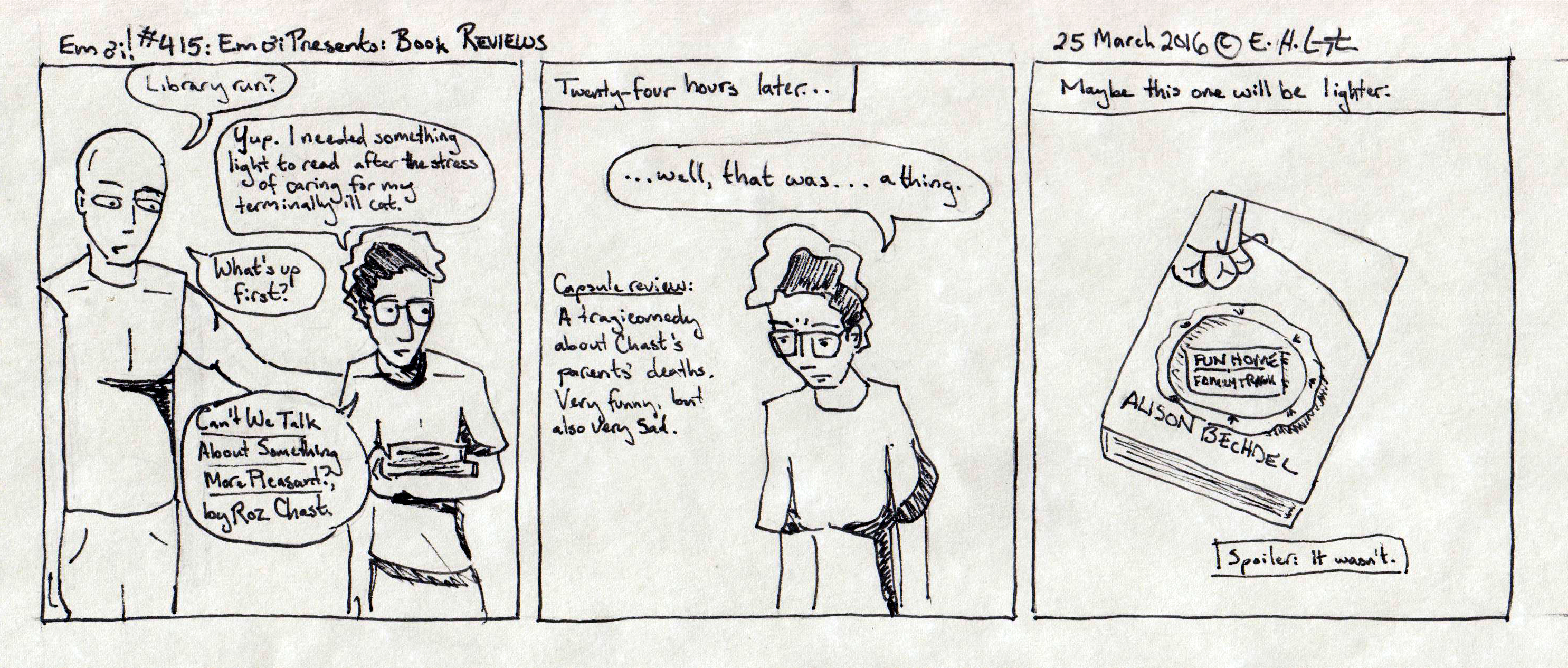
Em oi! #415: Em oi! Presents: Book Reviews

You will almost certainly need to click to embiggen.

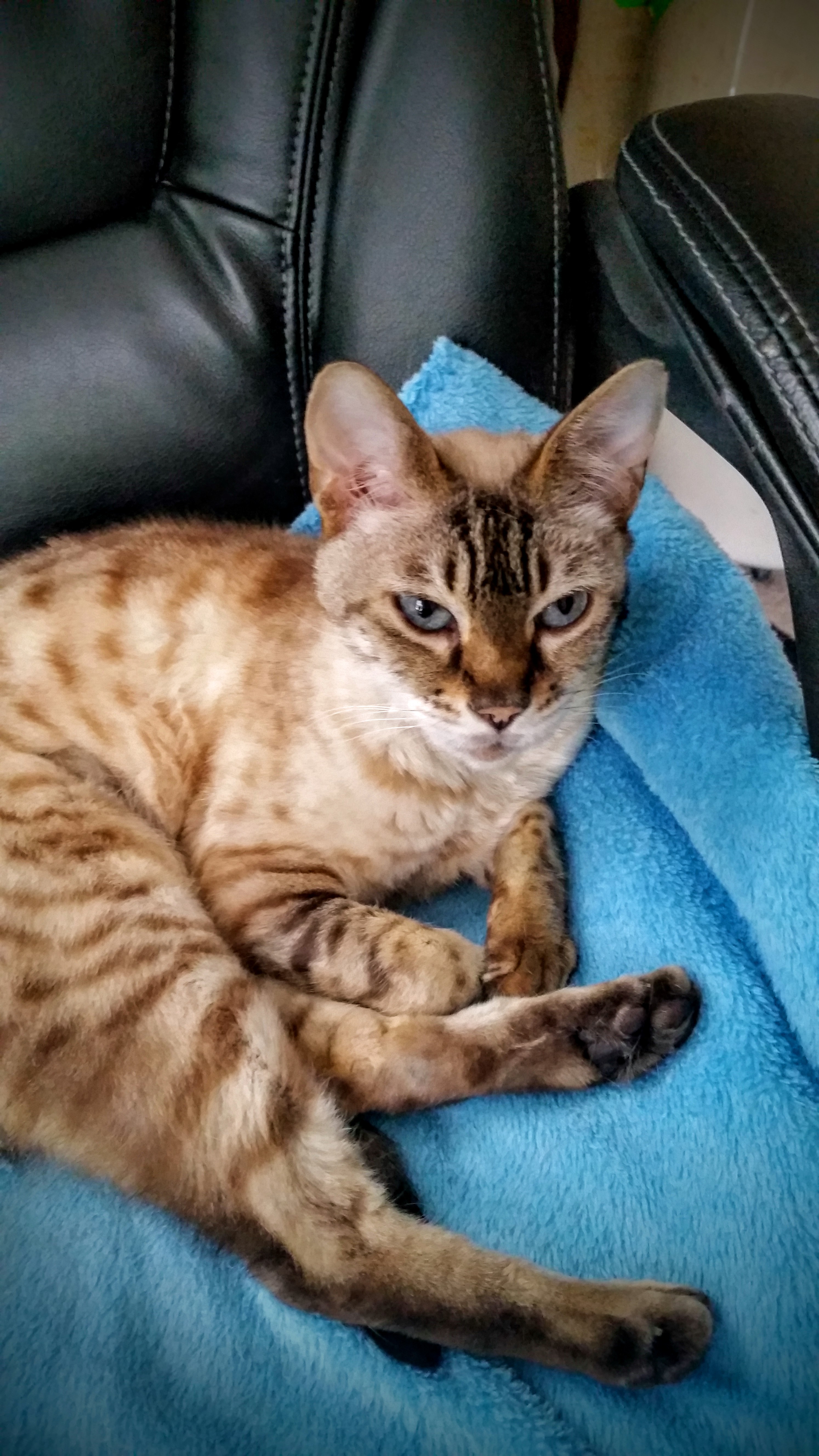
What it says on the tin. Kali is sleeping on my lap right now as I write this, and talking about her medical problems feels almost like a betrayal to be honest. A HIPAA violation or something. But having visited a few different people with healthy cats this weekend, the toll the cancer has taken is really obvious. She seems comfortable at the moment at least. Because she hangs out in my office, we’ve basically been together 80% of every day for the last seven or so weeks since the cancer’s return was diagnosed. That also means I have plenty of time to observe her behavior and obsess over what she’s doing / not doing / eating / not eating.

I haven’t been dealing with the stress super well. Currently I’m running around 45 miles per week, and at this rate I might hit 200 miles for the month of March (I’ve got 180 so far). I have a lot to do, but it’s hard to focus on. In addition, I’m trying to finish up a play which is really stressing me out as well (the subject matter is a bit dark). If anyone has any suggestions for light reading, I’d be excited to hear them. After my adventures with Chast and Bechdel, I’m down to reading Good Omens for the fifteenth time. Anything funny / romantic / escapist would do.

Let’s file this under PN6714.D4 L86 2016, for Collections of general literature–Comic books, strips, etc.–Special topics–Other special (not A-Z).

Reading List for 2016

I read a few books in 2015:

  1. Hawksmoor, by Peter Ackroyd. Review.
  2. The Yiddish Policemen’s Union, by Michael Chabon. Review.
  3. Relentless Forward Progress, by Bryon Powell. Didn’t review.
  4. Dune, by Frank Herbert. Review.
  5. Gligamesh (John Harris version; audio book). Didn’t review.
  6. Into Thin Air, by Jon Krakauer. Didn’t review.
  7. Blind Descent, by James M. Tabor. Review.
  8. Touching My Father’s Soul, by Jamling Tenzing Norgay and Broughton Coburn. Didn’t review.
  9. Solaris, by Stanislaw Lem. Review.
  10. The Martian, by Andy Weir. Review.
  11. Starship Troopers, by Robert Heinlein. Review.
  12. The Confusion, by Neal Stephenson. Maybe when I finish the next one I’ll review the series.
  13. The Fellowship of the Rings, by J.R.R. Tolkien. Reread, so didn’t review.
  14. Racing Weight, by Matt Fitzgerald. Didn’t review.
  15. World War Z, by Max Brooks (audiobook). Review.
  16. Blueshift, by Claire Wahmanholm. Not going to review, but I’ll say that if this doesn’t get picked up by a publisher, the world will be a sadder place.

That’s ten fiction books in various genres and five nonfiction. I also read
about 3,500 pages of books as an editor (one 300-ish page novel and twelve non-fiction books, several of which were highly academic). There may have been a few more that didn’t make it onto the list, plus let’s not even mention the various books that I picked up, read a chapter of, and put down again. (I am an annoyingly peripatetic reader; my tendency is to leave books here and there, never finishing more than a chapter at a go. Sometimes it can take me a long time to read things.)

I think my favorite of this group was Dune. That is a hard determination to make; many of these really spoke to me in deep ways, and as a writer I learned a lot from many of them. My love for The Yiddish Policemen’s Union is very profound, I should add. It was a close race.

This was also the year that my book came out in paperback. So far, of the initial one hundred copies I purchased, I have twenty left. I didn’t get a website up yet, but soon. I know I’ve been saying that for several months now.

This is my preliminary reading list for 2016. Some of these are carry-overs from last year, and I have to look at them again and determine whether or not they’re still something I’m interested in. In a few days when I have solidified it, I’ll move it to the navigation bar above. If you have any books to recommend for me, feel free to let me know and maybe I’ll add them to the list.

    • The Southern Reach Trilogy: Annihilation, Authority, and Acceptance, by Jeff VanderMeer
    • Cloud Atlas, by David Mitchell
    • Ancillary Justice, by Ann Leckie
    • A Girl Is a Half-Formed Thing, by Eimer McBride
    • Viviane, by Julia Deck
    • The Way of Kings, by Branden Sanderson
    • Rock ‘n’ Roll, by Tom Stoppard
    • Being and Nothingness, by Jean-Paul Sartre
    • Dhalgren, by Samual R. Delaney (I did a little excited dance when this came in the mail)
    • Emma, by Jane Austen (How have I not read this before? I have read P&P, S&S, Persuasion, and Northanger Abbey.)
    • The Parallax View, by Slavoj Zizek
    • The System of the World, by Neal Stephenson
    • The Silmarillion, by J.R.R. Tolkien
    • The History of Human Sexuality, by Michel Foucault
    • “The Library of Babel,” by Jorge Luis Borges (yes okay, it is a short story)

Starship Troopers, because why stop with the cheap scifi just when I’m hating myself?

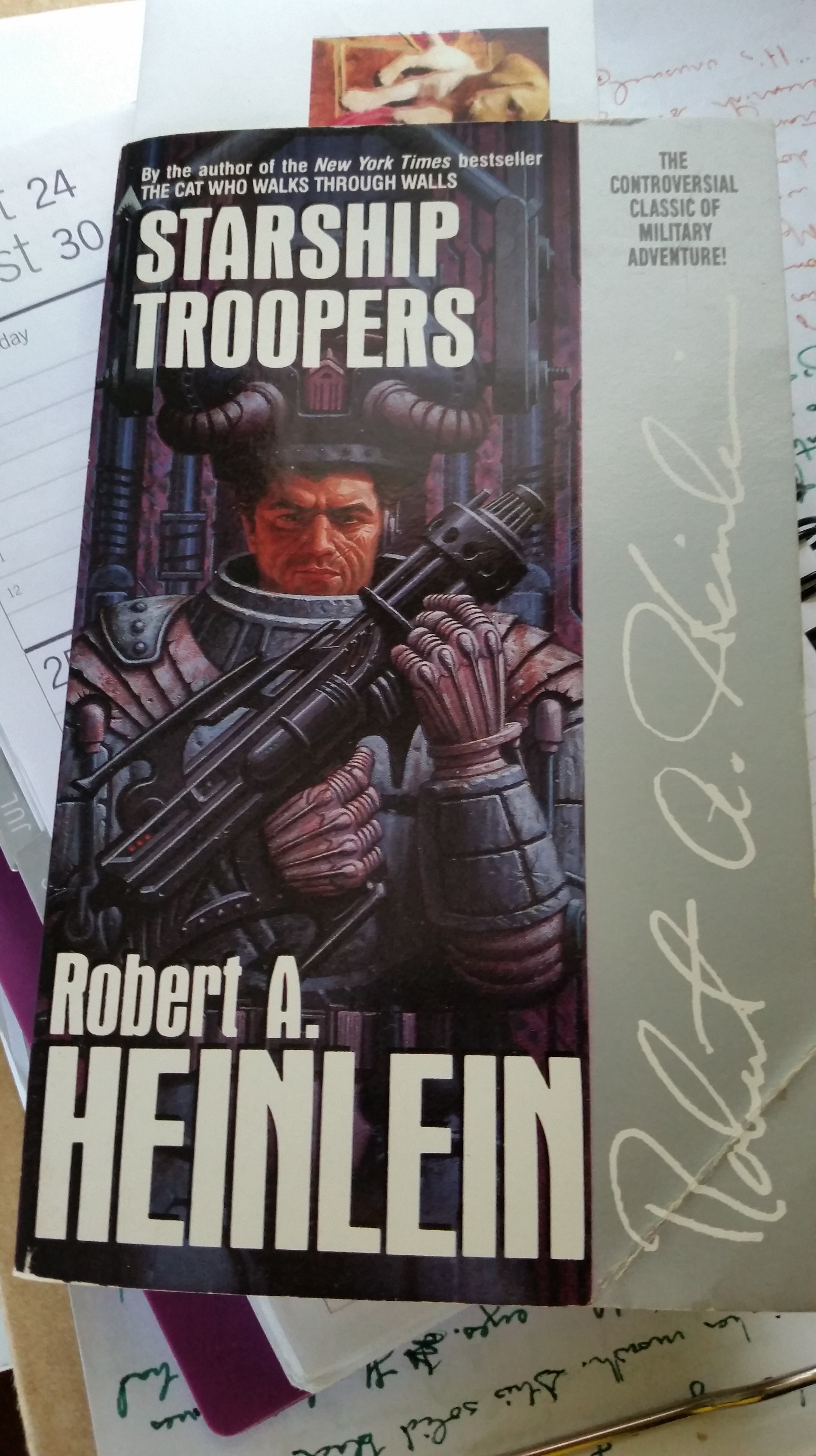
Heinlein, Robert A. Starship Troopers. New York: Ace Books, 1987. First published by G.P. Putnam’s Sons, 1959.

Not like a Cyberman at all.

I have become enamored of reading bad science fiction late at night when I am feeling anxious for whatever reason. In this case, the cat’s health issues over the past month have certainly been a constant source of stomach-churning fun.[1]

Short story shorter, a few weeks ago I found a copy of Starship Troopers in the Alex P— Immemorial Wing of the library. I’d recently had a discussion with my youngest brother about politics in literature, so I decided to take a little look through it. So let’s summarize the plot!

Juan “Johnnie” Rico is an immigrant from the Phillipines (or the area formerly known as) to the US (or the area—you get the idea—the book isn’t super specific about world geography in a lot of ways) who grows up in luxury, the son of a rich businessman. He’s living in a futuristic society (post-20th century, date not specified but seems pretty far into the future, since there’s faster-than-light travel and various other gadgets) in which military or other civil service is a prerequisite for becoming a full citizen (of what is referred to as the Federation). Most people don’t bother—you can live a perfectly fine life without becoming a citizen; the main drawback is that you don’t get to vote. Still, come their 18th birthdays, Johnnie, his best friend Carl, and a girl in his class named Carmen all go down to the Army/Navy office and sign up. Carmen, who is very good at math and has good reflexes, goes to piloting school. Carl, who we are led to believe is pretty smart, winds up in R&D. And Johnnie, who has no particular skills other than being a pretty engrossing narrator, joins the M.I., or Mobile Infantry. They are basically like the normal infantry, except they have rocket-powered jumpsuits that allow them to bound over a lot of terrain relatively quickly. This turns out to be something of a blessing in disguise for him, as he is able to gain discipline, martial skills, insight into why a person might become a soldier and why it’s important that only those who have served have the vote, and other pressing societal issues. After a while, the Federation gets into a war with the bug people. Juan makes up with his estranged father, then goes to officer training school and winds up as a lieutenant leading his own platoon.

Heinlein writes about military life with a certain familiarity—he went to the naval training academy himself, though he was discharged in the 1930s with TB and never saw combat. Still, his descriptions of boot camp have a vividness to them that will be somewhat familiar to anyone who has taken part in physically demanding activities.[2] In fact, while the book is set in the future, it’s a future that smells a lot like the 1950s. We have air cars, yes, as well as faster-than-light ships and an elaborate body armor for soldiers that enables them to fly, but people still read newspapers and receive telegrams, fill out forms by hand and receive paper letters. Perhaps more striking, all the fighting is done by boots on the ground rather than, for example, drones.[3] Of course, the book would not have been as exciting had our hero been training to fly drones rather than fight himself.

Philosophically speaking, there are a few other interesting points to be made. In many ways, Rico functions as a cog in a machine, and he implies that everyone in the army functions in the same way. This is, on the one hand, bureaucracy taken to its natural extreme; on the other hand, it’s confusing to think of an army where everyone has to fight, including people who might otherwise have incredibly important skills that would dictate that they should be kept alive (like code breakers/linguists/etc.). Interestingly, despite having many friends die in training and combat, Rico never questions 1) the training he is receiving, 2) the war he is fighting, or 3) the overall necessity for war (he sees it as a biological necessity based on the availability of habitat). And for all his pro-MI rhetoric, Rico never really gets a triumph. He succeeds in a lot of things, including rescuing his Buck Sergeant[4], a man called Zim, from the bugs, but he is injured during the rescue and doesn’t really recall all of it, negating and distancing him from what would otherwise have been quite a victory. In this way, Heinlein sort of acknowledges, obliquely, that while war may be rationalized with a variety of pretty, noble tropes, its actual execution is quite a bit uglier, and much less noble.

This book does a good job of developing the world in which it’s set gradually; by the time you get to the end, you’ve gotten a fairly good idea of what life in it is like, but Heinlein doesn’t rush to dump information on you at the beginning. The book also features a fair amount of diversity in terms of race compared to most science fiction. And, at least compared to Stranger in a Strange Land, Heinlein’s treatment of women here is much less aggravating; yes, Rico repeatedly remarks at how pretty women are, but he’s unable to get off with anyone—in general because all the women he meets are way smarter than he is. He’s not bitter about this, which is refreshing, and the women, as I mentioned, are genuinely intelligent and good at their jobs (c.f. the constant parade of large-breasted bimbos in SiaSL).

My brother, mentioned mere paragraphs ago, reads this book as a satire. His reasons for this seem to be rooted in a few things about the book–for example, the way the the “bugs” are dehumanized/caricatured and some things about the way the bureaucracy functions, as well as the fact that later on, Heinlein commended the author of The Forever War, Joe Halderman, on having written such a good novel, and The Forever War is widely regarded as being about its author’s experience during the Vietnam War (in Vietnamee, Kháng chiến chống Mỹ). Having read the book, I’m not sure I believe him; Heinlein is a competent writer and a good storyteller, but I don’t know if he’s good enough to pull off that kind of unflinching satire.

I think that’s about all I have to say about this one. I’m told there’s a film version, but I looked at the plot, and it looked like the director didn’t actually read the book so much as steal the character names/title. Interestingly, there are a lot of articles suggesting that the film version is satire. So there’s that.

Next time: Something with women in it.


It's now her chair. Sometimes I get to share it.
It’s now her chair. Sometimes I get to share it.

[1] For those not following along on Facebook, the cat had an adenocarcinoma of the small intestine. She is currently doing well following a bowel resection, but the cancer isn’t really cured and will return, probably within the next six months. But there have been a few anxious nights, mostly because I’m still a hypochondriac.

[2] Like ultrarunning.

[3] Drones are weird, aren’t they? At any point in the last ten thousand years of human history right up to, oh, the mid-1990s, that war will always have to be fought by people was a reasonable assumption to make. Now the elimination of people from offensive combat could totally happen.

[4] Good luck figuring out the ranks discussed in the book. Lieutenant is higher than sergeant; that’s all I can tell you.

“Spice must flow”: Dune Reviewed

Herbert, Frank. Dune. Ace Special 25th Anniversary Edition. New York: Ace Books, 1990.

Dune is apparently the most popular science fiction book ever published. I’m not kidding—you can google that shit. Anyway, this year is the 50th anniversary of its publication (1965–2015), and I had never read it. Then one night I was having a discussion with B about world building in scifi/fantasy and he said, “Every universe has one thing that it’s centered around. In Star Wars, it’s the Force. In Dune, it’s the spice.”

I was unfamiliar. Having just finished Solaris, I decided I would rectify that and dug out our copy.[1] Soon I was deep into to the world of the gom jabbar and the kwizach hadarach, the reverend mother and the melange. Many a night in the last few weeks I was up far past my bedtime, tellling myself I’d read just a few more pages before I turned out the light.

In case you, like me, have been living under a rock for the last my entire lifetime and then some, this is the plot (spoilers ahead):

Duke Leto Atreides, his concubine Lady Jessica, who is a highly trained Bene Gesserit adept, their fifteen-year-old son Paul (who has also been trained in his mother’s weirding ways), and the duke’s entire entourage pick up and move from Caladan, a normal-sounding planet with lakes and rainfall, to Arrakis, also called Dune, a desert planet where it never rains and the native Fremen wear special stillsuits designed to reclaim all bodily moisture for recycling. Arrakis was previously ruled by the Harkonnens, who are the mortal enemies of the Atreides, and the switch got made basically because the Padishah Emperor decided it should happen.

Not long after their arrival, the duke receives notice that there is a traitor in his midst. And then, returning from a night of supervising his troops, Duke Leto finds that the Harkonnens have engineered a plot to land highly trained imperial troops on the planet, kill him and his family, and take the place back.

After a daring escape and a lot of running around in which nearly every character you’ve come to care about dies in rapid-fire succession, Paul and the Lady Jessica wind up getting adopted by a band of Fremen led by a man named Stilgar. Lady Jessica actually takes Stilgar in close combat (unarmed) to gain their acceptance, and later on Paul knifes a guy, so it’s not like this part of their journey was easy. After they return to the Fremen home base, Lady Jessica (who is pregnant with the late duke’s child) is tested with the Water of Life and becomes a Reverend Mother (a type of religious leader), which means that she gets certain powers primarily related to communicating psychically (in a sense) with the band’s previous Reverend Mothers. This isn’t good for the fetus (who will grow up to be St. Alia of the Knife), but what can you do.

Meanwhile, Paul falls in love with a Fremen woman named Chani, and they will have a son together in fairly short order, because I guess condoms don’t exist in the year 10,191. Paul, now known by the Fremen as Usul (privately) and Maud’dib (publically), to say nothing of his other titles (Lisan al-Ghaib for one, and Kwisatz Haderach for another) is able to see the future to some extent because of the spice, his natural inclinations, and the Water of Life. Eventually, he leads the Fremen to freedom from the Harkonnens and bullies the emperor into abdicating and letting him marry his daughter in a political alliance, making him at about age 17 or 18 the emperor.

Whew. So it’s a long book. I actually haven’t touched on about 90% of what goes on, because there’s a ton of subplots. The gist of it is that everyone has a plan. The Bene Gesserit, for example, have been manipulating the various nobles in a breeding program to try and get the Kwisatz Haderach. What they intend to do with him is not clear.[2] Baron Harkonnen has a plan to get his nephew Feyd-Rautha on the imperial throne as well, which somehow involves his other nephew (“Beast” Rabban) taking over Arrakis as ruler and running it into the ground; that’s to say nothing of his initial plot to kill Duke Leto, of course. The emperor has his own plots involving control of the spice market and the nobility. The Guild (the ones who fly everyone around through space) take spice from the Fremen in exchange for preventing weather satellite and other disturbances, giving the Fremen time to execute their plan—the very gradual terraforming of Dune. I think there might be even more plots than that, some of which don’t really play out until the sequel.

This is an interesting and problematic book for a number of reasons. First, there are the women. I’ll just say that Lady Jessica is basically one of the best female characters I’ve ever encountered. Super smart, unflappable in the face of danger, highly deadly in hand-to-hand combat, and capable of undergoing the spice agony and transforming the Water of Life within her body—basically a bad ass. Highly determined and difficult to control, too—did I mention she’d originally been ordered by the Bene Gesserit to produce a daughter for Duke Leto rather than Paul? She does what she wants. She also has two kids who are highly trained Bene Gesserit adepts, trained by herself. I should mention at this point that Herbert evidently based Lady Jessica on his wife, which makes me pretty happy because in other respects he was a little bit shitty (I’ll get to this) and I feel like it redeems him for me a bit.

Unfortunately, the other women in the book are not quite as exciting as characters go, mainly because there is a strong male/female divide throughout the text. Not just within the Reverend Mothers, as I mentioned earlier, although there is that and it’s explained away by the fact that men take and women give and it’s hard for the two sides to look at each other, which would be an interesting sentiment if Herbert followed it to its natural gender-deconstructing answer in Paul, but he doesn’t. Beyond that, women are largely confined to the home and sietch (the Fremen settlements); they counsel and advise, and they have children, and they plot, but they have to have men to listen to them/to manipulate in order to actually achieve anything. Chani, the woman Paul falls in love with, is out on patrol with a group of Fremen when he meets her, and she actually knifes a couple of people over the course of the book . . . until she has kids and gets sent to a safe place for most of the rest of the story. Also, after she meets Paul she basically has no concerns besides his well-being throughout the rest of the book. Within the Fremen society, if you kill a guy, you are asked to take care of his wife and kids—and you’re given the option of marrying the wife or taking her as a servant for at least one year, and it doesn’t seem like she gets much say in the matter. The woman Paul inherits in this way seems very practical and totally willing to marry a guy who knifed her husband not 24 hours before. Women in the sietch basically exist to produce children; they do a few other sietch jobs but they’re there, and the men care for them. The other major female character is Reverent Mother Helen Mohiam, who is scheming and manipulative—scary and powerful, but only by acting through others, primarily the emperor.

In a somewhat related vein, we have the Harkonnens, who are the enemies of the Atreides and very evil. We know they’re evil because—and this is where the writing of Frank Herbert sort of fails to come into its own—the second chapter involves Baron Vladimir Harkonnen basically telling us his evil, evil plot to kill the Atreides through devious underhandedness while he strokes his mustache and laughs maniacally. If that weren’t explicit enough, we also get all these signs (and by signs I mean, I guess, stereotypes) that tell us the baron is a bad dude—he’s super fat, for one (he has to wear suspensors to maneuver his bulk around) and is a glutton for food and power. He’s homosexual, or at least seems to prefer men; he also expresses lustful thoughts about then-15-year-old Paul and not only buys slaves but has them drugged so he can have sex with them more easily. He makes his nephew, Feyd-Rautha, kill people—and okay, it’s not like his nephew was a good guy either, because we see him displaying his killing talents by fighting gladiators with a poisoned blade.[3]

Both of these things—the women’s rather distinct position in society and the rather heavy-handed “clues” to the Baron’s evilness (fatness, homosexuality)—feel like relics of the time period of the book’s initial publication. I’ve talked before about the feeling one gets, reading old science fiction, that while writers (inevitably men) were sort of sure that women would exist in the future, none of them are exactly clear on what they’ll be doing. “Women doing science? Having thoughts? Why would these things ever happen?” they seem to think, and so you see women along in various situations—spaceships and what have you—in which they serve as some sort of more or less sophisticated window dressing. I’m looking at you, Uhura. The Baron’s indicators of evil just feel dated. First, I have to wonder, given the average size of people in 1965 compared to 2015, how fat Herbert thought was so fat it needed anti-gravity devices to move around. Second—and this is what I mean when I said this is kind of shitty of Herbert—he had two sons. One (Brian Herbert) has made his living clinging to Dune’s coattails; the other, Bruce Herbert, was a gay activist who died of AIDS in 1993. Now, at the time Dune was published, Bruce would have been 14, which at the time was very young for a kid to be out of the closet, so I’m perfectly willing to believe that Herbert was mostly reflecting the unconsidered opinions of the time and may have changed his tune later on when he found out his son was gay. But still, kind of shitty.[4]

The book has a bunch of really interesting themes that Herbert addresses with varying levels of sophistication. For example, the tendency of people to follow leaders rather unquestioningly, the uses (and problems) of being able to see the future, the idea of fate and whether or not it can be avoided or changed, the question of the greater good, and different systems of government and their benefits and drawbacks. Perhaps most interestingly, Herbert is concerned with the intertwining of religion and politics; Paul benefits from the Bene Gesserit’s propagandists, who basically primed the community of Fremen to believe in him.

Actually, there are a lot more questions I have to ask about this book, like is it another example of the “White guy joins a foreign culture and becomes its most awesome member” genre (surprisingly hard to answer briefly), as well as the converse position, “Is everyone on Dune White?” (films say yes), but this review is already well over 2,000 words, so I don’t have time here. So to wrap up: Herbert’s writing is exciting if mostly unpoetic (he has his moments), and the text is very engrossing. This particular edition of the book is nice in that there’s a dictionary at the back as well as some other appendices that try to explain the world Paul’s living in. It does suffer from less-than-perfect typography, which includes not just quotation marks facing the wrong way, but also lines of text printed at different sizes and sometimes even randomly repeated. I’d guess that there’s been a better reprinting since 1990, so if you’re looking to read the book, seek that out.


[1] I was given my copy of Dune by a friend I’d lent a calculus textbook for a semester to as a thank-you present.

[2] Basically,when the Bene Gesserit Reverend Mothers look into their minds, they can see a sort of hallway with all the Reverend Mothers along it, and they are able to receive advice from those who came before—so history is preserved within them, as a sort of living racial memory. But there’s a male side to the corridor too, and none of them can access that information. So they have embarked on a breeding program to produce a man who can. Why they want that information and why they thought such a person would be someone they can control is not revealed.

[3] Part of this scene reveals that it’s typical to fight the gladiators when drugged, which seems unfair. Feyd-Rautha instead fights them undrugged, but with a conditioned “stop” word that he can use as a distraction to stab the guy. In one of those awesome literary parallels, Feyd also has a similar word implanted in him, but during their final combat Paul refuses to use it . . . and yet, his saying “I’m not going to say it” makes Feyd freeze enough that Paul can stab him. So. What happened.

[4] One always wants to believe that writers have more considered opinions than other people and think the “right” thing even when others are still against it. Of course, this is clearly not the case—there have been plenty of racist/sexist/homophobic writers who were still great writers (see the line about “The Earth, that with this strange excuse/Pardoned Kipling and his views” in the William Butler Yeats farewell poem written by W. H. Auden). Auden later removed that stanza, which makes me wonder if he actually decided that the Earth does not pardon Kipling . . . but regardless of his [Auden’s] thoughts on the matter, there are a lot of people who have forgiven Kipling.