January 2026 Newsletter: New Year, New Novels

Hello! It’s the new year, somewhat inescapably. So much has happened since I wrote the draft of this newsletter, I don’t even know where to start. The month of December was kind of a disaster around these parts, for reasons I will get to later, and the global political events of the last three days are so bizarre and terrible, I don’t even know what to say about them, except possibly a long and offensive string of blasphemous/curse words.

Putting that aside, about two weeks ago, when I was putting together my announcement for the release of The Alignments, I started thinking about my relationship with music, which is highly…obsessive, I guess is the word I would use. I have the tendency to fall in love with a song and then listen to it over and over again a truly egregious number of times. The song gets tangled up with whatever I’m working on, until I can later recall the circumstances of writing the novel by listening to the song. This is the way that my books get assigned theme songs—what song became special to me when I was working on it? What song came, in some warped way, to typify what I was trying to do?

These are the theme songs of the books that have been released:

  • Dionysus in Wisconsin: Big God, by Florence and the Machine. (I mean…)
  • Old Time Religion: Old Time Religion, by Pete Seeger and Arlo Guthrie.
  • Troth: Harmony Hall, by Vampire Weekend.
  • Lazarus, Home from the War: Half the World Away, by Oasis. (Although this book had a lot of good songs, and eventually it’s kind of what got me into Springsteen.)
  • The Alignments: This Will Be Our Year, by The Zombies. I didn’t realize at the time that it was from an album called Odyssey and Oracle, but when I found out…well, it’s appropriate.

As I work on the third draft of Renaissance, two songs have been battling it out for the position of theme song. I’m excited to see which one wins.

Speaking of which…

Here’s the news, in order of least to most important:
0/ Thank you to everyone who bought/read/left a review of The Alignments. I really appreciate you.

1/ At the end of the year, I usually do a blog post listing all the books I read in the previous year and short reviews of each. That post has gone live and can be found here.

2/ I have updated the series roadmap to include The Alignments and release info about Renaissance. I know I previously said it would be out 3/2. Because of all the stuff that happened in December and how stressed out everything was making me, I’ve moved the release to 4/13. I hope this isn’t too much of a disappointment. I hate having to change it. I was just having anxiety dreams and I needed to release some of the steam. But I’m very happy with the new schedule, which leads to…

3/ Renaissance is up for preorder here. Other sites to follow! Here is the cover and blurb:
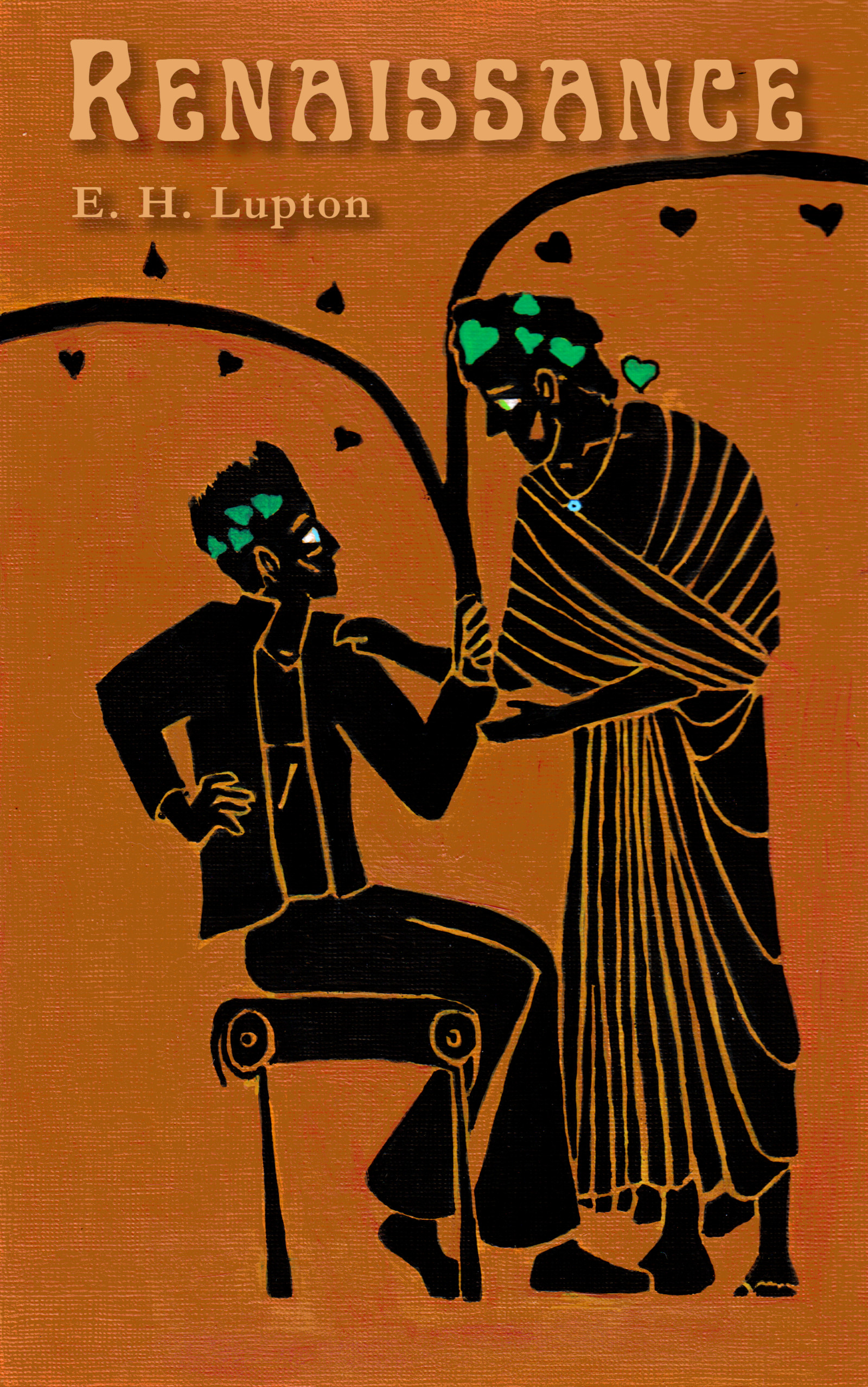
Renaissance, by E H Lupton. Greek black figure art; a man wearing a leather jacket sits on a bench holding a thyrsus. A man dressed as dionysus bends over him.

June, 1971. As the academic year draws to a close, Sam and Ulysses are looking forward to a quiet summer. But when Ulysses’s grandmother is hospitalized, it becomes clear that relaxation is not in the cards. Unable to accept that her fall was an accident, Ulysses begins to investigate whether it may be related to a cult from their past whose mysterious and powerful leader seems to be popping up all over town.

Sam’s doing his best to hold things together and be supportive, but it’s hard when his new husband is barely listening and keeping him at arm’s length every time family is concerned. And on top of everything else, the library has something urgent to tell Sam…

As they reunite with old friends and prepare to bid farewell to others, Sam and Ulysses will see their marriage tried, their lives threatened, and meet an old enemy they thought long dead.

If you preorder it, let me know and I will send you one of these postcards for free!
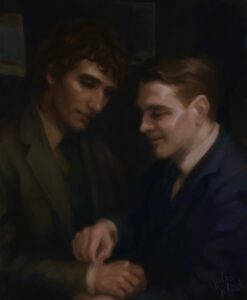
Sam and Ulysses, wearing nice suits. Ulysses is helping Sam with a cuff link. It's a scene from The Alignments.

I know the big issue is that some people really love paperbacks, and I can’t do paperback preorders. But you can still get one!

  • if you buy the paperback in the first month or so and let me know, I’ll send one to you
  • if you come to an in-person sale, you can get one free with purchase (and I have a special Laz postcard too if you buy his book)
  • that’s it I guess

4/ It’s traditional at the beginning of the year for an author to lay out what they’re hoping to accomplish. The last six months of 2025 were quite stressful, riddled with my own illness (I wound up getting diagnosed with asthma); our dog dying; moving one kid to a new daycare; the unexpected diagnosis, decline, and death of a friend; and then immediately thereafter we did two rounds of the flu. As a consequence, my list of goals is a little pared-back. Still, I think it’s not bad:

  • Publish Renaissance in April! I’m really excited about this.
  • Start work on an audiobook version of Dionysus in Wisconsin. It’s time. Doing an audiobook is a little scary, but I love audiobooks so much, and I want my work to be accessible that way.
  • Maybe another short story or novella, I’m not sure yet. I love writing novellas, but I have learned they don’t take less work than novels.
  • The next Laz novel, ideally by the end of the year. This is a book about what happens when you take someone who is already kind of stressed out and on the edge and give him one more thing. Which is currently how I feel. So that should be good.

In a lot of personal ways, 2025 was not a great year. I prefer less fascism, less strife, fewer deaths among my friends. But it was also a fun and productive year—I published Lazarus, Home from the War, a book that went on to be named to the best of 2025 list by the biggest romance podcast out there. I published “Sparking Something,” which is a moody little AU scene that I really enjoyed working on. And I published The Alignments, which came out so much more awesome than I thought it would. I edited and put out seven episodes of the podcast, which is not what we usually shoot for but considering everything? I think I’m happy.

It was a year where there was a lot going on, and I think I’m proud of myself for getting through it. I’m glad you all got through it too, even if you’re feeling bruised by what you went through. I hope you have had some time off to recover, whether that meant making cookies and going to see friends or sitting in a darkened room listening to The Mountain Goats and reading hockey romances. (I have done both of these lately.) And I hope that if you had a 2025 like mine, you have a better 2026. I don’t necessarily have any clever reasons to hope that 2026 will be better, I just think at least it’s going to be different, which can be its own type of better.

Upcoming Events
In ten days, I’ll be presenting at the Wholehearted Writers Week!

At the end of next week, I’ll be selling books at the Well-Red Damsel’s Damsels Not in Distress event (January 18), which combines sword yoga with a romantasy book sale. There are yoga classes offered at 10, 11:30, and 1pm; the book sale is 11am-3pm. If tickets are still available, they’ll be here. I do not know what sword yoga is. It sounds fun? The event will be held at the Baird Center in Milwaukee (400 W. Wisconsin Ave.). You can also check out the Well-Red Damsel’s website here. We will also have some little felt things (hopefully bookmarks!). I do not know if the print copies of The Alignments will have arrived or not. Check my social media for updates closer to the date.

More events in March, but I won’t bother you with them just now.

No book reviews this month, because I just posted my list of everything I read in 2025. See you in February!

The Alignments

I hope you’re all having a good day. I went out to brunch and had a celebratory waffle because as of this morning, The Alignments is available to all!

A few useful links:


I want to thank everyone who helped me out on this–there’s a ton of people listed in the Acknowledgments section–and everyone who has voiced support over the last year. It means a lot to hear that my writing has made you happy, or made you think, or that you were so moved you got a friend to read the book too. Special thanks to Eliot, who was not just line/copy editor but developmental editor as well.

For a bunch of reasons, including that this is a novella, so the spine is pretty thin and won’t match the other books, and because I wanted to publish a collection of all the shorter stuff down the line, I hadn’t been planning to do a print version. However, a bunch of my family members are very ride-or-die with print, so here is the deal: I am planning to do a small print run of novellas. I don’t quite know what the costs will be yet–probably about $8-10 if I have to ship them, maybe less if you find me at an event. If you are really excited about this prospect, let me know and I’ll make sure to count you when I figure out how many to order.

Finally, at the Big Gay Market yesterday, in addition to meeting some really cool people (including friends of a friend, which is always awesome), I found out that at least two bookstores in the Madison area are carrying my stuff–Garden Wall Bookshop in Verona and Lake City Books downtown on the Square. So if you’re in the area and want to support a local bookstore with your purchase, you should check those places out!

Happy Solstice/Happy Yalda, Happy (last night of) Hanukkah, Happy Birthday to my (several) relatives who have birthdays between now and Christmas, Happy Christmas, and Happy Boxing Day to those who celebrate! I’ll be back with more updates, including some January events (hint: I’m going back to a Well-Red Damsel thing!) and info about Renaissance just after New Years. (Happy New Years, too.)

The Gales of November 2025 Newsletter

There’s a lot going on this month. Probably the biggest news is I have a planned release date for Renaissance (March 2nd). Hopefully I’ll have things ready to put it up for preorder next month, just around the solstice (in honor of Sam’s birthday). There’s also a secret project you’ll find out about then—be ready! I am hard at work to finish the covers for everything.

I went out and volunteered with the local Dems the other day, partly because they called and asked if I was free during a moment when I was feeling particularly helpless, and I want to recommend this to everyone. It’s everything I hate (leaving the house, talking to people), and yet the people who came to the door to talk to us were almost universally excited and had ideas and things to say. I hope the exercise of talking to someone about their hopes and fears was as fruitful for them as it was for me—something about meeting someone I have never met and nevertheless finding out we have a lot in common was very heartening. In Wisconsin, many elections turn on very small margins—Harris lost by less than 1% of the vote—so even knocking on a few doors can make a big difference. Wisconsin people can get involved here. People in other states might have luck with this, or look up your local groups.

(I wrote this before the Tuesday victory of so many amazing candidates in NYC, New Jersey, and Virginia among them. Following that victory, I think I believe in the power of volunteering like this more than I did before.)

Upcoming Appearances

I will be moderating a conversation with MA Wardell in honor of the release of his new book, Husband of the Year, at Tropes and Trifles in Minneapolis, MN, from 7–9pm on November 18th. I will also be signing books afterward if you like, and I promise to bring cool free stickers, so come by and say hello. Details and preorders for both of us are on the Tropes and Trifles website here: https://tropesandtrifles.com/events/3751820251118.

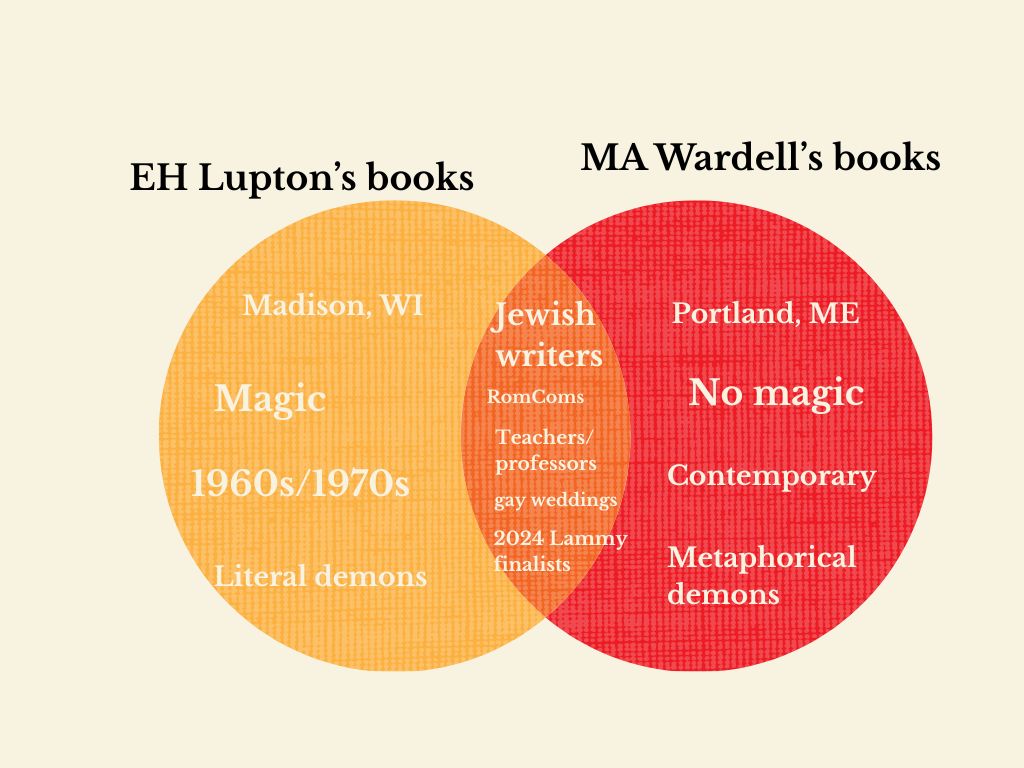
I created the following Venn diagram to explain how our works are similar enough to be read against each other for this event! Hope you all find it informative.

A Venn diagram. On the EH Lupton's books side, it lists "Madison, WI, Magic, 1960s/1970s, and Literal demons." On the MA Wardell's books side, it says, "Portland, ME, No magic, Contemporary, Metaphorical demons." In the middle, it says, "Jewish writers, romcoms, teachers/professors, gay weddings, 2024 Lammy finalists."

I will be selling books at the Scorpio Market in Madison, WI on November 23. It will be at the Tinsmith from 1pm-6pm. “Masks required, misfits welcome.” We will have the usual assortment of cool stuff: books, poetry tarot cards, felted crows and nazars, stickers and postcards. More info here.

In December, I’ll be at the Big Gay Market on December 20th from 10am-5pm. It’s being held at the Alliant Energy Center in Madison! Come by and pick up last-minute holiday presents! Get a tarot reading for $5! Enjoy lots of other vendors! I went to the Big Gay Halloween Market and had a great time—I bought some quartz skulls for , some ginger tea, and a print that my 8yo immediately took from me.

For those in the audience who are also writers and are looking for a chance to meet other writers, maybe hear some informative presentations about different aspects of the writing process, maybe have a little retreat from the comfort of your homes, I will be presenting at Wholehearted Writers Week in January. My topic is revision, which is really the heart of writing! This is sure to be a really great conference, and no matter where you are in your writing process I encourage you to come. Applications and additional information here.

Headshot of EH Lupton. I'm speaking at Wholehearted Writers Week! January 12-16, 2026. Wholeheartedwriters.weebly.com

Other Stuff

We put out a podcast episode in October! Episode 96, on Pope Joan. Hoping we will have more regular episodes in November as our schedules calm down.

Dionysus in Wisconsin will be 40% off on Kobo from November 7–17, so tell your friends.

Books I’ve Read Lately

Paladin’s Strength (cis M/F) and Paladin’s Hope (cis M/M), by T. Kingfisher. Both of these were delightful entries in the series that began with Paladin’s Grace. I think I liked Paladin’s Strength a little better—it chronicles the meeting of a paladin, who is investigating some of the murders that happened in the previous book, with a nun whose sisters were kidnapped. Their two investigations draw them in similar directions. In Paladin’s Hope, a paladin with really bad night terrors meets a pathologist (a lich doctor, in fantasy novel parlance), and they work together to solve a deadly puzzle.

An Unfinished Love Story: A Personal History of the Sixties, by Doris Kearns Goodwin. It’s hard not to hear about the way the Kennedy administration inspired people to get involved in public service and not also want to do something. It’s hard to hear clips of MLK’s “I Have a Dream” speech, or Johnson’s “We Shall Overcome” speech and not feel moved. The audiobook had actual archival recordings sprinkled in, which was great. I cried a little, even though I knew what was going to happen. To be clear, DKG is a presidential historian, and keeps her focus squarely on the events she or her husband were part of in that decade. If you’re looking for a history that includes the Beatles, Woodstock, Stonewall…none of that is here. The moonshot is, because LBJ was involved. But it’s a great history nevertheless.

Husband of the Year (cis M/M), by MA Wardell. Wardell wrote Mistletoe and Mishigas, which was up for the Lammy last year against Dionysus in Wisconsin. I tried to read it at the time and wasn’t all that into it, probably because I’m not a Christmas book person. But I was asked to participate in an event for this book, and honestly, I liked it a lot more. It was more like a book-length epilogue for the two characters (who were introduced in a book I haven’t read). It’s very sweet with almost no angst. I honestly don’t think Wardell and I have a lot of overlap in terms of audience, but if you really want to see contemporary queer romances with Jewish characters, mental health rep, and elementary school teachers, you might enjoy this series.

A watercolor of a pumpkin.

Reading List for 2016

I read a few books in 2015:

  1. Hawksmoor, by Peter Ackroyd. Review.
  2. The Yiddish Policemen’s Union, by Michael Chabon. Review.
  3. Relentless Forward Progress, by Bryon Powell. Didn’t review.
  4. Dune, by Frank Herbert. Review.
  5. Gligamesh (John Harris version; audio book). Didn’t review.
  6. Into Thin Air, by Jon Krakauer. Didn’t review.
  7. Blind Descent, by James M. Tabor. Review.
  8. Touching My Father’s Soul, by Jamling Tenzing Norgay and Broughton Coburn. Didn’t review.
  9. Solaris, by Stanislaw Lem. Review.
  10. The Martian, by Andy Weir. Review.
  11. Starship Troopers, by Robert Heinlein. Review.
  12. The Confusion, by Neal Stephenson. Maybe when I finish the next one I’ll review the series.
  13. The Fellowship of the Rings, by J.R.R. Tolkien. Reread, so didn’t review.
  14. Racing Weight, by Matt Fitzgerald. Didn’t review.
  15. World War Z, by Max Brooks (audiobook). Review.
  16. Blueshift, by Claire Wahmanholm. Not going to review, but I’ll say that if this doesn’t get picked up by a publisher, the world will be a sadder place.

That’s ten fiction books in various genres and five nonfiction. I also read
about 3,500 pages of books as an editor (one 300-ish page novel and twelve non-fiction books, several of which were highly academic). There may have been a few more that didn’t make it onto the list, plus let’s not even mention the various books that I picked up, read a chapter of, and put down again. (I am an annoyingly peripatetic reader; my tendency is to leave books here and there, never finishing more than a chapter at a go. Sometimes it can take me a long time to read things.)

I think my favorite of this group was Dune. That is a hard determination to make; many of these really spoke to me in deep ways, and as a writer I learned a lot from many of them. My love for The Yiddish Policemen’s Union is very profound, I should add. It was a close race.

This was also the year that my book came out in paperback. So far, of the initial one hundred copies I purchased, I have twenty left. I didn’t get a website up yet, but soon. I know I’ve been saying that for several months now.

This is my preliminary reading list for 2016. Some of these are carry-overs from last year, and I have to look at them again and determine whether or not they’re still something I’m interested in. In a few days when I have solidified it, I’ll move it to the navigation bar above. If you have any books to recommend for me, feel free to let me know and maybe I’ll add them to the list.

    • The Southern Reach Trilogy: Annihilation, Authority, and Acceptance, by Jeff VanderMeer
    • Cloud Atlas, by David Mitchell
    • Ancillary Justice, by Ann Leckie
    • A Girl Is a Half-Formed Thing, by Eimer McBride
    • Viviane, by Julia Deck
    • The Way of Kings, by Branden Sanderson
    • Rock ‘n’ Roll, by Tom Stoppard
    • Being and Nothingness, by Jean-Paul Sartre
    • Dhalgren, by Samual R. Delaney (I did a little excited dance when this came in the mail)
    • Emma, by Jane Austen (How have I not read this before? I have read P&P, S&S, Persuasion, and Northanger Abbey.)
    • The Parallax View, by Slavoj Zizek
    • The System of the World, by Neal Stephenson
    • The Silmarillion, by J.R.R. Tolkien
    • The History of Human Sexuality, by Michel Foucault
    • “The Library of Babel,” by Jorge Luis Borges (yes okay, it is a short story)

Are You Afraid of the Dark (Damp, Tight, Dangerous, Rocky, Cold…): Blind Descent Reviewed

Note to readers: I wrote most of this review whilst sitting in B’s room in the outpatient surgery clinic, waiting for his surgery to be over. So if it seems for whatever reason to be more than unusually disjointed, that’s why. He’s fine, by the way, and recovering well.–Ed.

Tabor, James M. Blind Descent: The Quest to Discover the Deepest Cave on Earth. New York: Random House, 2010. 978-1-4000-6767-1.

There is a whole genre of books about people accomplishing difficult feats in incredibly dangerous environments. Jon Krakauer, for example, has made a living writing this kind of book for some time—first Into the Wild, about an independent or insane (depending on your point of view) kid from a wealthy East Coast family who starves to death in the Alaskan wilderness, and then Into Thin Air, about a disaster on Mt. Everest (one he personally witnessed). In some of the book, the feat accomplished is more subtle; a good example is Peter Matthiessen’s[1] masterful The Snow Leopard, the diary of a trek he made through Nepal with the naturalist George Schaller. And then there’s Blind Descent, James M. Tabor’s book of two speleologists racing to find the deepest cave.

Cave in Ha Long Bay, Viet Nam
The only photo from the only cave I’ve ever walked through, in Ha Long Bay, Viet Nam.

Caving—the type these guys are into, at least—is basically a crazy occupation; I think if you’re not already into it when you start the book, you’re not going to be tempted to pick it up. I have walked through a few caves that were fitted out for tourists, but real caving involves all the fun (and dangers) of rock climbing and scuba diving, except done in pitch black and often with freezing cold water running over you, with wind gusts as loud as a 747 rushing past. Sound like fun? Caving is cold, wet, dirty, hard, exhausting work, and the only thing that relieves the monotony is that cavers sometimes go crazy and get what’s called “the Rapture,” which is like a panic attack except with hallucinations and other terrible things. Also, if you get stuck on Mt. Everest, sometimes they can land a helicopter and bring you down. If you make a mistake and hurt yourself in a cave, you’re pretty much fucked unless your friends can carry you back to the surface—a journey that can involve vertical climbs (or if you’re incapacitated, hoists) of 500 feet or more. And that’s not even going into cave diving, which is basically a quick way to wish for death, as far as I can tell. Seriously, about half the named cave divers in this book died.

The book chronicles several expeditions launched by two men, American Bill (William C.) Stone and Ukrainian Alexander Klimchouk. Stone works in a group of caves in Oaxaca, Mexico called Cheve (Chay-vay, not like the cheese; a New Yorker article spells it as Chevé), while Klimchouk works in Krubera Cave in the Arabika Massif in the Western Caucasus, located in what is either the country of Abkhazia or the Abkhazia region of Georgia.[2] In the book, their expeditions are set up as a sort of race to the bottom to discover the deepest cave.

Here I have to pause. In order to draw the reader in, Tabor to some extent skips explaining a lot of his terminology. By “deepest cave,” he doesn’t mean the deepest point on Earth (which would be in the Marianas Trench) or even the deepest point on land (which could be, I suppose, the bottom of the TauTona Mine in Carletonville, South Africa or the Kola superdeep borehole, or potentially the valley under Byrd Glacier[3]), but the deepest depth reachable when descending from the mouth of the cave. To put it another way, Krubera Cave’s entrance is in the mountains, approximately 6,500 feet up (159), so when these cavers descend 7,208 (plus or minus 66) feet, they’re not going 7,208 +/- 66 feet below sea level. Tabor also glosses over what the actual science being done here is—although both Stone and Klimchouk are PhD-holding scientists, it’s unclear what either of them is hoping to get out of the caves beyond just messing around in caves for some reason. Stone does develop technology for use in caves (for example, a rebreather for diving, and a sonar machine for mapping), but he does that to support his caving habit and make caving better rather than doing some sort of cave-based research.

Although I think the book has a number of deficiencies, I first want to say that the writing is good and clear and the book is very engaging. For someone with no knowledge of caving, mountaineering, or diving, I understood the objectives each man was trying to achieve and was able to follow—with excitement—the progress through each cave. The major issues were these:

  1. Women: Although there were women along on both expeditions, Tabor is largely uninterested in them and women in caving generally unless they are 1) sleeping with Bill Stone, 2) the discoverer of Cheve Cave (unavoidable), or 3) I can’t think of a third category. Two of Stone’s girlfriends are involved in the expeditions he leads, and both are mostly described as beautiful—although Tabor is forced to admit that both are experienced cavers, he seems surprised when they actually pitch in and take part in the expeditions. Stone’s girlfriends’ appearances are mentioned both the first time they appear, and then again if they come along on a subsequent expedition, as though we might have forgotten that they are “beautiful,” “tall,” “striking,” etc. Another woman, involved in the Ukrainian expedition, is described as “as strong and brave as she was pretty” (231). Spare me. Needless to say, the men’s physical appearances aren’t really touched on, at least not in such obnoxious detail. In the American expeditions, the presence of women seems to be a point of friction between the male members of the team, but Tabor is uninterested in exploring the roots of this sexism, or discussing at all the history of women in caving; he’s equally uninterested in exploring why the Ukrainian teams seemed to include more women and have fewer problems with sexism. His writing style, though striving for some type of objectivity, doesn’t ever escape from these issues—for example, he mentions a woman getting her hair caught in a rappel rack during a descent—“what every female (and long-haired male) dreaded” (218). Why not just say “what every long-haired caver fears”? Does every female caver wearher hair long?
  2. Communism versus capitalism. Of course, Klimchouk grew up and learned to cave in the USSR, and his view of caving as a cooperative venture between a lot of highly trained people, each of whom takes on specific responsibilities, is in many respects radically different from Bill Stone’s strong-leader-tells-people-what-to-do mindset. Interestingly, Klimchouk’s expeditions seem to be more comfortable in some respects for the cavers (e.g., atmosphere—no sex in the camps; better rations) as well as safer (lots of people die on Stone’s trips, though Tabor absolves Stone of all the deaths). But rather than exploring the complexities of this difference, Tabor seems inherently suspicious of communism in a weirdly 1950s Better Dead Than Red sort of way (maybe I’ve just been hanging around far-leftist academics/radicals for too long?) and is uninterested in the political differences between leadership styles.
  3. Stone versus Klimchouk. While the book is framed in terms of two caves, the book is really written in terms of Stone versus Klimchouk, with the first half serving as a biography of Stone and an account of several expeditions to Cheve and the second half serving as a biography/account of Klimchouk and his expeditions. Except—this is kind of weird, and I’ll warn for a spoiler—while Klimchouk wins, he gets barely ten chapters to himself, plus a few more in the “Game Over” section, while the first thirty-one chapters cover Stone and Cheve, plus more in the “Game Over” section.
  4. A few off-color jokes in the endnotes. To be honest I don’t really care enough to list them here. They were off-color, though.
  5. As, I assume, part of the aforementioned attempt to reduce the science to make everything more readable, many questions about caves, caving, and the rules of the competition are left unspoken and thus confusing. For example, Stone’s group proved via a dye test that Cheve is much longer than its current terminus would suggest—the river that flows into its mouth has an outflow several miles and 8,500 feet down. If the cave went all the way through the distance betweeen the entrances and exits, Cheve would be the deepest cave. Yet clearly the water goes all the way through—why does the cave have to be traverseable by humans in order to take that distinction? Krubera has been dug out and widened in many places by its explorers—why is this legal? (Of course most of the time they’re removing breakdown—piles of rubble left by water—but I’m still curious what the stance on digging is.)[4] Why is cave diving so dangerous? Why do divers have to physically hold on to a line with one hand rather than clipping onto it like a mountaineer?
  6. Somewhat annoyingly, while there is a section of photographs, none of them are actually referenced in the text (as someone in publishing, I see this as poor form, though it does happen). Further, while there are lots of attempts to draw a picture using words of a specific cave feature, a photograph would have been instructive. Maddeningly, in a few spots photographs are actually described, but not reprinted.
  7. Finally, there is the weird desire for completion. As understandable as it is, I have to say that it seems a little bit weird to recount the finding of Krubera’s bottom in 2004 as “game over, end of the line, the last great terrestrial discovery has been made.” There are a couple of reasons for this—for one, that actually wasn’t the lowest point in Krubera—a diver has since pushed the bottom down by another 52 meters (although this happened after the book’s publication, so I don’t blame Tabor for missing it). But that’s the thing—as Bilger puts it in the article I linked to earlier, Everest was Everest before Norgay and Hillary got to the top of it, but you don’t really know how deep a cave is until you’ve gone all the way to its bottom. So not only can there deeper points in the same cave, there could easily be deeper caves elsewhere in the world—something Bilger points out, but Tabor seems loathe to admit. While I understand the desire to tie things up, this seems factually inaccurate.

So there are those things. On the whole, though, while I found them annoying and perplexing—and while I would have made different choices in many places had I been writing/editing the book, I found it, as I said, largely engaging, easy to read, and informative on at least the main points of caves, diving, and the bizarre phenomenon known as supercaves.


[1] I am saddened to see, writing this, that Peter Matthiessen died almost a year ago, on 5 April 2014. If you are looking for a good read, I heartily recommend The Snow Leopard. He wrote a lot of other books, too.

[2] Tabor seems uncommitted on this point, but in fact there’s a lot of geopolitical mess going on in this region—Abkhazia wants to be a country of its own, but it’s recognized by only a few other countries, so it exists in a weird sort of limbo at the moment.

[3] Unlike determining the highest point on Earth, these lowest points seem to have a lot of asterisks: the Kola superdeep borehole is the deepest, but it’s man-made and not human accessible—I think the Kola superdeep borehole was specifically conceived as a project to see how deep a hole could be drilled. The TauTona Mine is human-accessible but, again, man-made. The sub-glacier spot is covered with ice (for a while longer, anyway). There are also caves that are bigger than either Cheve or Krubera (such as Sơn Đoòng Cave in Viet Nam, although Wikipedia doesn’t explain in what respect it is the biggest). So as with so many things, it depends on how you’re asking the questions.

By the way—the Wikipedia page for the Kola superdeep borehole gives in two paragraphs more scientific explanation for why anyone should care about going deep into caves/drilling a deep hole in the ground than Tabor gives in his entire book.

[4] This question and some others that have come up for me were answered at least partially in the New Yorker article linked to earlier: Bilger, Burkhard. “In Deep: The Dark and Dangerous World of Extreme Cavers.” New Yorker, 21 April 2014. http://www.newyorker.com/magazine/2014/04/21/in-deep-2.

Such Tsuris: The Yiddish Policemen’s Union Reviewed

Chabon, Michael. The Yiddish Policemen’s Union. New York: Harper Perennial, 2008. 978-0-00-714983-4.

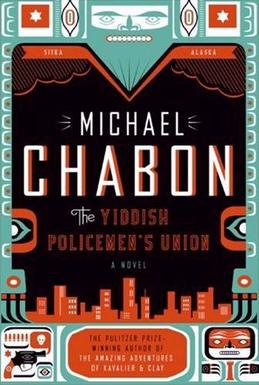
First edition cover, via Wikimedia.

It’s hard to know where to begin with this review, or what my potential readers’ background on these topics may be. I guess the place that makes the most sense to me to start is with Yiddish. Or more specifically, this question: “Why is Hebrew the language of Israel?”

The answer is both more simple and more complicated than you’re probably imagining. Way back in the day, Hebrew was spoken. Then it wasn’t—those who saw that Mel Gibson film might remember that some of the characters in it spoke Aramaic rather than Hebrew.[1] Also, during the diaspora, some Jews spoke Greek. I believe there were actually quite a few Jewish philosophers who wrote in Greek around the beginning of the Common Era. Hebrew survived as a written language through the Middle Ages in much the same way that Latin did; it was a language in which Jews all over Europe could correspond.[2] Gradually, however, people started actually speaking local languages that were to a large extent creoles—Yiddish (spoken mostly among Eastern European Jews) is the most famous, but there’s also Ladino (spoken in Spain), Judeo-Arabic (different variants of which were spoken in many places across North Africa), and Bukharian (spoken in Central Asia), to say nothing of the local languages of the places the Jews were living.[3]

So we have a linguistic jumble, and around the beginning of the twentieth century, we also have what is referred to as the first Aliyah (1882–1903), in which a bunch of Jews (35,000) immigrated from places including Eastern Europe and Yemen to what was then Ottoman Palestine.[4] What language to speak? Hebrew, as the language of the Tanakh, was perhaps an obvious choice, but there are a lot of problems associated with taking a basically dead language and reviving it. To give an easy example, as languages go along they get new vocabulary words as new things appear. So if a language was last really spoken in the Middle Ages, you suddenly have to come up with words for things like buses or electrical outlets.[5] This work was carried out by one guy: Eliezer Ben-Yehuda, who is typically credited with basically singlehandedly bringing Hebrew back to life. Not only that, after making Aliyah, he and his wife raised their son (Ben Zion Ben-Yehuda) speaking Hebrew, making him the first native speaker in centuries.

Moving on from there, I think the history becomes probably better known to most people. Jewish immigration to Mandatory Palestine[6] increased greatly after WWII and the Holocaust. In 1948, Israel became an independent country and immediately survived the Arab–Israeli war (May 1948–March 1949); Hebrew became its official language, and Yiddish gradually diminished, as Ben-Yehuda had wanted. Actually, it’s not quite as simple as saying that Yiddish “gradually diminished”—the Israeli government adopted a policy of promoting Hebrew over Yiddish, even going so far as to ban Yiddish-language theatre in the 1950s. For a moment, however brief, Yiddish had a shot, and it didn’t work out.

This is approximately where Chabon picks up, beginning his alternative history of Jews with the question of “What if Israel hadn’t worked out the way it did?”[7] What if Israel had fallen, and Jews from all over Europe had instead made their way to somewhere else? During the aftermath of the Holocaust, there were proposals floated to give Jews a piece of land in Alaska. Of course, no one really wants to live in Alaska, so in real life nothing came of this. But in The Yiddish Policemen’s Union, after the fall of Israel, that is where Jews wind up, in a settlement called Sitka, population 4 million.

Meyer Landsmen is a detective working for the Sitka police department, homicide division. Before divorcing his wife, he was essentially their top guy, but for the past two years he’s been in something of a decline. His partner is Berko Shemets, who is half Tlingit Indian and also his cousin. About two months before the Sitka territory is set to revert back to American control (think Hong Kong circa 1997), a man is shot in a room of the hotel Landsmen lives in. The man, Mendel Shpilman, turns out to have been a former ultra-Orthodox Jew (referred to as Black Hats in the book). Worse, he may have been the Tzadik ha-Dor, a man who might have, if the time were right, become the Messiah.

I have to give a little digression here on the Messiah, because if you are familiar only with the Christian idea of Messiah—Jesus descending from the clouds, seven trumpets, various pools of blood and people getting the end times kicked out of them—then you are going to be very confused by that last statement. In Judaism, the Messiah is more of a political position—like a king, basically. Somewhat more complicatedly, there are different ideas about how he gets to come do his job. Many people believe that it is up to people to perfect the world before the Messiah will come. Others put their stock in the rebuilding of the Temple (and I guess the reclaiming of Jerusalem? Although maybe that goes without saying) as the thing that will put everything in motion. These ideas are all sort of referred to in the book without really being named or explained in detail.[8]

Going back to the story: Mendel Shpilman is dead, and of course there is a cover-up and much push-back from higher-ups to keep things quiet. And so we begin a journey through a tiny, complicated, fascinating community. Chabon is playing with the oeuvre of Chandler, and the work is an interesting hybrid of the two of them, with Chabon’s poetry and Chandler’s precision of language. Chabon’s metaphors don’t surprise me as frequently as Chandler’s do; he’s too modern and not inspired enough by Hemingway. But he gets off a few good ones. For those who don’t know a ganef from a shlamiel, there’s a Yiddish glossary in the back of the book.

What else can I say? This book was intense. Unlike (many of) Chandler’s works, there’s something bigger at stake than just figuring out who killed one poor guy—the fate of the Sitka district and its inhabitants is constantly at the forefront of the characters’ minds. Like Chandler, though, Chabon plays a bit fast and loose with some of the plot details; thinking back, I cannot piece together the connection between the main plot and a particular tip given to the main character that leads him into a gun battle . . . but as with the case of who killed the chauffeur in The Big Sleep, I don’t care. The story is too entertaining and engrossing to get hung up on tiny details like that.

The book’s ending is abrupt. Somewhat dissatisfying. Leaves room, perhaps, for a sequel. Of the first three of Chabon’s books that I read, The Final Solution, Gentlemen of the Road, and The Yiddish Policemen’s Union, all contain significant Jewish characters and cultural references. I think, in fact, his books have gotten Jewy-er as he went on. Unfortunately, since this one came out his next book was about record collectors and midwives.

Finally, I have to note that despite the book’s centering on Orthodox Jewish men, who inhabit a world in which women are solidly peripheral, there are still a good number of women in the book with not just speaking parts, but some measure of actual power. Of course the main actors (or shall I say villains) are male, but it’s a measure of how attentive Chabon is that over the course of the book Landsmen interacts with a good number of women; in the hands of a lesser (or less caring?) author, there could easily have been only two women in the whole book. Here I think he outdoes Chandler, whose women characters are often around to push the plot forward as villains or seductresses (or seducees), and who are rarely just included as characters who provide information to the detective and then leave in the way that the male characters do. The egalitarian treatment here, in the face of the pervasive sexism of the Orthodox, is a nice if subtle touch.

I don’t have much else to say about this. As a writer, I’m jealous of what Chabon has achieved here. The book is a real triumph—not just of voice, but of culture and world-building. As a (rather unobservant) Jew, I’m excited by the reflection of something I identify with as my culture (if in a distant, somewhat warped way) in the mainstream. And as a critic, I’m comfortable saying to you: read this book; you won’t regret it.


[1] Aramaic is a Semitic language written with Hebrew letters. Today, the place a non-Jew or non-academic is most likely to encounter it is in the Passover liturgy, which has a few songs in Aramaic (e.g., “Chad Gadya”). Parts of the Talmud are also written in Aramaic. Also, not having seen The Passion of the Christ before, I looked it up–turns out the film is also in Hebrew and Latin, which kind of obscures my point.

[2] For more on the transformation from Latin to local vernacular languages (and the advent of nations in the modern sense), see Imagined Communities, by Benedict Anderson.

[3] My great-grandfather spoke I think six languages, maybe seven, on his arrival in America. He taught himself English by reading the New York Times.

[4] There was also a Second Aliyah, 1904–1914, and then more immigration during the period during which the area was under British control (1920–1948), during which it was referred to as the British Palestinian Mandate.

[5] Latin has also faced this challenge, at least in Vatican City, where you can get the ATM to display in Latin. A friend of mine who is a grad student in Classics claimed that the neologisms they’d come up with in Latin were unpoetic. Hebrew’s neologisms are often drawn from other languages—for example, the word for “bus” is “autobus.”

[6] Seriously, they couldn’t come up with a better name?

[7] I’m simplifying a bit, both in the actual history of Israel and the history of the world as presented by Chabon—the fall of Israel is far from the only difference.

[8] I should emphasize that, unlike Christianity, the arrival of the Messiah in Judaism is not preceded or followed by “end times” of any stripe. Christianity is very much a millenarian religion in that respect. [Ok, since I first wrote this essay, I have been informed by my youngest brother that a religion is only considered millenarian if the apocalypse they are predicting is predicted to happen soon–so Harold Camping saying the world will end on October 21, 2011 (spoiler alert: it didn’t) made him/his followers millenarian, but the general Christian belief that one day the messiah will return doesn’t make Christianity an inherently millenarian religion. I apologize for any confusion my remarks may have caused. –Ed.]

New Year, New Year

rc2_8828 This morning, somewhat against my better judgment,[1] I ran the New Year’s Day Dash, a 5-mile (road) race. Thanks in part to a few friends pacing me the first mile and a half (or perhaps I mean letting me hang with them before they took off), I finished in 40:34, a personal best and about a minute faster than my time last year. Perhaps that will be auspicious.

Everyone has been posting about their New Year’s Resolutions: go to the gym, lose ten pounds, eat healthy, get eyebrows under control. Some good ideas, some not so good. Well, I already go to the gym and I don’t really want to lose any weight, and my eyebrows are a lost cause. Instead, I’ve been thinking about books.

I read a lot. But after Goodreads sent me an email congratulating me on reading three books last year, I started going through my records and memory, as best I could, because surely that couldn’t be accurate. And, luckily (surprise), it wasn’t. I just didn’t review everything I read.[2] But I also have a bad habit of reading in parallel, so I might get halfway through something, then put it down and not come back for a year. Also, I read a lot of books for work–last year, I edited books on topics ranging from screenwriting to the rhetoric of the gross anatomy lab to Asian philosophy to nursing. So if I feel like I read constantly, it’s because I do . . . but it’s not always reading for pleasure.

Having come to this determination, I have made a list of books I want to read in 2015. As a writer, it helps to keep the mind fresh, and I begin to find that it’s important to find an escape from the grind of reading to edit, which is a different type of reading. I have to shut down that part of my brain sometimes. There’s no theme to these books, other than for most of them I saw reviews in different publications and found them interesting, and they’re in no particular order. I can’t guarantee I won’t get distracted or add or subtract from the list, but I’ll see how far I can get with it. My other resolutions are to finish reading/blogging about Ulysses, remember to water the plants in my office, and get my SADs under control. Let’s do this!

  • Hawksmoor, by Peter Ackroyd Review
  • The Southern Reach Trilogy: Annihilation, Authority, and Acceptance, by Jeff VanderMeer
  • Cloud Atlas, by David Mitchell
  • Tender is the Night and The Crack Up, by F. Scott Fitzgerald (maybe)
  • Ancillary Justice, by Ann Leckie
  • A Girl Is a Half-Formed Thing, by Eimer McBride
  • Island, by Aldous Huxley (maybe)
  • Viviane, by Julia Deck
  • Without You, There Is No Us, by Suki Kim
  • The Yiddish Policeman’s Union, by Michael Chabon Review
  • Relentless Forward Progress, by Bryon Powell
  • Dune, by Frank Herbert
  • Gligamesh, by the people of Babylon
  • The Way of Kings, by Branden Sanderson
  • Into Thin Air, Jon Krakauer
  • Lying: A Metaphorical Memoir, by Lauren Slater (maybe)
  • Blind Descent, by James M. Tabor Review
  • Rock ‘n’ Roll, by Tom Stoppard
  • Blueshift, by Claire Wahmanholm (a pre-publication copy kindly provided by the author)
  • I’m not going to say I’m going to read Being and Nothingness, by Jean-Paul Sartre, but every year this time when my SADs get bad I try to.

Are you reading anything interesting next year? Or, alternatively: Any other resolutions?

rct_8273

You can check out book reviews I’ve posted here on the book review and book reviews tags, because apparently I suck at metadata. Also check out the writing category for reviews of films, plays, and other stuff (I promise most of it is not bitching about how difficult it is to write a novel).

[1] Against my better judgment ought to be the title of my blog sometimes. This particular race was against my better judgment because it was cold and I was up late the night before and also I have some tendonitis in my ankle.

[2] I usually only put reviews on Goodreads if I’ve written a review of them, and I only do that when something interesting strikes me about the books to write about.

Episode 5: The Lotus Eaters

A few brief bits of housekeeping before we get going: first, I have back-linked all the episodes of

Datura.
Datura.

Ulysses so far commented upon to the introductory blog post, which will now also serve as an index. It can be viewed here. Also, in many cases I have made some small tweaks to the writing to make the style slightly less bombastic or grandiloquent or I guess casual and more something my MA advisor wouldn’t have shaken his head at and dismissed out of hand. Still not perfect. Oh well. Also, for those of you who are sick of Ulysses, I should have another comic ready to go soon. The summer sabbatical was nice, but I am starting to feel like drawing again. Hooray? Also, you might have noticed that I moved all The Joy of Fishes-related links to this page. Just a reminder, if you read it, please consider reviewing it on Amazon or Goodreads. Thank you!

And now, Ulysses. Enjoy.


This section of Ulysses, “The Lotus Eaters,” takes its name from an episode in the Odyssey referred to somewhat briefly in chapter IX of Homer’s text. Odysseus and his men land on an island to get fresh water and food. Odysseus sends a few men into town to see what’s up. It turns out everyone on the island eats lotuses, and the lotuses are so delicious that once you taste them, you don’t want to do anything else but lie around eating lotuses all day. (Please make your own joke about the 1960s here.) Odysseus marches his men back onto the boat and gets out of there tout de suite.

In their 2000 film “O Brother, Where Art Thou?,” which happens to also be an adaptation of the Odyssey, the Coen brothers used the episode of the Lotus Eaters to refer to religion—specifically, as our heroes are wandering through the countryside, they come across a long line of (somewhat stoned- or hypnotized-looking) people dressed in white, waiting in line to be baptized.

Not coincidentally, although almost certainly unrelated to the Coen bros, this episode of Ulysses has a lot of religion in it. In fact, the whole book has a lot of religion—it’s set in Ireland, after all, a place where divorce was illegal until 1996[1] because of the influence of the Catholic church. But if you are about to quote Marx’s quip about religion being the opiate of the people and think we’re done, think again. This is Joyce—nothing is so uncomplicated.

In the first episode (Telemachus), we saw several different ideas about religion. Stephen, called a “fearful Jesuit” by Buck Mulligan, seems to believe in a deity he is unwilling to worship. Like Lucifer[2], at the end of Portrait, we get this scene between Stephen and his friend Cranly:

After a pause Cranly asked:
—What age is your mother?
—Not old, Stephen said. She wishes me to make my easter duty.[3]
—And will you?
—I will not, Stephen said.
—Why not? Cranly said.
—I will not serve, answered Stephen.
—That remark was made before, Cranly said calmly.
—It is made behind now, said Stephen hotly. (Portrait, 259–60)

Stephen claims that he “neither believe[s] in [the eucharist] nor disbelieve in it” (Ibid.), but his stance in Ulysses is a bit less equivocal, telling Haines, “You behold in me . . . a horrible example of free thought” (1.625–6). “Free thought” meaning “thought free from the dictates of ‘Christian revelation’ “ (Gifford 24). He is quite firm on this point, to the extent that he is unwilling to take communion to appease his dying mother. But as much as he makes these claims, he’s still very much in the grip of religion, seeing himself as well as “a servant of two masters . . . an English and an Italian. . . . The imperial British state . . . and the holy Roman catholic and apostolic church” (1.638–43). In fact, like Lucifer whom he quotes, Stephen is defined by religion and God, regardless of the latter’s existence; his desire to disobey the church brings him into much more strife than simply not caring about religion would—compare his refusal to take communion to appease his dying mother versus Bloom’s relaxing through a church service he doesn’t particularly understand or care to learn about.

In the first episode we also see Haines, who “couldn’t stomach that idea of a personal God. . .” (1.623), and Buck Mulligan, who is an irreverent medical student (as I already quoted, his feelings about death are put to Stephen like this: “And what is death . . . your mother’s or yours or my own? You saw only your mother die. I see them pop off every day in the Mater and Richmond and cut up into tripes in the dissectingroom. It’s a beastly thing and nothing else” (1.4–6)).

Finally we get to Mr Leopold Bloom. His attitude towards religion seems to stand somewhere between irreverence and ignorance.[4] For example, it is difficult to know whether or not he is joking when, watching a service, he muses, “Letters on his [the priest’s] back: I.N.R.I? No: I.H.S. Molly told me one time I asked her. I have sinned: or no: I have suffered, it is. And the other one? Iron nails ran in” (5.372–74). Similarly, he attributes the use of wine during the Eucharist ceremony to it being “more aristocratic than for example if he drank what they [the parishioners] are used to Guinness’s porter or some temperance beverage. . .” (5.387). During the mass he thinks of sex: perhaps he will meet Martha “one Sunday after the rosary” (5.375); imagines the priest murmuring to the communicants “Shut your eyes and open your mouth” (5.349–50); considers the confession process as a sadomasochistic ritual in which the confessor asks the priest to “punish me, please” (5.426); and imagines a woman confessing her infidelity (5.427–32). It should be noted that Bloom actually proposes the idea of the mass as an opiate during this section: “Good idea the Latin. Stupefies them first” (5.350–51) and sees the communicants as walking with “blind masks” (5.353) to take communion.[5]

What does this add up to? For Stephen (and probably for Mulligan, whose “Ballad of Joking Jesus” is showcased in several sections), religion is a source of creative energy if not comfort. For Bloom, it’s a source of mild interest. For none of them is it actually a sedative or distraction from the true woes of the world. But perhaps other things are—for example, Bloom ignores the gravity of the service to think about sex. While walking, he meets M’Coy, who is so wrapped up in preparing for a trip to the races that he will miss Paddy Dignam’s funeral (5.169–73). In another scene, Bloom calculates the amount of porter a local businessman must have sold in order to make a million pounds (answer: about 15 million gallons)—a lot of porter, and another common addiction (5.304–12). Bloom muses on drugs as well—cigars have “a cooling effect. Narcotic” (5.272), and the Chinese might prefer “an ounce of opium” (5.327) to learning about Christianity. All these things (sex, drugs, gambling) are in our modern time are commonly understood as things that one can become addicted to, which is to say that they can certainly be so distracting as to take one away from the duties of one’s life.

The message here is difficult to tease out, and of course different readers will draw different conclusions. Is Joyce suggesting that religion is problematic, but other things are problematic too? That “worldly” things like sex and gambling prove more of an opiate than religion? That somehow the removal of a deity from religion causes it to become one more distraction like any other? Any of the nice moral summaries I come up with sound pat, and I’m not convinced that Joyce actually believed any of them, since he notoriously indulged in both drink and sex himself (see for example Chiasson 2014). Ultimately there’s not an easy answer here, perhaps because there’s no author trying to pass judgment—although I’ve used the word “addiction” in the preceding paragraph, Joyce wouldn’t have, even were he alive today. This is just life—sometimes some things blind us to other things that are going on; preoccupied, we find ourselves unable to interact with every encounter the way that we should. In other words, perhaps everyone is an eater of lotuses.[6]

Notes

[1] As noted by (I’m sorry) Christopher Hitchens, the repeal of this law was opposed by, among others, Mother Theresa herself. (He noted this in several places; see for example his letter to the New York Review of Books here.) Also, I note from her Wikipedia page that she is now The Blessed Theresa of Calcutta, M.C., which is annoying because she’s from Macedonia.

[2] I’m not prepared to walk you through the mythology here. I suggest a reading of John Milton’s Paradise Lost. It’s a good book. Or, the relevant reference, as summarized in Portrait:

Lucifer, we are told, was a son of the morning, a radiant and mighty angel; yet he fell: he fell and there fell with him a third part of the host of heaven: he fell and was hurled with his rebellious angels into hell. What his sin was we cannot say. Theologians consider that it was the sin of pride, the sinful thought conceived in an instant: non serviam: I will not serve. That instant was his ruin. (126)

[3] “Easter duty” refers to “the obligation to receive Holy Communion at least at Easter time . . .” (Catholic Essentials website, quoting “A Catholic Dictionary, 1951”; link below). Receiving communion requires that one have confessed first as well, so Stephen’s mother is essentially requesting him to go through the whole ceremonial shebang. See http://catholicessentials.net/easterduty.htm.

[4] Bloom later comments that Christianity is “more interesting if you understood what it was all about” (5.423–24). It’s hard to know how to take the INRI remarks in view of this.

[5] It’s worth pointing out that Bloom’s attitude towards Judaism is typically more reverent—and tinged with remembrances of his father. See for example 7.206–13: “Poor papa with his hagadah book, reading backwards with his finger to me. Pessach. Next year in Jerusalem. Dear, O dear! All that long business about that brought us out of the land of Egypt and into the house of bondage Alleluia. Shema Israel Adonai Elohenu. No, that’s the other. Then the twelve brothers, Jacob’s sons. And then the lamb and the cat and the dog and the stick and the water and the butcher. And then the angel of death kills the butcher and he kills the ox and the dog kills the cat. Sounds a bit silly till you come to look into it well. Justice it means but it’s everybody eating everyone else. That’s what life is after all.” Sharp readers will note this is as slightly wrong as the earlier INRI (it’s not “into the house of bondage”), which certainly leads to more questions. However, the topic of Bloom’s (putative) Judaism exceeds this essay, so I will return to it at a later time.

[6] Having spent my past week hanging out with a bunch of actors, I feel pressed to add something about the performativity of the mass scene—the way in which the priest seems to be moving through a series of steps (suggested by him reading things off cards and the like) rather than truly engaged in the service. So, too, one could ask if the predictable actions of the parishioners are meant to suggest members of an audience, or even of a Greek chorus, performing some kind of specific role. But no space for that here. Perhaps another time.

References

Catholic Essentials. “Easter Duty.” 2008. http://catholicessentials.net/easterduty.htm.

Chiasson, Dan. “ ‘Ulysses’ and the Moral Right to Pleasure.” The New Yorker, 16 June 2014: http://www.newyorker.com/books/page-turner/ulysses-and-the-moral-right-to-pleasure.

Hitchens, Christopher. “Mother Theresa.” The New York Review of Books, 19 December 1996: http://www.nybooks.com/articles/archives/1996/dec/19/mother-teresa/.

Joyce, James. Portrait of the Artist as a Young Man: Edited with an Introduction and Notes by Seamus Deane. New York: Penguin Books, 1992.