January 2026 Newsletter: New Year, New Novels

Hello! It’s the new year, somewhat inescapably. So much has happened since I wrote the draft of this newsletter, I don’t even know where to start. The month of December was kind of a disaster around these parts, for reasons I will get to later, and the global political events of the last three days are so bizarre and terrible, I don’t even know what to say about them, except possibly a long and offensive string of blasphemous/curse words.

Putting that aside, about two weeks ago, when I was putting together my announcement for the release of The Alignments, I started thinking about my relationship with music, which is highly…obsessive, I guess is the word I would use. I have the tendency to fall in love with a song and then listen to it over and over again a truly egregious number of times. The song gets tangled up with whatever I’m working on, until I can later recall the circumstances of writing the novel by listening to the song. This is the way that my books get assigned theme songs—what song became special to me when I was working on it? What song came, in some warped way, to typify what I was trying to do?

These are the theme songs of the books that have been released:

  • Dionysus in Wisconsin: Big God, by Florence and the Machine. (I mean…)
  • Old Time Religion: Old Time Religion, by Pete Seeger and Arlo Guthrie.
  • Troth: Harmony Hall, by Vampire Weekend.
  • Lazarus, Home from the War: Half the World Away, by Oasis. (Although this book had a lot of good songs, and eventually it’s kind of what got me into Springsteen.)
  • The Alignments: This Will Be Our Year, by The Zombies. I didn’t realize at the time that it was from an album called Odyssey and Oracle, but when I found out…well, it’s appropriate.

As I work on the third draft of Renaissance, two songs have been battling it out for the position of theme song. I’m excited to see which one wins.

Speaking of which…

Here’s the news, in order of least to most important:
0/ Thank you to everyone who bought/read/left a review of The Alignments. I really appreciate you.

1/ At the end of the year, I usually do a blog post listing all the books I read in the previous year and short reviews of each. That post has gone live and can be found here.

2/ I have updated the series roadmap to include The Alignments and release info about Renaissance. I know I previously said it would be out 3/2. Because of all the stuff that happened in December and how stressed out everything was making me, I’ve moved the release to 4/13. I hope this isn’t too much of a disappointment. I hate having to change it. I was just having anxiety dreams and I needed to release some of the steam. But I’m very happy with the new schedule, which leads to…

3/ Renaissance is up for preorder here. Other sites to follow! Here is the cover and blurb:
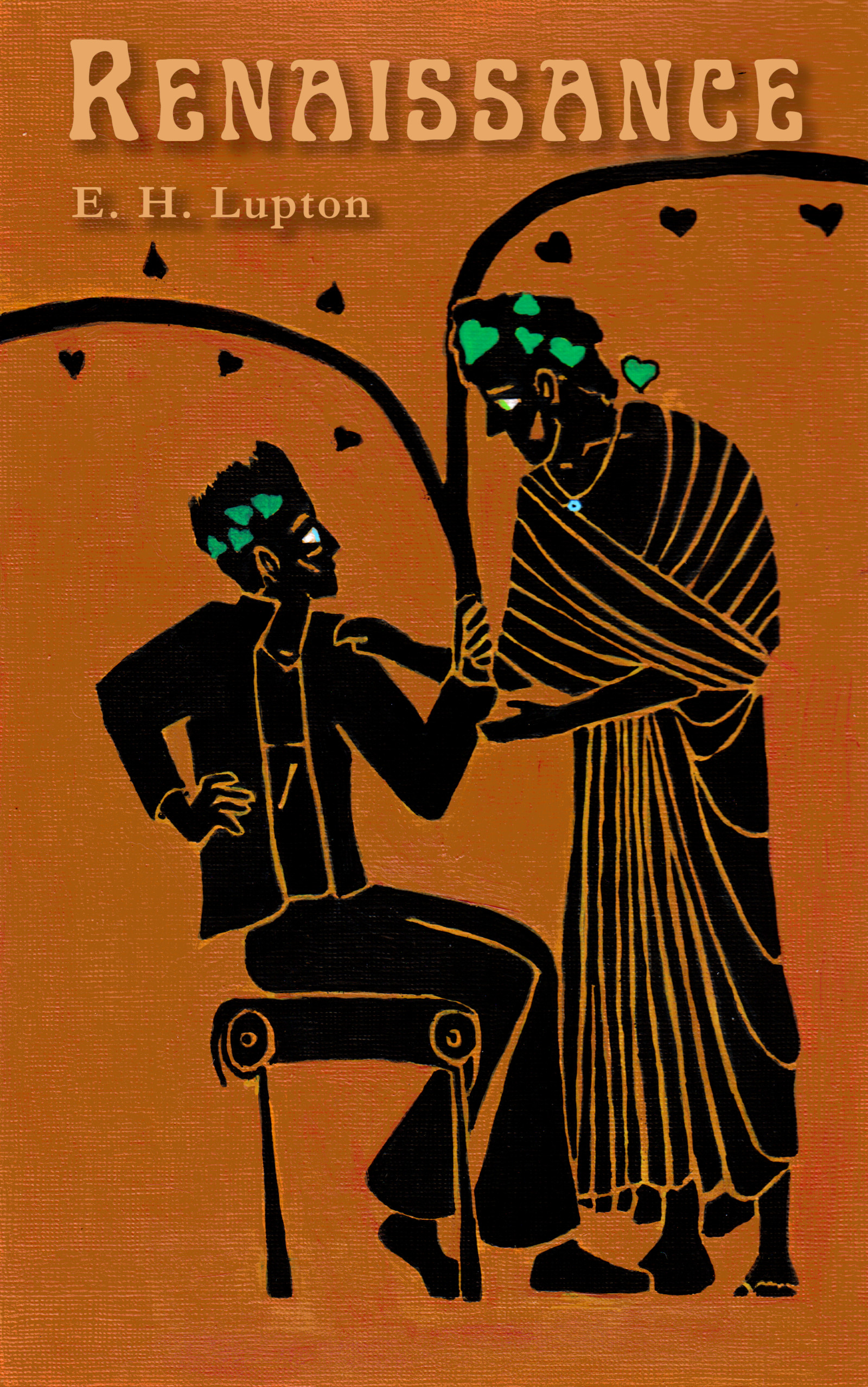
Renaissance, by E H Lupton. Greek black figure art; a man wearing a leather jacket sits on a bench holding a thyrsus. A man dressed as dionysus bends over him.

June, 1971. As the academic year draws to a close, Sam and Ulysses are looking forward to a quiet summer. But when Ulysses’s grandmother is hospitalized, it becomes clear that relaxation is not in the cards. Unable to accept that her fall was an accident, Ulysses begins to investigate whether it may be related to a cult from their past whose mysterious and powerful leader seems to be popping up all over town.

Sam’s doing his best to hold things together and be supportive, but it’s hard when his new husband is barely listening and keeping him at arm’s length every time family is concerned. And on top of everything else, the library has something urgent to tell Sam…

As they reunite with old friends and prepare to bid farewell to others, Sam and Ulysses will see their marriage tried, their lives threatened, and meet an old enemy they thought long dead.

If you preorder it, let me know and I will send you one of these postcards for free!
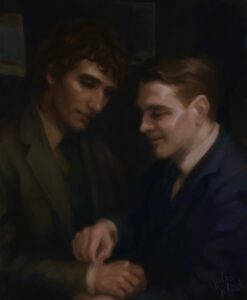
Sam and Ulysses, wearing nice suits. Ulysses is helping Sam with a cuff link. It's a scene from The Alignments.

I know the big issue is that some people really love paperbacks, and I can’t do paperback preorders. But you can still get one!

  • if you buy the paperback in the first month or so and let me know, I’ll send one to you
  • if you come to an in-person sale, you can get one free with purchase (and I have a special Laz postcard too if you buy his book)
  • that’s it I guess

4/ It’s traditional at the beginning of the year for an author to lay out what they’re hoping to accomplish. The last six months of 2025 were quite stressful, riddled with my own illness (I wound up getting diagnosed with asthma); our dog dying; moving one kid to a new daycare; the unexpected diagnosis, decline, and death of a friend; and then immediately thereafter we did two rounds of the flu. As a consequence, my list of goals is a little pared-back. Still, I think it’s not bad:

  • Publish Renaissance in April! I’m really excited about this.
  • Start work on an audiobook version of Dionysus in Wisconsin. It’s time. Doing an audiobook is a little scary, but I love audiobooks so much, and I want my work to be accessible that way.
  • Maybe another short story or novella, I’m not sure yet. I love writing novellas, but I have learned they don’t take less work than novels.
  • The next Laz novel, ideally by the end of the year. This is a book about what happens when you take someone who is already kind of stressed out and on the edge and give him one more thing. Which is currently how I feel. So that should be good.

In a lot of personal ways, 2025 was not a great year. I prefer less fascism, less strife, fewer deaths among my friends. But it was also a fun and productive year—I published Lazarus, Home from the War, a book that went on to be named to the best of 2025 list by the biggest romance podcast out there. I published “Sparking Something,” which is a moody little AU scene that I really enjoyed working on. And I published The Alignments, which came out so much more awesome than I thought it would. I edited and put out seven episodes of the podcast, which is not what we usually shoot for but considering everything? I think I’m happy.

It was a year where there was a lot going on, and I think I’m proud of myself for getting through it. I’m glad you all got through it too, even if you’re feeling bruised by what you went through. I hope you have had some time off to recover, whether that meant making cookies and going to see friends or sitting in a darkened room listening to The Mountain Goats and reading hockey romances. (I have done both of these lately.) And I hope that if you had a 2025 like mine, you have a better 2026. I don’t necessarily have any clever reasons to hope that 2026 will be better, I just think at least it’s going to be different, which can be its own type of better.

Upcoming Events
In ten days, I’ll be presenting at the Wholehearted Writers Week!

At the end of next week, I’ll be selling books at the Well-Red Damsel’s Damsels Not in Distress event (January 18), which combines sword yoga with a romantasy book sale. There are yoga classes offered at 10, 11:30, and 1pm; the book sale is 11am-3pm. If tickets are still available, they’ll be here. I do not know what sword yoga is. It sounds fun? The event will be held at the Baird Center in Milwaukee (400 W. Wisconsin Ave.). You can also check out the Well-Red Damsel’s website here. We will also have some little felt things (hopefully bookmarks!). I do not know if the print copies of The Alignments will have arrived or not. Check my social media for updates closer to the date.

More events in March, but I won’t bother you with them just now.

No book reviews this month, because I just posted my list of everything I read in 2025. See you in February!
Books of 2025

For those who are really interested in what writers read. This year, I read a lot of somewhat random romances because I swung hard into audiobooks. My library generally has crummy waiting times for queer romances, but when I sorted by “available now,” I found a few interesting ones.

Organized by genre.

Romance

  1. You Should Be So Lucky, by Cat Sebastian (m/m, both cis). I don’t care about baseball but this was good. (Reread.)
  2. The Secret Lives of Country Gentlemen, by KJ Charles (m/m, both cis). I read the second one first, so I knew how this ended, which was good because it was very tense there for a moment.
  3. The Sugared Game, by KJ Charles (m/m, both cis). Love Will Darling. (Reread.)
  4. Subtle Blood, by KJ Charles (m/m, both cis) (Reread.)
  5. True Pretenses, by Rose Lerner (m/f, both cis). I had a lot of problems with the use of some antisemitic tropes here. But the characters are compelling.
  6. Hither, Page, by Cat Sebastian (m/m, both cis). Another reread. Very lovely and quiet.
  7. Never Judge a Lady by Her Cover, by Sarah MacLean (m/f, both cis). Look, MacLean writes very particular stuff. I wish this one specifically had allowed the FMC to be less gender? And the implicitly gay viscount should have gotten a happy ending.
  8. Bombshell, by Sarah MacLean (m/f, both cis). Early Victorian feminist revenge fantasy rather than actual historical romance, but not in a bad way.
  9. Lord of Darkness, by Elizabeth Hoyt (m/f, both cis). A well-written excursion into definitely not my thing.
  10. Nine Rules to Break When Romancing a Rake, by Sarah MacLean (m/f, both cis). Also wish there had been a lot less gender in this one.
  11. Sailor’s Delight, by Rose Lerner (m/m, both cis). Another Jewish character, and it’s really well done! Closed door, I wish it wasn’t, just for reasons of closure.
  12. A Gentleman’s Gentleman, by TJ Alexander (m/m, both trans). There is one major historical…call it a choice that isn’t in accordance with reality, let’s say, and if you can get past that, I think you will enjoy it. More than that, I think it is worth trying to suspend your disbelief and getting to know this book, because there’s a lot of interesting stuff here (philosophically) and there’s a lot of fun stuff (the actual plot).
  13. The Queer Principles of Kit Webb, by Cat Sebastian (m/m, both cis, one of them is bi). The rare reread where I think I liked parts of it better and parts of it worse on the second go-round. It doesn’t really work on its own as well as I initially thought.
  14. The Perfect Crimes of Marian Hayes, by Cat Sebastian (m/ bi f, both cis). A reread where I came out loving it. Let Marian do crimes! She’s good at it. And she could use a treat.
  15. Wilde in Love, by Eloisa James (m/f, both cis). James doesn’t really care about historical accuracy, and no one has a problem that can’t be solved by having a lot of money and smiling winningly at people. This series would be better with a couple of queer characters in the mix to up the camp levels, but it’s already so silly and fluffy, I don’t know what to do.
  16. Too Wilde to Wed, by Eloisa James (m/f, both cis)
  17. Born to be Wilde, by Eloisa James (m/f, both cis)
  18. A Caribbean Heiress in Paris, by Adriana Herrera (m/f, both cis). I wish she had subverted some of the more problematic tropes she’s playing with (like protective man/weak lady in need of protection–girl never even got to shoot anyone despite carrying a pistol the whole time!), but the way it addressed race, class, and colonialism was tremendous.
  19. Mr. Collins in Love, by Lee Welch (m/m, both cis). Remember Mr. Collins from Pride and Prejudice? Remember hating him for proposing to Lizzy badly and being kind of a doofus? Turns out he’s an anxious wet cat. This is a really daring little novella, and Welch totally pulls it off.
  20. Seducing the Sorcerer, by Lee Welch (m/m, both cis). Um…does what it says on the tin. Read it while I was sick and up nights, and it was great. There was a magic horse made of an old burlap sack. In the way that horses aren’t just a mode of transportation for a historical story but a character, it really becomes a character, and I loved it so much.
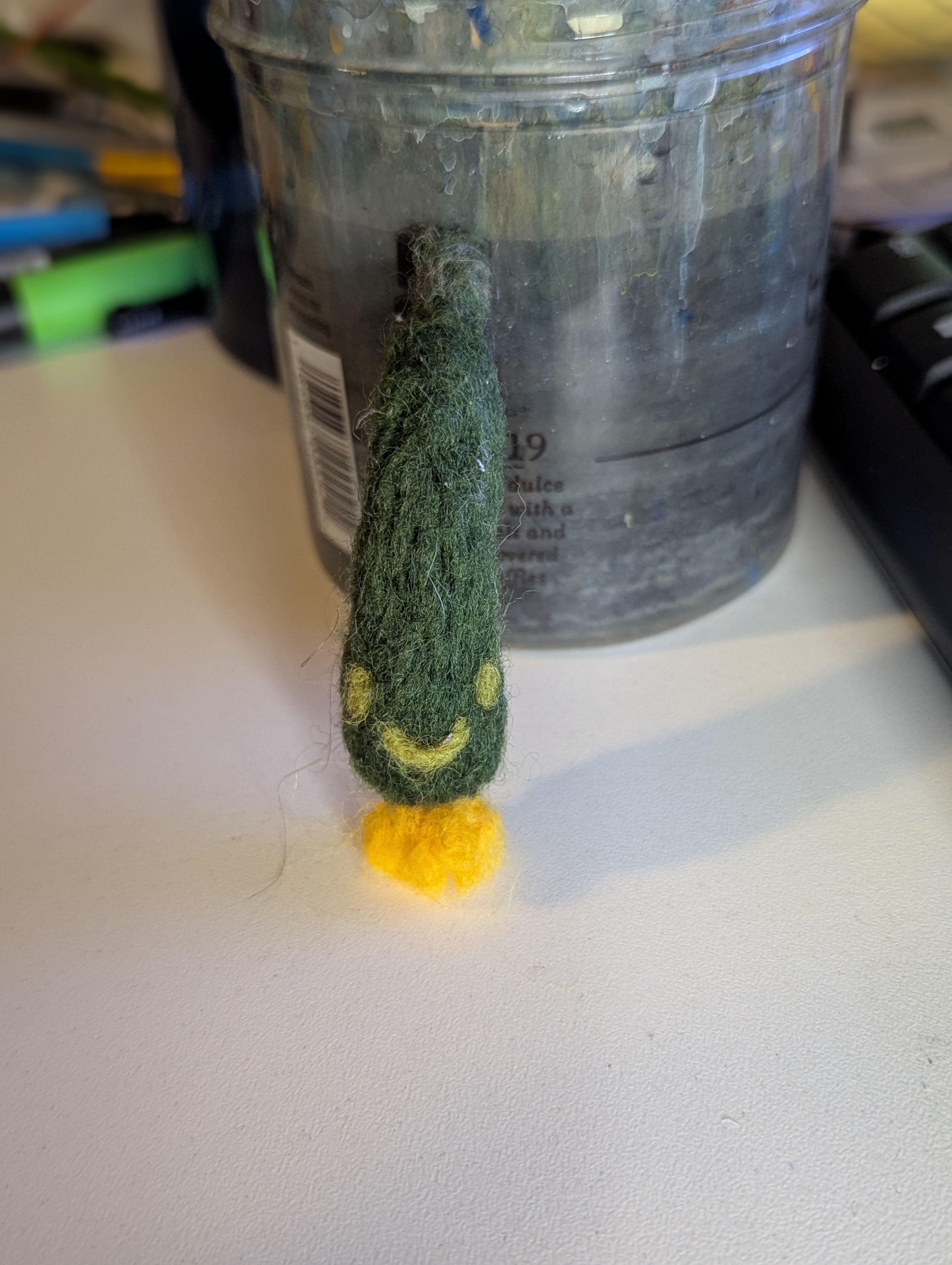
  21. The Barkeep and the Bro, by AJ Truman (m/m, both cis). A contemporary romcom, which was always going to be a hard sell, and indeed it didn’t work for me. This is an age gap, forbidden boss/employee, daughter’s ex-boyfriend, gay-or-possibly-bi-for-you book, and the tropes kind of took over. But because I read it and mentioned it to a friend, I was given a felted zucchini. (There is a scene in the novel in which a zucchini figures prominently.) So. Take that as you will.
  22. Paladin’s Grace, by T. Kingfisher (m/f, both cis). These books (yeah, I read all four) are all so fun and funny. The world reminds me a bit of Terry Pratchett.
  23. Paladin’s Strength, by T. Kingfisher (m/f, both cis). I liked this one the best. 
  24. Paladin’s Hope, by T. Kingfisher (m/m, both cis). I was disappointed that this is the shortest of the books.
  25. Paladin’s Faith, by T. Kingfisher (m/f, both cis). Probably the best plot of the four books in the series but my least favorite romance. Honestly I’m not sure these actually qualify as romances? They might be fantasy novels with romantic elements. 
  26. Husband of the Year, by MA Wardell (m/m, both cis). I still don’t really read contemporary, but this was nice–Jewish guy in interracial relationship gets married and adopts his husband’s nephew. More serious stuff than I expected from a romcom, but it tends to flinch away from any kind of real conflict; either you will like that or you won’t.
  27. Breakout Year, by KD Casey (m/m, both cis). A sweet Jew4Jew sports romance that was somewhat oddly shaped, story-wise. A little squishy in the middle, but Casey writes a delicious sentence, and ultimately it was enjoyable.
  28. Home Ice Advantage, by Ari Baran (m/m, both cis). A former NHL star becomes the head coach of his hometown team and winds up falling for the (Jewish) assistant coach who got overlooked for the job. I know even less about hockey than I do about baseball, but the emotional arc here was delicious and subtle.

A felt zucchini (green), with yellow blossom at one end. It is smiling.

Scifi/Fantasy/Horror

  1. Gideon the Ninth, by Tamsyn Muir. Lesbian space Jesus saves the planet with swords.
  2. Harrow the Ninth, by Tamsyn Muir. Ten thousand years is exactly the amount of time needed to develop the most toxic workplace in the universe.
  3. Nona the Ninth, by Tamsyn Muir. What if instead of gender, we had swords, ghosts, and spaceships?
  4. System Collapse, by Martha Wells. I think this is the one I got hit by a car while I was listening to the audiobook. So, uh. Distracting.
  5. All Systems Red, by Martha Wells. Reread. If I had Kevin R. Free dollars, I’d hire him to do my audiobooks. I also read this aloud to my 8yo. I read this book probably too many times in a short period. It impressed me more after having read through all the other books.
  6. Artificial Condition, by Martha Wells. Reread.
  7. Fugitive Telemetry, by Martha Wells. Reread.
  8. “Home, Habitat, Range, Niche, Territory,” by Martha Wells. Technically a short story. Also a reread?
  9. The Haunting of Hill House, by Shirley Jackson. Masterful. More queer than I remembered. Technically this was a reread but I read it the first time when I was maybe 20.
  10. The Masquerades of Spring, by Ben Aaronovich. I want to recommend this to everyone. Delightful and funny. Like Wodehouse but add Americans, race, queerness, magic, and jazz.
  11. We Have Always Lived in the Castle, by Shirley Jackson. Look, Merricat should be allowed to murder all those dreadful people. As a treat.

Plays

  1. The Bacchae of Euripides: A Communion Rite, by Wole Soyinka. He really gets Dionysus and creates a great, very dark, comedy.
  2. The Bakkhai, by Euripides, trans. by Anne Carson. Not as good as Soyinka’s. Sorry, tumblr. Get your “not for me…not if it’s you” out of here, Anne Carson.
  3. Father Comes Home from the War, by Suzan-Lori Parks. She’s one of the top playwrights of our modern times and this is a banger.
  4. We Bombed in New Haven, by Joseph Heller. Not famous for a reason.

Mysteries

  1. No. 1 Ladies’ Detective Agency, by Alexander McCall Smith. Is it a mystery? There’s a detective. But it’s a wonderful portrait of a time and place he clearly loved.
  2. Fer-de-lance, by Rex Stout. Very clever, a little racist and sexist.
  3. Fadeout, by Joseph Hansen. When I was getting sick in August, I spent a lovely rainy morning reading this in my brother’s sunroom while the kids ran around playing. Also it’s a nice California noir.
  4. Lavender House, by Lev AC Rosen. Rosen is way more about vibes than about creating a mystery that wraps up well. And the vibes are good! I was just left with a lot of questions.

Nonfiction

  1. Ghostland: An American History in Haunted Places, by Colin Dickey. Very interesting. 
  2. Hi Honey, I’m Homo: Sitcoms, Specials, and the Queering of American Culture, by Matt Baume. I had a lot of thoughts about how you get to see what they want you to see. But mostly I was left imagining showing Bewitched to Ulysses, and I couldn’t stop laughing.
    • No, okay, I guess I am going to talk about this. When you watch TV (and this is still true even with streaming), what you see is the shows they decided to make. Obviously. But why do they decide to make a show? It’s because they (they being network executives) do a complex calculation that boils down to “what will catch the public’s imagination such that we can make a boatload of dollars from this?”
    • And a lot of this is predicated on this idea of what “middle America” wants. (What is “middle America”? I feel like I live there? But also where I live, I have a lesbian mayor, a lesbian senator, and a gay congressperson.)
    • Anyway, whenever you’re asking, “Why weren’t there any gay main characters on TV before Will and Grace?” the answer is basically an exec thought that “middle America” wouldn’t like it. Even getting queer recurring characters or story lines that painted queer guest stars as sympathetic could be a stretch during some periods.
    • And now we have had a mainstream sitcom with a married gay couple who adopts a child and they’re main characters in the show, yay progress.
    • But if you think about this, and think about the world, and the vastness of the stories that are never being told because someone thinks they won’t be profitable stories, it gets very sad. I feel very tinfoil hat-y when I talk about it, but the censorship freaks me out. Not the “pulling your book out of a library” censorship, which is devastating, but the “we are going to ignore your ideas and not give you a chance” censorship.
    • Anyway, yay, self-publishing?
  3. “Appropriating the Golem, Possessing the Dybbuk: Female Retellings of Jewish Tales,” by Ruth Bienstock Anolik. Modern Language Studies, vol. 31, no. 2 (Autumn 2001): pp. 39-55.
  4. Alone, Unarmed, and Unafraid: Tales of Unarmed Reconnaissance During Vietnam, by Taylor Eubank. Engaging, but I don’t know if I recommend it.
  5. Three Men in a Boat (To Say Nothing of the Dog), by Jerome K. Jerome. Is this nonfiction? I don’t know. I had an abridged audiobook narrated by Hugh Laurie. I wish he’d done the whole thing.
  6. Things I Overheard While Talking to Myself, by Alan Alda. I’m not big on celebrity memoirs but this was good. Alda is an old school, fought-for-the-ERA liberal, and I love him.
  7. You Could Make This Place Beautiful, by Maggie Smith. A divorce memoir. I…wish she’d just hate him. Or talk more about craft, because she obviously wants to. But as it stands, it was good but felt a little like Swiss cheese?
  8. An Unfinished Love Story: A Personal History of the 1960s, by Doris Kearns Goodwin. I cried, even though I knew who died and when. For example, her husband Dick Goodwin was at the White House getting the East Room ready when they brought Kennedy’s body back from Dallas to lie in state. Everyone was so young and idealistic and they worked so hard. The audiobook has clips of the original deliveries of many of the speeches she talks about (including RFK [original recipe] talking about the death of MLK Jr. on the campaign trail in Indiana the night King died), which was amazing.
  9. A Swim in a Pond in the Rain, by George Saunders. Ultimately I disagree with him about the interpretations of the stories that he offers, and I only sort of like his ideas about how to write a story, but I liked the book. Make of that what you will.
  10. Manhood for Amateurs, by Michael Chabon. An older volume of essays, but one I really enjoyed. Made me laugh aloud at times.
  11. Entangled Life: How Fungi Make Our Worlds, Change Our Minds, & Shape Our Futures, by Merlin Sheldrake. Mushrooms are terrifying, and I’m 20 million microbes walking around in a human suit.
  12. Reading Selfishly: A Craft Journal for Writers, by KD Casey. I don’t think this is officially out yet, but she dropped a link to the first public version on Bluesky, and I think I’m officially a fan.
  13. Crochet Monsters: With more than 35 body patterns and options…, by Megan Lapp. I made four monsters out of this. All in all they were the biggest crochet projects I’ve finished to date. Even with a smallish hook (3.75-4mm), the monsters are all about 8″ tall or more. The book is well laid out, the instructions it offers are easy to parse even for a beginner-to-intermediate crocheter, and there are loads of photos. My kids liked flipping through it and coming up with new monsters, and I didn’t hate making them.

YA Novels I Read Aloud to My Children

  1. Wintersmith, by Terry Pratchett. It was good. I have no notes except that it felt like the main character has out-aged the kid I was reading this to a bit and I want to wait before I read him the next one.
  2. Over Sea, Under Stone, by Susan Cooper. Not as good as The Dark Is Rising. The child still really liked it.
  3. Greenwitch, by Susan Cooper. Very good.
  4. The Grey King, by Susan Cooper. Cooper is a powerhouse. I don’t know what to say. More creepy poems in fantasy novels! (Content warning! There’s a dog that gets shot in this one. I was a little shocked.)
  5. The Hobbit, by JRR Tolkien. Reads aloud well. (Not only was this a reread, this wasn’t even the first time I’d read this aloud.)
  6. The Halloween Moon, by Joseph Fink. If you want a middle-grade YA novel about a Jewish kid, you could do worse.

I Do My Thinking Myself: The Modernist Detective and Raymond Chandler’s The Big Sleep

Chandler, Raymond. The Big Sleep. 1939. Reprint, London: Penguin, 2014.

Philip Marlowe takes a case for an old general by the name of Sternwood. A rich man, Sternwood has two daughters who run wild. He has received some IOUs—a spot of blackmail for one of the daughters (Carmen)—and wants Marlowe to look into it. As Marlowe is leaving the Sternwood mansion, the general’s other daughter, Vivian (Regan) calls him in to ask if he has been asked to find her estranged husband, who departed suddenly not long ago. He hasn’t, but he will before he gets out of the mess he’s just walked into.

The Big Sleep, Chandler’s first novel, furnishes a complex and twisty plot in which bad guys and good guys alike go down like dominoes. A woman’s ex-lover shoots a man who is photographing said woman in the nude and steals the photo plate, only to have it taken from him. The thief gets killed by the dead photographer’s lover; then the thief’s girlfriend tries to sell some information about the vanished husband’s ex-lover and winds up getting her intermediary killed by the ex-lover’s bodyguard . . . there’s more, but maybe I’ve made my point. At every turn, wisps of truth float through Marlowe’s fingers as he tries to figure out who knows what and who’s lying to him (hint: it’s almost everyone).

The book is set quite firmly in Los Angeles in the 1930s. Prohibition is over and so, largely, is the recession; the oil derricks[1], which were responsible for putting the city on the map, are beginning to lose their primacy on the landscape, and the place is starting to grow rapidly. Not every detail of the book holds up well by modern standards. For example, the amount of fuss Marlowe kicks up about some pornographic books seems silly by the standards of the internet. A young woman being photographed nude is potentially a major scandal, whereas today it can make someone’s career. There’s a gay character who isn’t treated very well (although to be fair, when Marlowe chews him out, he has just murdered a man in front of Marlowe), and there’s a somewhat perplexing racial slur.[2] In addition, the question of who killed the chauffeur is famously left unresolved—however, I have to admit that had I not read an anecdote in which Chandler confessed to not knowing either, I likely wouldn’t have noticed that detail. Throughout, if these petty complaints ever threaten to overwhelm the story, Chandler throws in another beautifully crafted line to make the reader forget her complaints—although calling them lines fails to acknowledge how masterful his prose is in sum, how well-chosen each word is.

At the end of the book, we leave Marlowe in a bar in something of a moral quandary. Midway through the book, he mentions a chess board in his room: “There was a problem laid out on the board, a six-mover. I couldn’t solve it, like a lot of my problems. I reached down and moved a knight. . . . The move with the knight was wrong. I put it back where I had moved it from. Knights had no meaning in this game. It wasn’t a game for knights” (168–170). By the final pages, Marlowe has taken over the role of the knight, and in doing so proved himself correct. He cannot apprehend the murderer or even reveal the location of the murdered man’s body lest he give the game away. All his attempts to protect the general and his daughters have backed him into a corner. And so he drinks and ruminates fatalistically on death, “the big sleep” (250). This paralysis is intentional. In effect, Chandler is producing a treatise on the modernist detective novel, and does as effective a job in defining it as he does in his famous essay, “The Simple Art of Murder.”

The Victorian detective, epitomized by Sherlock Holmes, is a figure of romanticized panopticism. No matter how grave or petty a crime is, no matter how complex, Holmes reassures us that the criminal will be found. Marlowe, in his own words, is not Sherlock Holmes: “I don’t expect to go over ground the police have covered and pick up a broken pen point and build a case from it. If you think there is anybody in the detective business making a living doing that sort of thing, you don’t know much about cops. It’s not things like that they overlook if they overlook anything” (131). Later he adds, “I’m a very smart guy. I haven’t a feeling or a scruple in the world. All I have the itch for is money. I am so money greedy that for twenty-five bucks a day and expenses, mostly gasoline and whisky, I do my thinking myself, what there is of it: I risk my whole future, the hatred of the cops and of [gangsters]. I dodge bullets and eat saps and say thank you very much” (247–248). Unlike the comparatively aloofness of earlier detectives (such as the aforementioned Holmes; Philo Vance, who is also namechecked by Marlowe; or C. Auguste Dupin) who never get their hands dirty, Marlowe cares about his cases and spends his time sticking his nose in where it’s not wanted. He also reflects on the process of detection and how it has been represented to his clients.[3] The world has changed a lot since 1893; on the eve of the second World War, there are no reassurances to be found.

Ultimately I don’t think this is Chandler’s greatest novel—I’d give that accolade to The Long Goodbye—but don’t let that hold you back from reading it. Chandler, even on a bad day, is better than most contemporary writers could ever hope to be.


[1] Mentioned recently on Marketplace.

[2] Perplexing in that I’ve never seen an expression like that used. It was clear from context that it was slightly derogatory in some way.

[3] If the modernist detective novel is characterized by a greater degree of self-reflection, a willingness to get one’s hands dirty, and yet a feeling of futility or of being trapped by the situation in which one finds oneself, the postmodern detective novel is characterized by a broadening of focus in an attempt to solve crimes by looking at the ills of the society that produced the criminal, or by a sense that crimes are in some sense unsolvable. I’ll get back to you about the post-postmodern (i.e., contemporary) detective novel.

Episode 3: Proteus

Okay, so if you are reading through Ulysses as I am posting these, this is probably the first section that you really run the risk of getting hung up on. The language and style here are a bit more complicated than in previous sections, and if you aren’t accustomed to reading things in stream of consciousness, it can be disconcerting, to say nothing of the subject matter being outside most people’s familiarity. Don’t panic though—once you get into it, this section is great, and it’s not as difficult as you may be thinking right now.

Basically what happens in this section, and I don’t want to over-simplify, is that Stephen is killing time before he meets Buck, so he walks along the beach at Sandymount Strand and thinks about philosophy. He remembers his time studying in Paris and his father recalling him to Dublin because of his mother’s illness. He writes a poem. He urinates.

20140623_102802
Edgar, playing the role of Stephen, shows how much physical action goes on in this episode.

Why do these few things seem intimidating? Moreso than the previous chapters, Joyce has here used a style called stream of consciousness, which can be disconcerting to the uninitiated reader. Stream of consciousness is a technique used for providing readers with a window to the character’s interior world; however, it is not simply as straightforward as having a character essentially “say” what they are thinking. Contrast the two following paragraphs:

One summer afternoon Mrs Oedipa Maas came home from a Tupperware party whose hostess had put perhaps too much kirsch in the fondue to find that she, Oedipa, had been named executor, or she supposed executrix, of the estate of one Pierce Inverarity, a California real estate mogul who had once lost two million dollars in his spare time but still had assets numerous and tangled enough to make the job of sorting it all out more than honorary. Oedipa stood in the living room, stared at by the greenish dead eye of the TV tube, spoke the name of God, tried to feel as drunk as possible. But this did not work. She thought of a Lotel room in Mazatlán whose door had just been slammed, it seemed forever, waking up two hundred birds down in the lobby; a sunrise over the library slope at Cornell University that nobody out on it had seen because the slope faces west; a dry, disconsolate tune from the fourth movement of the Bartók Concerto for Orchestra; a whitewashed bust of Jay Gould that Pierce kept over the bed on a shelf so narrow for it she’d always had the hovering fear it would someday topple on them. Was that how he’d died, she wondered, among dreams, crushed by the only ikon in the house? That only made her laugh, out loud and helpless: You’re so sick, Oedipa, she told herself, or the room, which knew. (Pynchon, 1965, 1–2)


His gaze brooded on his broadtoed boots, a buck’s castoffs, nebeneinander. He counted the creases of rucked leather wherein another’s foot had nested warm. The foot that beat the ground in tripudium, foot I dislove. But you were delighted when Esther Osvalt’s shoe went on you: girl I knew in Paris. Tiens, quel petit pied! Staunch friend, a brother’s soul: Wilde’s love that dare not speak its name. His arm: Cranly’s arm. He now will leave me. And the blame? As I am. As I am. All or not at all. (3.446–52)

In both paragraphs, we see the character’s environment and hear her/his thoughts. But Oedipa’s thoughts are to a point (the death of Pierce Inverarity and her history with him), while Stephen’s thoughts wander from his shoes[1] to a woman he knew in Paris to a literary allusion boyhood friend (Cranly). Oedipa’s thoughts are also marked out with certain guideposts, words like “supposed,” “thought,” “wondered,” while Stephen’s thoughts arise more organically from the paragraph.

Joyce’s version is more accurate, in my (limited?) experience as a thought-having human being. Most people don’t think in straight lines and in sentences. At the same time, Joyce’s version is more difficult and risky. He has to trust that his audience will understand the shift from what Stephen is doing (looking at his boots) to what he is thinking without needing little signposts to mark the way. He doesn’t even typographically set the thoughts off from the narration through the use of italics. This is—in my estimation, at least—gutsy. As a writer, one always worries about the reader understanding what one is trying to do. (I say “one” because as far as I can tell, this is a universal problem.) I admire the panache here as Joyce just throws the chapter out there, like a challenge to his readers. It’s also risky to write an entire chapter with so little movement. The plot, if one can claim Ulysses has a plot, is not advanced here in any significant way. Primarily this is a full chapter of character development; more than that, as Stephen cools his heels, we are also killing time. It is risky to slow down the story like that—when you lose your momentum, you risk boring your audience and losing them as well. But the fascinating use of language here keeps us reading. (Or keeps me reading, at least.)

So how as a reader do you deal with the mélange of thoughts, memories, and even bits of external narration found here? I have tried two different strategies. The first is to get a copy of the Gifford and look everything up. Gifford is quite thorough in this episode—though it is only a bit more than 500 lines, he offers twenty-two pages of notes. Nearly every line seems to be noted. On the other hand, you can also just forge ahead and let the text wash over you. Although if you read what I just said about the Gifford you may be shaking your head, I think this is a tenable strategy. The stuff in the notes is largely interesting but not essential to understanding the text—sure, it is nice to get a translation of the few French phrases, or to know that “lawn Tennyson” (3.492) is a play on the game of lawn tennis and Alfred, Lord Tennyson, but these things are not essential to understanding what is going on, they only enrich the experience. I do encourage you as a reader just to dive in; you may not get every reference, but you will get the gist of what is going on, and some of the references will become more clear as you go on in the book.[2]

I have one other thing I want to discuss, and that is Stephen’s poem. I will quote it here:

He comes, pale vampire, through the storm his eyes, his bat sails bloodying the sea, mouth to her mouth’s kiss. (3.397–8)

Joyce actually wrote two books of poetry[3]. I haven’t made a thorough investigation of them, but I don’t recall being blown away by the ones I did read.[4] This poem in particular is a derivative work—Gifford refers to it as “a souped-up . . . version of the last stanza of ‘My Grief on the Sea,’ a poem translated from the Irish by Douglas Hyde” (1988, 62). It is one of the marvelous Joycean ironies of this book that while Stephen-who-is-Joyce is lying on the beach writing these kind of wretched poems, Joyce himself is writing this amazing chapter that is actually quite poetic in much of its language and that is also such a break from what came before in so many ways.[6]

This has been a shorter essay than some of the others, I think. Not to suggest that this episode is less good, but I have less to say about it because I can either talk about these general things or give a sort of line-by-line discussion of what I’m enjoying,[7] which could be a bit tedious. Next time though, we get to Mr Leopold Bloom, and I am excited to talk about him, so make sure you tune in—same blog time, same blog channel.

Notes

[1] Could we take a moment to admire the shoe-related puns here? Stephen is wearing shoes given to him by a friend (I assume Buck Mulligan, owing to remarks in ep. 1 on other clothes he has given Stephen, plus the phrase “a buck’s castoffs,” but the text seems to be nonspecific), and could potentially be addressing his remarks (the “you”) to either the friend or the shoes. When he says, “Staunch friend, a brother’s soul,” he could be referring to Mulligan, or to the shoes themselves, which also have a soul (sole).

[2] Your goal in general should be to make it as far as episode 17 (Ithica). That episode will explain a lot.

[3] Chamber Music and Pomes Penyeach.

[4] Wikipedia notes that many of his poems are still in print in anthologies today, and that some of the poems in Chamber Music were widely regarded as being technical masterpieces. It also notes that in 1909, Joyce wrote to Nora Barnacle[5] that “When I wrote [Chamber Music] I was a lonely boy, walking about by myself at night and thinking that one day a girl would love me” (Source). That is such a lovely sentiment I take back any of the mean things I said.

[5] The woman he eloped with after going on a first date with her on June 16, 1904, which PERHAPS NOT COINCIDENTALLY is the day Ulysses is set on. They actually didn’t get married until 1931, despite having two kids in 1905 and 1907 respectively.

[6] Except possibly Tristram Shandy? Hm.

[7] I cannot believe I wrote over a thousand words and didn’t find a way to work in a brief discussion about the beach being full of clammy sand (“His blued feet out of turnedup trousers slapped the clammy sands . . .” [3.370–1]). It’s clammy because it’s coldish and dampish, and it’s clammy because it’s a beach and there are clams in it. YES.

References

Gifford, Don, with Robert J. Seidman. Ulysses Annotated: Notes for James Joyce’s Ulysses. 2nd ed., rev. and exp. Berkeley: University of California Press, 1988.

Pynchon, Thomas. The Crying of Lot 49. New York: Bantam, 1965.

Episode 2: Nestor

This is a short episode but one in which many of the novel’s famous lines occur.[1] Here we see Stephen Dedalus as a teacher in a boys’ school, teaching history, literature, and maths to his students. After they go outside for a field hockey game, Stephen talks to his boss, the headmaster Mr. Deasy, about various topics—money, the English, religion, and foot-and-mouth disease. On this last topic, Mr. Deasy asks Stephen to take some letters to newspaper editors he knows, and Stephen agrees. As he leaves, Mr. Deasy chases him down to offer one last (anti-Semitic) joke.

There is a lot to talk about here in terms of colonialism—Stephen teaching his students the history of ancient Greece, his inner thoughts on Haines’s remarks in the previous section, his recollection of seeing a Siamese person working in the library in Paris in which he was studying,[2] the boys playing field hockey (an English game) rather than hurling (a somewhat similar Irish game), Mr. Deasy’s reverence for all things British (up to a picture of Albert Edward on his wall[3]), and so on. There’s a lot to say also about the father-son connections—as Tindall observes, Deasy (pronounced like “daisy”) seems to want to be a father figure to Stephen, who rejects his advances; Deasy’s name seems to prefigure the appearance of Leopold Bloom (who occasionally goes by the pseudonym “Henry Flower,” but we’ll come to that in time),[4] who will serve as a better (?) father figure to Stephen. There’s a lot about religion and a lot of pretty clear parallels to the Odyssey (Deasy represents Nestor to Stephen’s Telemachus). But I’m not going to talk about all of that right now, or not directly, though I’ll come back to some things later on. I’m going to talk about this line:

—History, Stephen said, is a nightmare from which I am trying to awake. (2.377)

What does this mean? Don Gifford notes that it is a reference to Franco-Uruguayan poet Jules Laforgue, who wrote, “ ‘La vie est trop triste, trop sale. L’histoire est un vieux cauchemar barioléqui ne se doute pas que les meilleurs plaisanteries sont les plus courtes’ (Life is very dreary, very sordid. History is an old and variegated nightmare that does not suspect that the best jokes are also the most brief)” (1988, 39). This is interesting but unilluminating. Tindall notes that the entire chapter is about history—in fact, it is listed as the “art” of the chapter on the schemas. “To [Stephen] the past is intolerable, its shape arbitrary, its materials fictive and uncertain . . . Confined to time and space, history is impermanent and unreliable” (1959, 141). But this again is mostly a restatement of what Stephen is actually saying, rather than an explanation thereof.

So what does it actually mean? Deasy provides a clue when he replies, “The ways of the Creator are not our ways . . . . All human history moves towards one great goal, the manifestation of God” (2.380–1). This is a very Victorian view of history, although Gifford traces it all the way from Augustine of Hippo through Giordano Bruno to Georg Wilhelm Friedrich Hegel himself (1988, 39). By contrast, Stephen’s view is much more modernist verging on post-modern[5]: rather than being a progression toward something, history is instead the nearly random actions and reactions of a disparate group of people with variable motives, terrible and uncontrollable.[6] For a writer, there are some interesting implications to this. Stephen is, of course, denying the idea of destiny, but maybe there’s more than that. Books, after all, contain a plot wherein actions within a narrated time stream take place in a certain order and come to a conclusion. In a certain sense, because the plot is created by someone outside the novel, the conclusion is in fact a preordained final point toward which the rest of the book works. By awakening from the “nightmare” of history, Stephen can perhaps step outside this emplottedness and write something different, something that similarly lacks destiny.

Reading Stephen as Joyce, of course, we can say definitively that he did manage this with Finnegans Wake.[7] But that’s breaking the fourth wall a little bit. And it’s also not entirely fair, because obviously when he was writing this, Joyce didn’t know that he was going to write Finnegans Wake. But if he really did go out to “Forge in the smithy of [his] soul the uncreated conscience of [his] race” (Portrait, 275–6), I suppose we can guess that he probably had something brewing.[8]

There’s one other thing I want to talk about with regards to this episode, which is movement. In the whole section, Stephen stands in his classroom, goes to Mr. Deasy’s office, and then walks out of the school. There is absolutely nothing remarkable here—very little movement, some strained conversation without much in the way of emotion or really description, but yet through what Joyce refers to as a personal catechism,[9] we as readers not only get a good sense of Stephen’s emotions, but we tacitly understand that this is somehow his last day of this. He is leaving the school. As he declared in the first episode that he won’t return to the Martello tower, he also won’t return to the school. I’m not the only one who senses this, by the way—Tindall also remarks on it (1959, 141). This is thematically appropriate somehow—the first part of Ulysses seems to concern death: the death of Stephen’s mother, the funeral Bloom attends, and also the death of certain parts of Stephen’s life—he is leaving the tower, leaving his job. He has reached a certain point of life—I can certainly relate to this feeling—where the things of his youth no longer fit, yet he doesn’t quite know which of the trappings of adulthood he’s reaching for—he doesn’t know what he’s going to be yet.[10]

Where is he going? What will become of him? Tune in tomorrow for the next episode.

Notes

[1] The assertion that these are famous lines is made in the Ulysses Wikipedia article and is uncited. But I think it’s true. (See Wikipedia ).

[2] I feel like I should comment on this, even if only to say that yes, there were a lot of Siamese students (mostly the children of elites, including many of King Chulalunkorn’s (Rama V’s) sons studying in the West during the late Victorian period. The crown prince, Vajiravudh, who would become Rama VI, lived in the UK from 1893–1902ish and took a degree at Oxford in law and history.

[3] Prince Albert Edward was Edward VII (r. 1901-1910); his son Albert Victor was possibly somehow mixed up in the Jack the Ripper killings but probably just a somewhat weird product of royal inbreeding. See also my essay on From Hell, “That Sick Feeling: From Hell Reviewed.”

[4] Leopold Bloom is our Odysseus to Stephen’s Telemachus, but we won’t meet him until episode 4.

[5] That’s right, I said post-modern. I’ll talk a little more about the (surprisingly many) po-mo aspects of the book later on.

[6] As Amy Fish at the Modernism Lab at Yale University points out, Ulysses was composed directly after World War I, a time when the idea that things were going in a planned direction seemed especially ludicrous.

[7] Damn, I said I wasn’t going to talk about the po-mo stuff until later on. Also I should point out that in a sort of weird ironic counterpoint to my suggestion that the Wake is something different from the nightmare of history qua novel plots, it’s about one man dreaming all of human history. I think.

[8] Or, that is to say, he may have had an idea of the direction in which he wanted his literary project to move. For the uninitiated, I didn’t mention this before, but you should know that Ulysses is sort of a sequel to A Portrait of the Artist as a Young Man, which was originally the (unpublished) book Stephen Hero, and the character of Stephen Dedalus is a somewhat thinly veiled (or, say, semi-autobiographical) version of Joyce himself, who at one point used the name “Stephen Daedelus” as a pen name.

[9] This is the term he uses in the Gilbert schema (here).

[10] I apologize for my gratuitous use of the em dash in that last sentence.

References

Fish, Amy. “Nestor.” The Modernism Lab at Yale University. http://modernism.research.yale.edu/wiki/index.php/%22Nestor%22. New Haven, CT: Yale, 2010.

Gifford, Don, with Robert J. Seidman. Ulysses Annotated: Notes for James Joyce’s Ulysses. 2nd ed., rev. and exp. Berkeley: University of California Press, 1988.

Joyce, James. A Portrait of the Artist as a Young Man. Edited, with an introduction and notes by Seamus Deane. New York: Penguin, 2003.

Tindall, William York. A Reader’s Guide to James Joyce. New York: The Noonday Press, 1959.

Dogs ChasingHappy Bloomsday, everyone!


Episode 1: Telemachus

I hope you have all had a chance to read the first episode. Check the project’s introduction for an explanation and links.
My primary copy of Ulysses.

Stately, plump Buck Mulligan came from the stairhead, bearing a bowl of lather on which a mirror and a razor lay crossed. (1.1–2)

My main copy of Ulysses (of course I have more than one) is rather heavily annotated at this point. The first marginal notation I come across here says “State-cross: Locate S [Stephen] w/in historical/political terms—G.B., HR Church.” I don’t know where this insight came from, probably the professor who gave the course in which I first read this book[1], but it’s a very interesting idea. Look at the sentence again:

Stately, plump Buck Mulligan came from the stairhead, bearing a bowl of lather on which a mirror and a razor lay crossed.

Lest you think this is grasping at straws, Stephen later reiterates it in conversation: “I am a servant of two masters . . . an English and an Italian. . . . The imperial British state . . . and the holy Roman catholic and apostolic church” (1.638–43).[2]

Ireland in 1904 was a colony of Great Britain. It’s not the sort of colony we usually think of when we talk about colonialism, because nowadays the Irish are seen as white and colonialism is something that white people do to non-white people (for example, the French in Algeria, the Belgians in the Congo, the French in Indochina, the British in India, the British in Burma). But the British have very much colonized Ireland and were governing them. On the other hand we have the Roman Catholic Church (or Holy Roman Apostolic Church, as Stephen Dedalus would refer to it), which exercised at the time (and for most of the 20th century and on into the 21st) enormous power over the people of Ireland. One thing I’m going to argue in this essay is that there are strong colonialist themes running through this book. This is not a controversial claim—a cursory search of the internet provides a number of papers, such as Roghayeh Farsi’s “James Joyce’s Ulysses: A Post-Colonial Text,” which argue essentially this. Worth noting is that Joyce began writing in 1918, shortly before Ireland declared its independence (January 1919) and began the Irish War of Independence with Britain; this war concluded around the time Ulysses was published in full (1921 versus 1922). Where is the line between a colonial novel and a post-colonial novel? We must be very close to it.

I’m getting a little ahead of myself. Let me back up a bit. The first three episodes of the book make up the “Telemachiad,” which is to say their focus is on our Telemachus, Stephen Dedalus.

Stephen Dedalus is one of the main characters in the book; in this section we meet two major supporting characters, Buck Mulligan and Haines. They are all three staying together in a Martello Tower, which is one of a bunch of towers put up in Ireland to look out for the possible invasion of Napoleon.[3]

Buck Mulligan is a medical student who is witty, quick to make up songs and ditties, and who holds nothing sacred, as he tells Stephen: “And what is death . . . your mother’s or yours or my own? You saw only your mother die. I see them pop off every day in the Mater and Richmond and cut up into tripes in the dissectingroom. It’s a beastly thing and nothing else” (1.4–6).

Haines, on the other hand, is “a ponderous Saxon [i.e., British] . . . [who is] bursting with money and indigestion” (1.51–2). He is every inch the colonial Brit, although he would no doubt claim himself enlightened. Tellingly, Mulligan observes that Haines’s father “made his tin by selling jalap to the Zulus or some bloody swindle or other” (1.156–7). This is a reflection of British colonialism[4]—the Zulus lived in Southern Africa and were defeated in the Anglo-Zulu War in 1879, which led to the fall of the Zulu empire. Haines is writing about Irish folklore (a book, I believe, possibly related to his degree) and has come to Dublin to do research. It is interesting that he is in fact living with two Irish men, neither of whom is exactly interested in serving as a native informant to him, but both of whom really want something from him—Mulligan wants money, and Stephen wants him to go away[5]. In fact, Stephen and Mulligan’s attitudes toward Haines are well, if unintentionally, summarized by Frantz Fanon in The Wretched of the Earth, when he writes of how native intellectuals are taught by colonialist bourgeois to believe in the ideals of Western civilization, which he describes as existing on a “Greco-Latin pedestal” (46). During the course of the decolonization process, the native intellectual begins to understand how indoctrinated into the ideology of his conquerors he has been, and eventually “he turns himself into an awakener of the people; hence comes a fighting literature, a revolutionary literature, and a national literature” (223).[6] So on the one hand we have Stephen the bard who wants to be rid of the British, and on the other hand Buck Mulligan the medical student who wants to Hellenize Ireland (1.158). What a pair. Haines’s attitude is typically apathetic, saying “An Irishman must think [that he is a servant of the imperial British state], I daresay. We feel in England that we have treated you rather unfairly. It seems history is to blame” (1.647–9). This is, implicitly, the viewpoint Jean Paul Sartre is raging about in his introduction to Fanon’s aforementioned text.[7]

The presence of the Catholic Church should also be regarded as a force for colonization; as Fanon puts it, “The Church in the colonies is the white people’s Church, the foreigner’s Church. She does not call the native to God’s ways but to the ways of the white man, of the master, of the oppressor” (42). And indeed, the Catholic Church’s oppressiveness in Ireland has been well documented (see for example Christopher Hitchens’s article(s) on Mother Theresa, or any of the millions of things written about the Magdalena asylums).

I’m nearly seven hundred words into this section and I have covered about a page and a half of the text. Seems about right. That aside, I think I have begun to make my point about the colonial/post-colonial themes in this episode. This is something that took me very much by surprise when I began re-reading this section, as it happens—in between my previous reading of the book and this one, I spent a great deal of time studying post-colonialism and post-colonial literature, so it really jumped out at me in a way it didn’t before. I will not discuss the next episode here (spoilers!), but suffice to say that these themes continue there in several ways.

In the rest of the episode, the boys have breakfast, get milk from the milk woman, and walk down the shore. They make plans to meet again later for drinks—Mulligan promises Haines that “[Stephen] proves by algebra that Hamlet’s grandson is Shakespeare’s grandfather and that he himself is the ghost of his own father” (1.555–7). Then Mulligan and Haines go to bathe in the ocean and Stephen continues on to work, which takes us to the next episode. Tune in next time!

Notes

[1] I’ll do him the honor of not giving his name here. He probably wouldn’t want to be associated with this kind of project. Also, he was kind of an asshole.

[2] The basic rule of Joycean scholarship is assume everything is intentional, because it generally is. At least, this is my interpretation; I can’t claim to be deeply immersed in the academic side of Joyce at this point.

[3] I recall being told that the Irish were hoping that Napoleon would help to liberate them from the British, but I cannot find a citation for that. However, Gifford does note that the French made four attempts between 1796–8 to provide assistance to the Irish during a revolution (23). For a picture of a Martello Tower and more on their history than is strictly necessary, see their Wikipedia page. Hope that was fun for you.

[4] Edward Said often looks at the small mentions of colonialism that mostly live in the background of British literature, such as the very brief discussion of the slave trade in Jane Austen’s Mansfield Park. Which is to say, this is a brief but important mention.

[5] As with many things in Joyce’s works, this is evidently drawn from an experience he had in which one of the other guests in the place he was staying had a nightmare and fired several shots from his gun into the wall above Joyce’s bed in the night. Joyce noped out in the morning, which is why Stephen expresses to Mulligan that he wants Haines to leave and refers to Haines ranting during the night.

[6] Fanon characterizes this as the phases through which a native intellectual passes,[+] however within a single society it does seem possible to see intellectuals who are in different phases simultaneously—for example, see the letters of non-fictional people Mohandas Gandhi and Rabindranath Tagore. (Note to self: add a citation when this book is published.) I have borrowed some of this terminology from Spivak, who discusses the epistemic violence the education of the non-Western intellectuals causes and the tendency of the Western intellectual to overlook the influence of ideologies in critiquing the position of the subaltern AT LENGTH in her amazing article “Can the Subaltern Speak?”

[+] Just as an aside, I swear I had a really good quote about this but I’ve lost it. I guess I am reading too many things at once.

[7] Sartre writes, “You know well that we are exploiters. . . . With us, to be a man is to be an accomplice of colonialism, since all of us without exception have profited by colonial exploitation” (The Wretched of the Earth, 25). His entire introduction is a stirring excoriation of European imperialism and is well worth a read.

References

Farsi, Roghayah. “James Joyce’s Ulysses: A Post-Colonial Text.” The Criterion: An International Journal in English, vol. 4, no. IV (2013): 1–8.

Fanon, Frantz. The Wretched of the Earth. Translated by Constance Farrington. New York: Grove Press, 1961.

Gifford, Don, with Robert J. Seidman. Ulysses Annotated: Notes for James Joyce’s Ulysses. 2nd ed., rev. and exp. Berkeley: University of California Press, 1988.

Said, Edward. Orientalism. New York: Vintage Books, 1978.

Spivak, Gayatri Chakravorty. “Can the Subaltern Speak?” in Cary Nelson and Lawrence Grossberg (eds.) Marxism and the Interpretation of Culture. London: Macmillan, 1988. Found online at http://www.mcgill.ca/files/crclaw-discourse/Can_the_subaltern_speak.pdf. (Online version is the referenced pagination.)
Thing I cannot cite yet, Routledge, 2014.

An Introduction to the Project

I quipped to my mother the other day that I wanted to re-read Ulysses and blog about it. In the month of June. And she said, “The whole thing?” Sure, why not? We have just passed the centenary of the release of Dubliners, and Bloom’s Day is coming up (June 16th).[1] Plus, Ulysses is a good book of the kind that is often on people’s bucket lists but seldom read. So I thought, “Why not write up a few of my thoughts about each section and post them?” I will try to keep it short, and perhaps my general impressions will give you a desire to delve into this amazing, beautiful book. Part of this will be chronicling my own path of discovery as I dive back into a work that is one of my favorites, but that I haven’t read in about a decade; part of this will be a sort of general discussion of the book and its themes from as writerly of a perspective as I can manage, since that is perhaps the one thing I can claim expertise in. Maybe. The one thing I will assert is that, unlike William York Tindall, I do not think Ulysses is “too difficult for careless reading” (123). Like any book, it can be read in a multitude of ways; any reasonably focused reader can make her way through it, enjoying the beauty of the language and storytelling without necessarily grasping the historical or philosophical references.

All of my citations will be to the text in the Gabler edition (see below for citation), but I will give an episode.line number citation (e.g., 1.10) so anyone who wants to follow along in one of the free online editions can do so (the line breaks follow the Garland, New York, 1984 critical edition). Do be aware that since the Gabler edition corrects several long-standing typos, the texts may differ slightly. The primary concordance I use is the Gifford—I’ll provide a citation for that when it proves necessary.

For those not familiar with Ulysses, although the chapters are not formally titled, Joyce created two schemas that divided it into eighteen episodes, all of which have names that refer to the Odyssey. These are the Gilbert schema and the Linati schema. I will probably not refer to these frequently, but you should know where some of this material is coming from. Other reference works I will cite as I go along.

As for what is the best way to read the book, I don’t think there’s any one right way to go about it. In high school, the first few times I attempted to make my way through the text, I had only the text itself. The first time I actually made it through, in college, I had the Gifford annotations by my side and frequently read it simultaneously with Joyce’s text. On this reading, I am making my way first through the episodes, then referring to the Gifford to clear up any lingering questions (and draw inspiration for these little essays). Any of these methods may work for you. For those who don’t have time to run to the library before starting this little adventure, this website containing hypertext annotations may be of use to you.

I feel at the outset that I should define my goal more specifically before I begin. This is not meant to be a series of scholarly essays into the text of Ulysses, although some of my essays do take on that form to a certain extent. This is also not meant to simply reproduce the information contained in any of the particular references I’ve consulted. Instead, I want you to read along with me and consider this a kind of book club discussion. You can find an ebook version here at Project Gutenberg or elsewhere on the web. I hope you’ll join me for a brief tour through a magnificent work of art.

Sections

Telemachus

Nestor

Proteus

Calypso

Lotus Eaters

Hades

Aeolus

Lestrygonians

Scylla and Charybdis

Wandering Rocks

Sirens

Cyclops

Nausicaa

Oxen of the Sun

Circe

Eumaeus

Ithaca

Penelope

Notes

[1] I’d originally planned to post one essay per day between May 29-June 16, but that isn’t happening, is it. Take what you can get, that’s my advice.

References

Joyce, James. Ulysses. Edited by Hans Walter Gabler, with Wolfhard Steppe and Claus Melchior. New York: Vintage Books, 1986.

Tindall, William York. A Reader’s Guide to James Joyce. New York: The Noonday Press, 1959.

Em oi! #388: The New Guy

em_388
Edgar came to live with us close to four weeks ago. I think it will be four weeks tomorrow, actually. It’s actually surprising how much about him has changed since we brought him home:

  1. He will walk on a leash and not freak out.
  2. He will go up and down stairs by himself, although he’s a bit clumsy.
  3. Weighs 46 lbs rather than 42.
  4. Is willing to walk past cars that are parked as well as cars that are turned on but not moving. Still terrified of moving cars though.
  5. We are reasonably sure he is flat-coated retriever and Aussie rather than part Newfie.
  6. I have decided on the best way to draw him. As you can see in the comic above, there was some experimentation.

At first Edgar was very shy and stayed in his crate most of the time, even though we left the door open so he could come and go as he wanted. I think he appreciated having the little cave to hang out in, because re-homing is incredibly stressful and confusing. And that’s for people; imagine how the dogs feel. Anyway, Edgar is a rescue dog and he had spent a lot of his life in to a shelter before entering the foster care system and then coming to us, so we knew that it would take him longer than it took Maya to warm up to us. After all, Maya was 12 weeks when we got her, versus Edgar at six or seven months–much more life to have traumatized him thus far. However, I am happy to report that he is thriving. I drew this follow-up comic to demonstrate Edgar hanging out in the atrium every morning while I eat breakfast:

breakfast comic

I’ll file this comic under SF427 .L86 2013 for Animal Culture–Pets–Dogs–Culture and care. Sadly, there was no entry for “doggy personal ads.”

And here’s a photograph of him I took earlier this afternoon:
Majestic as Fuck

And a picture of Edgar and Maya playing in the snow:
20131210_153913

So the reason we were able to get another dog is that we recently moved to a new house. I think I may have mentioned this before. But the thing is that we have been slowly going through a lot of stuff at the old condo that didn’t get moved, stuff that we should probably throw away so we can get the house on the market. Earlier this evening while doing this, I came across this piece of paper:
Found

If you can’t read, it says, “ทำงานทุกวันและเล่นไม่ได้ทำให้คุณจากคนไม่สนใจ,” which translates as “Working everyday and not playing makes Jack an uninteresting person.” Nowadays I would spell “Jack” as “แจก” rather than “จาก” I guess. But. I wonder what was going on when I made those notes? It also seems to say “Liz Bernstein–another Jew in Asia,” “มหา [maha] Ghosanada,” “CompLit,” and “No one is soverign [sic] in love.”

…It’s probably a good thing I’m finishing my thesis and graduating soon.

I should mention that the novella is due out at the end of the week. It will be available as a PDF and on all major ebook platforms (i.e., Kindle and Nook). So, uh, prepare to spend money on it? It should be pretty awesome. Here, in case you haven’t seen it yet, is the cover.

JoyOfFishesFinalCover96dpiRGB

Em oi! #382: Make Good Choices

No bare bodkins here, sorry.

We went and saw the new Hamlet out at American Player’s Theatre in honor of my cousin Keith graduating from his PhD program. It was a pretty good show–the fellow playing Hamlet reminded me of David Tennant’s Hamlet, to some extent, and the guy playing Polonius reminded me of Bill Murry’s turn at that role. Jim DeVita, who played Claudius, was quite good, and I was reminded of the first Hamlet I saw there, with Mr. DeVita in the title role then. Rosencrantz and Guildenstern were good and not portrayed as idiots, for once, which was very refreshing.

There were some more interesting things about the casting this time–for example, Horatio, Fortinbras, and a few other parts were played by African American actors; I don’t recall seeing that previously. It does kind of raise some other questions about race in casting (like: Couldn’t you cast a Black Hamlet?). But it’s a step, right?

The costumes were sort of surprisingly loud–the ball gowns and capes were made from some shiny material, maybe taffeta, and there wasn’t any wind, so as the actors went sweeping across the stage, we could hear the silken, sad, uncertain rustling. (And it didn’t thrill me.) But I do like a period dress Hamlet. I’ve been trying to put a finger on why modern-dress Shakespeare kind of bugs me, and I think it has something to do with the fact that when the actors are in modern dress, we have to pretend that the plays themselves are modern. What do I mean? Well, of course the plots are incredibly dynamic and, with a few exceptions, speak to us as much today as they did four hundred years ago. But not every sentiment in them is exactly an upstanding modern sentiment. For example: “Frailty, thy name is woman.” “Then weigh what loss your honour may sustain,/If with too credent ear you list his songs,/Or lose your heart, or your chaste treasure open/To his unmaster’d importunity.” Or how about Ophelia, speaking of the play, “Tis brief, my lord.” Hamlet: “As woman’s love.”

I could keep going, but I think I’ve made my point. I should add that I would rather see a modern dress anything than another “Hamlet wears tights and a dress tunic because that’s kind of like the way people dressed in the 1600s right?”

Interestingly, while I was drawing this comic, two people (neither of whom were aware of my researching J.P. Sartre) sent me the following joke:

Jean-Paul Sartre is sitting at a French cafe, revising his draft of Being and Nothingness. He says to the waitress, “I’d like a cup of coffee, please, with no cream.” The waitress replies, “I’m sorry, Monsieur, but we’re out of cream. How about with no milk?”

Why is this funny? Because Sartre focused on the idea of choice. His thing about “authenticity” was that everyone should live the life that they want, so long as they do not negatively affect/exploit others, replacing ego with a “spontaneous selfness” he refers to as “ipsity.” As part of being in the world, we are free; choices represent a problem because they limit our freedom. But in order to really make a choice, you can’t just follow the path of least resistance–you need to actually make a choice. Since there’s no cream, he can’t really choose not to have cream, since he couldn’t choose the opposite (to have cream). (Quote from The Stanford Encyclopedia of Philosophy. Wikipedia also has a nice summary.) Anyway, Hamlet’s choice to either get revenge or spare his father is problematic in Sartre’s terms.

This one is filed under PR2807.A8 L86 2013 for English literature–English renaissance (1500-1640)–The drama–Individual authors–Shakespeare, William–Separate works–Hamlet–Criticism.

The process of choosing titles is a bit troublesome. I almost went with “Authenticity” (after a Harvey Danger song) but only my brother S. would have gotten it, since he and I are the only remaining Harvey Danger fans. As it is, perhaps he will appreciate this one.

Anyway, changing topics, here is the first comic I ever drew with Shakespeare in it:

Men in Dresses is my Queen cover band.

This one I’ll file under PN56.H83 L86 2013 for Literature (General)–Theory. Philosophy. Esthetics–Relation to and treatment of special elements, problems, and subjects–Other special–Topics A-Z–Humor.

Also you should know that the Library of Congress has reserved the heading BF1311.S5 for Parapsychology–Spiritualism. Communication with discarnate spirits–Mediumship. Psychometry. Channeling–Spirit messages, inspirational records, etc.–Special, A-Z–Shakespeare, William. So. You know. That.

Em oi! #371: The Big Announcement

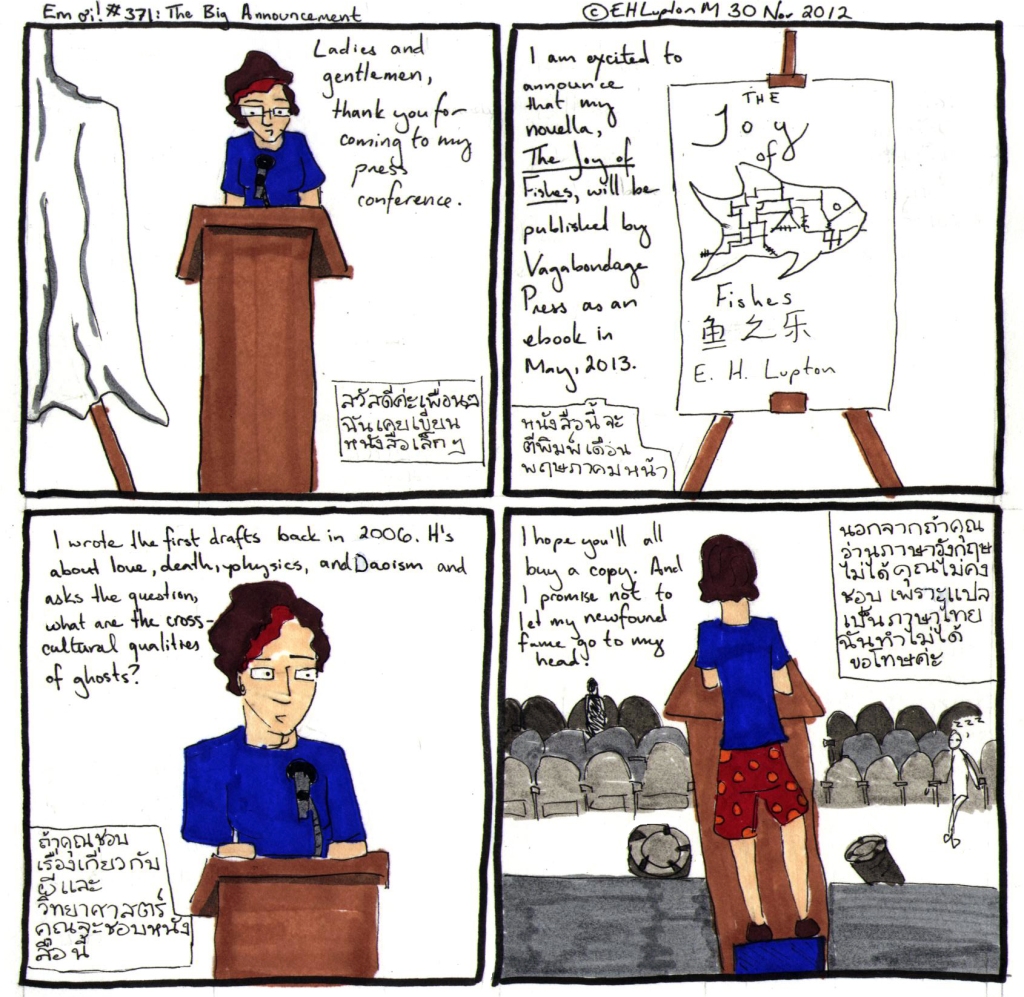
MAGNIFIQUE
This is absolutely true: Vagabondage Press will publish my novella as an ebook in May, 2013. I am very excited. This work was originally composed as my senior thesis for my English/Creative Writing degree in 2006. Since then, it has been through a number of rewrites (and will go through a few more before it is ready for prime time). More importantly, perhaps, I have begun to mature as a writer and I think I have been able to do the story justice.

This is a very brief summary of the story I wrote for my cover letter:

Mara Daniels is a physicist doing cutting-edge research into the nature of reality at the University of Chicago. She’s an astronomer. She’s an amateur student of Chinese philosophy. And she’s still recovering from last summer’s car crash that killed Benjamin Zhu, her fiancé. It’s a slow process; she can walk without a cane now but she still suffers from migraines, nightmares, and she’s seeing Zhou’s ghost everywhere she goes. The Joy of Fishes follows her through the day on which these threads begin to unravel.

To paraphrase Robert Persig, I will say that I am an expert on neither Daoism, nor astrophysics, nor neurology. However some of the bits about ghosts are pretty neat.

In honor of this being my first stand-alone publication, I’m going to file this comic under PS3612.U68 J69 2012, for American literature—Individual authors—2001-—L, subdivided on Table P-PZ40 under Separate works. By title.

To get you all thinking, I’ll add this: If you have a book club in the upper Midwest that would like to read the book and have me come and talk/answer questions, drop me a line and we can work something out.

(ถ้าคุณอ่านภาษาไทยในเรื่องนี้ ฉันต้องพูดขอโทษ เพราะฉันเขียนภาษาไทยไม่เก่งและไม่สวยด้วย)