At least January is over. (Or, as I write these words on the 23rd of January, I hope that it will be over when I send this. I have faith that January cannot last forever.)
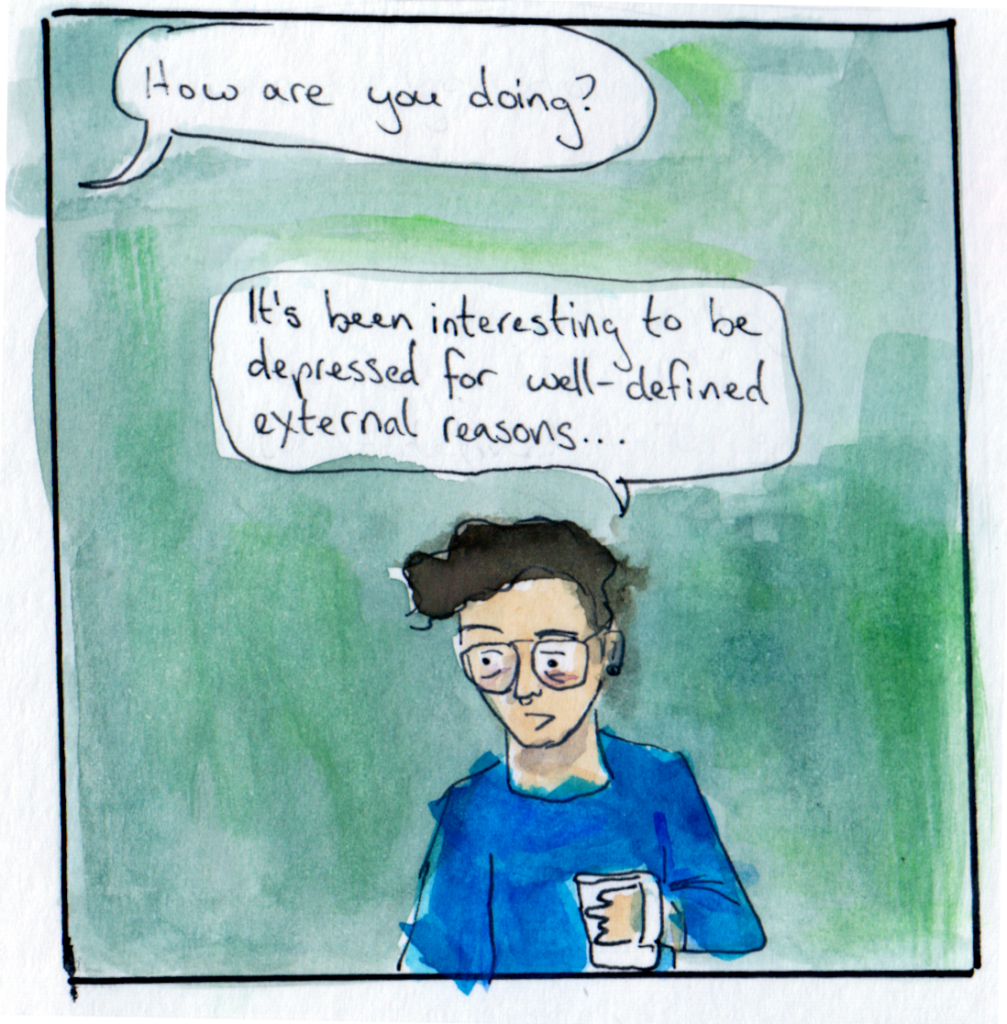
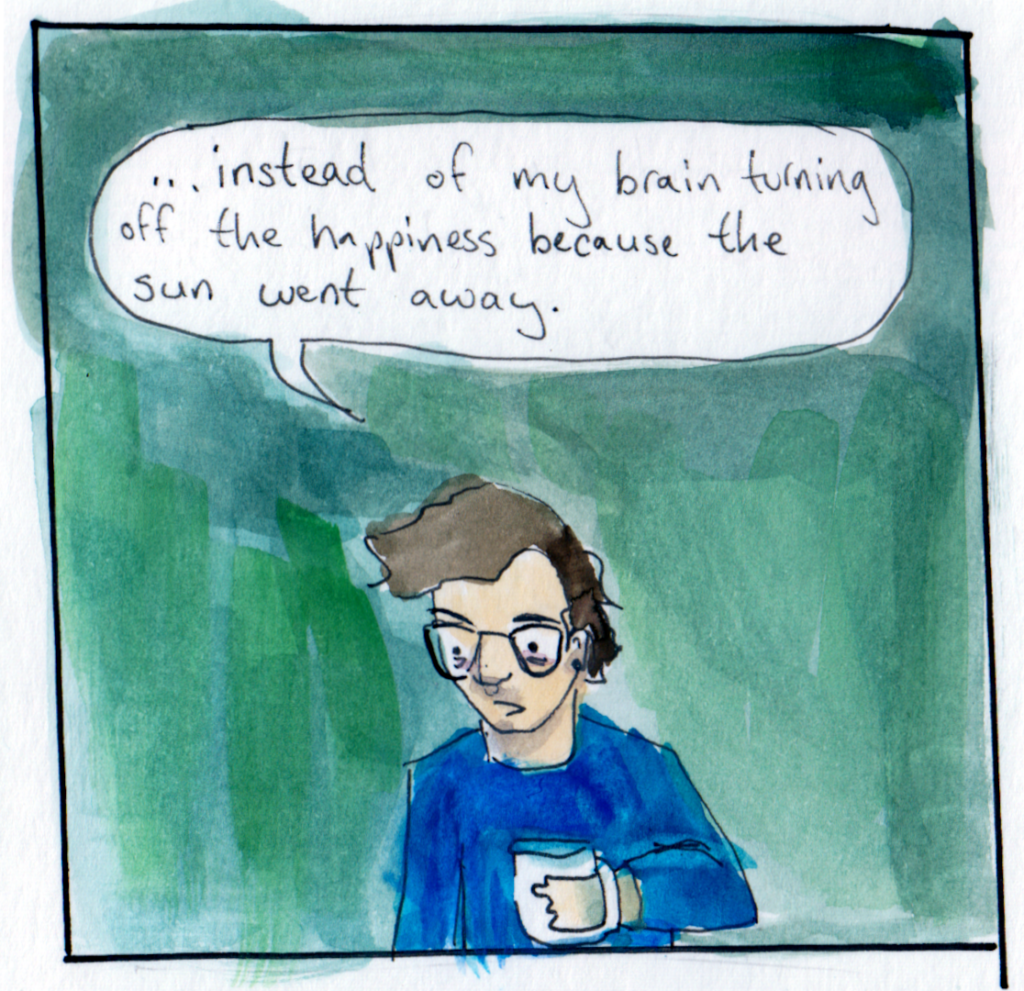
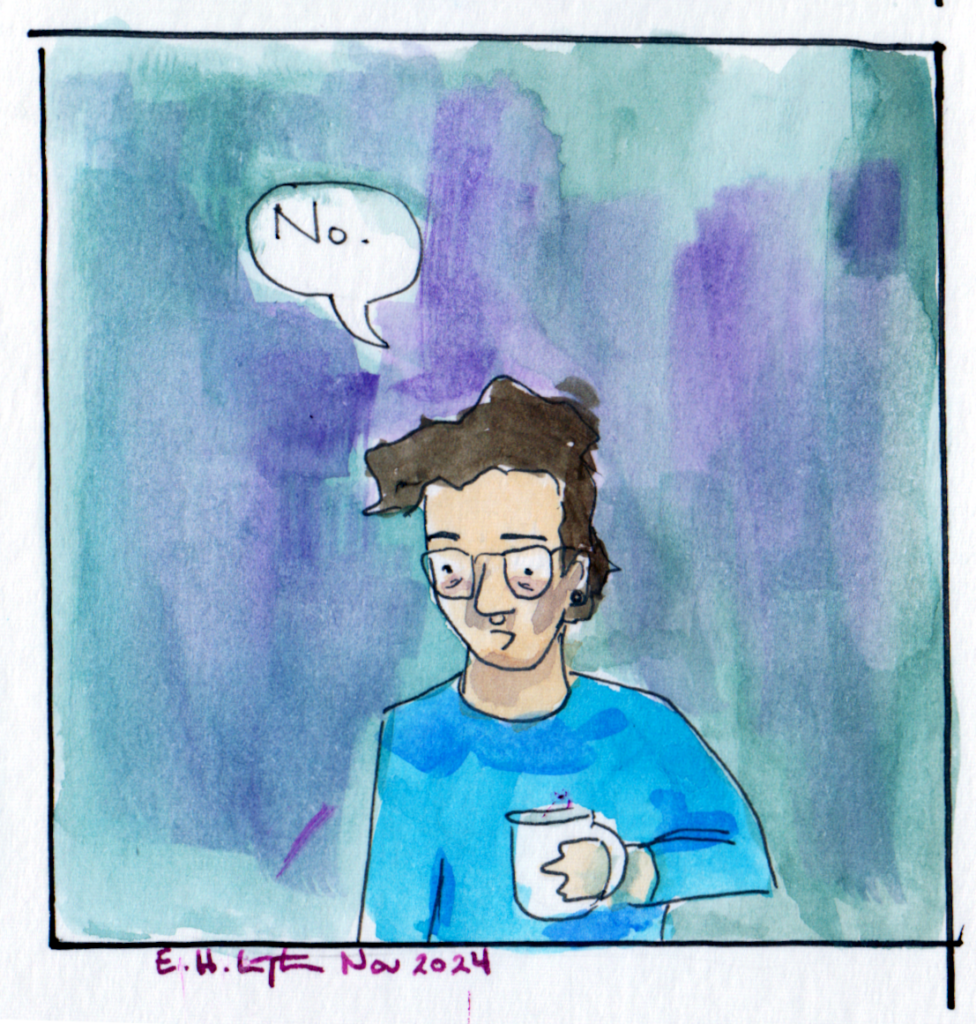
Living in the upper Midwest, never a picnic during the winter, has been especially stressful for the last couple of weeks owing to the ICE occupation of Minneapolis, a place where I have many friends and family members. I generally donate a book’s first day Amazon profits to a charity, and since I didn’t get that done in December for The Alignments, I wound up giving my money to the Immigrant Law Center of Minnesota. If you’re interested in making a donation to a Minnesota organization but don’t have any particular org in mind, you might like to look at this website that lists a whole bunch of good ones.
(Just to be clear, I don’t do this donation thing to goad people into preordering from Amazon or anything; it’s just the most popular single site people buy my books from. Amazon is patently not a good company, but also I respect them for the way they have made self-publishing both accessible and very popular. Business, it seems to me, is often about figuring out how to work with awful people and keep hold of your soul. This is my way.)
I can usually tell when I’m stressed out, because I read a lot more. Right now I am at six novels and two academic articles for the year, and we won’t even talk about the amount of fanfiction I consumed. I realize this isn’t that many comparted to many, but I do have a novel to finish. Part of my stress came from trying to finish Renaissance before sending it out for developmental edits. Then with it off my plate I didn’t know what to do with myself, so I read a lot, and eventually started revising the first draft of book 6. And now I’m revising Renaissance again before copyedits.
Thank you to everyone who has preordered Renaissance already, by the way. In less than a month, it reached the number of preorders The Alignments had during its entire preorder period (which, to be fair, was only slightly more than a month). This is a stat that means almost nothing, but also I’m extremely buoyed by it. It is wonderful to hear how many people enjoyed the previous books enough to take a chance on this one, and how excited everyone is for it.
Upcoming Events
Madison’s new mobile romance bookstore, WanderLust Mobile Books, will be having its grand opening on Valentine’s Day, and I’ve been invited to participate. I’ll be selling and signing books at Giant Jones Brewing Company, at 931 East Main Street in Madison, from 3–7pm. The bookmobile will be outside and we will be inside, so come by and say hi! We may also have little felted chickens in honor of Lupercalia Valentine’s Day.
On March 3rd at 6pm CT/7pm ET, I’ll be doing a zoom book talk with the Ashland, MA Public Library’s Romance Book Club. It doesn’t look like you have to be a MA resident to sign up. There’s also an option to order signed copies of books 1-4 through Tropes and Trifles in Minneapolis, MN. (I will be supplying them with signed Wisconsin Gothic book plates and they will mail the books, presumably around 3/3 or slightly thereafter.)
On March 11th, I’m participating in a romance panel discussion hosted by Forward Theater and the Wisconsin Book Festival at the Madison Central Public Library! Forward Theater is an exciting local theater company that does great work, and they’re presenting the world premier of Lady Disdain (by Lauren Gunderson!), which led to this event. I’m so excited to be a part of this evening. It will be at the Central Public Library from 7-8pm. I think this event is free and does not require a ticket.
Podcasts
We put out two podcasts in January—episode 98, on what the heck was wrong with Roman calendars, and episode 99, on authority! Stay tuned for episode 100 in February!
Book Reviews
I feel like I am in no way an early adopter on this, but Death in the Spires by KJ Charles was very good. It’s a mystery novel with a lot to say about bodies and liberation, about law and morality. There’s a relationship in it, but it is not a romance.
A Bloomy Head (cis F/trans M) by J. Winifred Butterworth was also delightful. It’s 1820 and the newly widowed Kate is trying to save her family farm by making cheese, her brother brought home his doctor friend who is recovering from a severely broken femur in the corner of her kitchen, and someone just found a decapitated body in the creek. You can order signed copies directly from the author if you are a lover of signed copies!
Finally, if you’re looking for something academic, I’ll recommend “Monster Culture (Seven Theses)” by Jeffrey Jerome Cohen. Come for the postmodernist theorist drinking game (take one drink if he mentions Foucault, Derrida, Kristeva, Bakhtin, Butler…maybe we better stop there, you’re looking wobbly), stay for the weirdly (annoyingly?) prescient things he says about outsiders, categories, and desire. It’s in a lot of places; I read the copy available here: https://www.qc.cuny.edu/academics/prod4/wp-content/uploads/sites/147/2024/08/FYW-Sample-Reading-B.pdf (warning, pdf).
That’s all for this month! Stay warm and fuck ICE!
For those who are really interested in what writers read. This year, I read a lot of somewhat random romances because I swung hard into audiobooks. My library generally has crummy waiting times for queer romances, but when I sorted by “available now,” I found a few interesting ones.
Organized by genre.
Romance
You Should Be So Lucky, by Cat Sebastian (m/m, both cis). I don’t care about baseball but this was good. (Reread.)
The Secret Lives of Country Gentlemen, by KJ Charles (m/m, both cis). I read the second one first, so I knew how this ended, which was good because it was very tense there for a moment.
The Sugared Game, by KJ Charles (m/m, both cis). Love Will Darling. (Reread.)
Subtle Blood, by KJ Charles (m/m, both cis) (Reread.)
True Pretenses, by Rose Lerner (m/f, both cis). I had a lot of problems with the use of some antisemitic tropes here. But the characters are compelling.
Hither, Page, by Cat Sebastian (m/m, both cis). Another reread. Very lovely and quiet.
Never Judge a Lady by Her Cover, by Sarah MacLean (m/f, both cis). Look, MacLean writes very particular stuff. I wish this one specifically had allowed the FMC to be less gender? And the implicitly gay viscount should have gotten a happy ending.
Bombshell, by Sarah MacLean (m/f, both cis). Early Victorian feminist revenge fantasy rather than actual historical romance, but not in a bad way.
Lord of Darkness, by Elizabeth Hoyt (m/f, both cis). A well-written excursion into definitely not my thing.
Nine Rules to Break When Romancing a Rake, by Sarah MacLean (m/f, both cis). Also wish there had been a lot less gender in this one.
Sailor’s Delight, by Rose Lerner (m/m, both cis). Another Jewish character, and it’s really well done! Closed door, I wish it wasn’t, just for reasons of closure.
A Gentleman’s Gentleman, by TJ Alexander (m/m, both trans). There is one major historical…call it a choice that isn’t in accordance with reality, let’s say, and if you can get past that, I think you will enjoy it. More than that, I think it is worth trying to suspend your disbelief and getting to know this book, because there’s a lot of interesting stuff here (philosophically) and there’s a lot of fun stuff (the actual plot).
The Queer Principles of Kit Webb, by Cat Sebastian (m/m, both cis, one of them is bi). The rare reread where I think I liked parts of it better and parts of it worse on the second go-round. It doesn’t really work on its own as well as I initially thought.
The Perfect Crimes of Marian Hayes, by Cat Sebastian (m/ bi f, both cis). A reread where I came out loving it. Let Marian do crimes! She’s good at it. And she could use a treat.
Wilde in Love, by Eloisa James (m/f, both cis). James doesn’t really care about historical accuracy, and no one has a problem that can’t be solved by having a lot of money and smiling winningly at people. This series would be better with a couple of queer characters in the mix to up the camp levels, but it’s already so silly and fluffy, I don’t know what to do.
Too Wilde to Wed, by Eloisa James (m/f, both cis)
Born to be Wilde, by Eloisa James (m/f, both cis)
A Caribbean Heiress in Paris, by Adriana Herrera (m/f, both cis). I wish she had subverted some of the more problematic tropes she’s playing with (like protective man/weak lady in need of protection–girl never even got to shoot anyone despite carrying a pistol the whole time!), but the way it addressed race, class, and colonialism was tremendous.
Mr. Collins in Love, by Lee Welch (m/m, both cis). Remember Mr. Collins from Pride and Prejudice? Remember hating him for proposing to Lizzy badly and being kind of a doofus? Turns out he’s an anxious wet cat. This is a really daring little novella, and Welch totally pulls it off.
Seducing the Sorcerer, by Lee Welch (m/m, both cis). Um…does what it says on the tin. Read it while I was sick and up nights, and it was great. There was a magic horse made of an old burlap sack. In the way that horses aren’t just a mode of transportation for a historical story but a character, it really becomes a character, and I loved it so much.
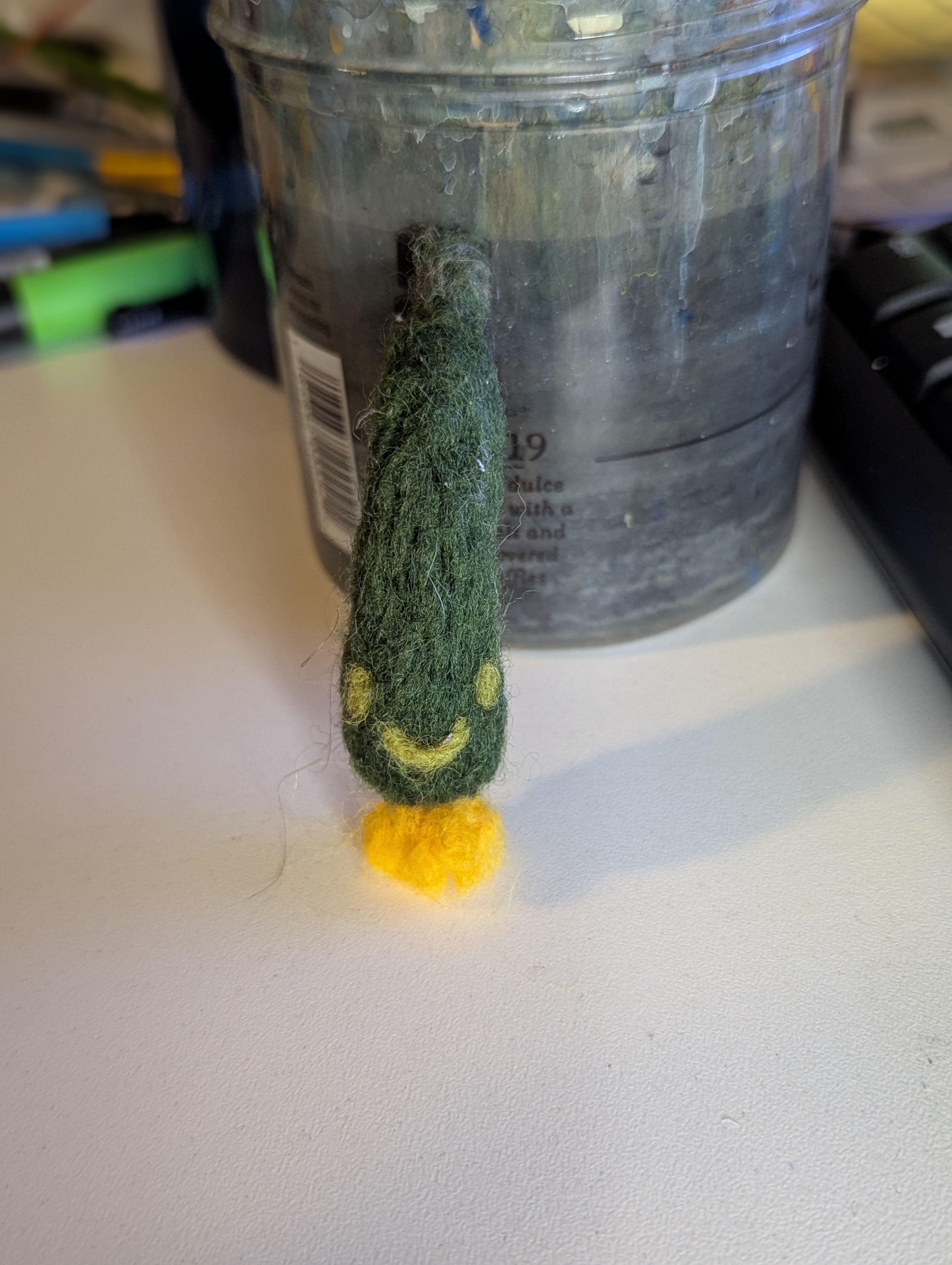
The Barkeep and the Bro, by AJ Truman (m/m, both cis). A contemporary romcom, which was always going to be a hard sell, and indeed it didn’t work for me. This is an age gap, forbidden boss/employee, daughter’s ex-boyfriend, gay-or-possibly-bi-for-you book, and the tropes kind of took over. But because I read it and mentioned it to a friend, I was given a felted zucchini. (There is a scene in the novel in which a zucchini figures prominently.) So. Take that as you will.
Paladin’s Grace, by T. Kingfisher (m/f, both cis). These books (yeah, I read all four) are all so fun and funny. The world reminds me a bit of Terry Pratchett.
Paladin’s Strength, by T. Kingfisher (m/f, both cis). I liked this one the best.
Paladin’s Hope, by T. Kingfisher (m/m, both cis). I was disappointed that this is the shortest of the books.
Paladin’s Faith, by T. Kingfisher (m/f, both cis). Probably the best plot of the four books in the series but my least favorite romance. Honestly I’m not sure these actually qualify as romances? They might be fantasy novels with romantic elements.
Husband of the Year, by MA Wardell (m/m, both cis). I still don’t really read contemporary, but this was nice–Jewish guy in interracial relationship gets married and adopts his husband’s nephew. More serious stuff than I expected from a romcom, but it tends to flinch away from any kind of real conflict; either you will like that or you won’t.
Breakout Year, by KD Casey (m/m, both cis). A sweet Jew4Jew sports romance that was somewhat oddly shaped, story-wise. A little squishy in the middle, but Casey writes a delicious sentence, and ultimately it was enjoyable.
Home Ice Advantage, by Ari Baran (m/m, both cis). A former NHL star becomes the head coach of his hometown team and winds up falling for the (Jewish) assistant coach who got overlooked for the job. I know even less about hockey than I do about baseball, but the emotional arc here was delicious and subtle.
Scifi/Fantasy/Horror
Gideon the Ninth, by Tamsyn Muir. Lesbian space Jesus saves the planet with swords.
Harrow the Ninth, by Tamsyn Muir. Ten thousand years is exactly the amount of time needed to develop the most toxic workplace in the universe.
Nona the Ninth, by Tamsyn Muir. What if instead of gender, we had swords, ghosts, and spaceships?
System Collapse, by Martha Wells. I think this is the one I got hit by a car while I was listening to the audiobook. So, uh. Distracting.
All Systems Red, by Martha Wells. Reread. If I had Kevin R. Free dollars, I’d hire him to do my audiobooks. I also read this aloud to my 8yo. I read this book probably too many times in a short period. It impressed me more after having read through all the other books.
Artificial Condition, by Martha Wells. Reread.
Fugitive Telemetry, by Martha Wells. Reread.
“Home, Habitat, Range, Niche, Territory,” by Martha Wells. Technically a short story. Also a reread?
The Haunting of Hill House, by Shirley Jackson. Masterful. More queer than I remembered. Technically this was a reread but I read it the first time when I was maybe 20.
The Masquerades of Spring, by Ben Aaronovich. I want to recommend this to everyone. Delightful and funny. Like Wodehouse but add Americans, race, queerness, magic, and jazz.
We Have Always Lived in the Castle, by Shirley Jackson. Look, Merricat should be allowed to murder all those dreadful people. As a treat.
Plays
The Bacchae of Euripides: A Communion Rite, by Wole Soyinka. He really gets Dionysus and creates a great, very dark, comedy.
The Bakkhai, by Euripides, trans. by Anne Carson. Not as good as Soyinka’s. Sorry, tumblr. Get your “not for me…not if it’s you” out of here, Anne Carson.
Father Comes Home from the War, by Suzan-Lori Parks. She’s one of the top playwrights of our modern times and this is a banger.
We Bombed in New Haven, by Joseph Heller. Not famous for a reason.
Mysteries
No. 1 Ladies’ Detective Agency, by Alexander McCall Smith. Is it a mystery? There’s a detective. But it’s a wonderful portrait of a time and place he clearly loved.
Fer-de-lance, by Rex Stout. Very clever, a little racist and sexist.
Fadeout, by Joseph Hansen. When I was getting sick in August, I spent a lovely rainy morning reading this in my brother’s sunroom while the kids ran around playing. Also it’s a nice California noir.
Lavender House, by Lev AC Rosen. Rosen is way more about vibes than about creating a mystery that wraps up well. And the vibes are good! I was just left with a lot of questions.
Nonfiction
Ghostland: An American History in Haunted Places, by Colin Dickey. Very interesting.
Hi Honey, I’m Homo: Sitcoms, Specials, and the Queering of American Culture, by Matt Baume. I had a lot of thoughts about how you get to see what they want you to see. But mostly I was left imagining showing Bewitched to Ulysses, and I couldn’t stop laughing.
No, okay, I guess I am going to talk about this. When you watch TV (and this is still true even with streaming), what you see is the shows they decided to make. Obviously. But why do they decide to make a show? It’s because they (they being network executives) do a complex calculation that boils down to “what will catch the public’s imagination such that we can make a boatload of dollars from this?”
And a lot of this is predicated on this idea of what “middle America” wants. (What is “middle America”? I feel like I live there? But also where I live, I have a lesbian mayor, a lesbian senator, and a gay congressperson.)
Anyway, whenever you’re asking, “Why weren’t there any gay main characters on TV before Will and Grace?” the answer is basically an exec thought that “middle America” wouldn’t like it. Even getting queer recurring characters or story lines that painted queer guest stars as sympathetic could be a stretch during some periods.
And now we have had a mainstream sitcom with a married gay couple who adopts a child and they’re main characters in the show, yay progress.
But if you think about this, and think about the world, and the vastness of the stories that are never being told because someone thinks they won’t be profitable stories, it gets very sad. I feel very tinfoil hat-y when I talk about it, but the censorship freaks me out. Not the “pulling your book out of a library” censorship, which is devastating, but the “we are going to ignore your ideas and not give you a chance” censorship.
Anyway, yay, self-publishing?
“Appropriating the Golem, Possessing the Dybbuk: Female Retellings of Jewish Tales,” by Ruth Bienstock Anolik. Modern Language Studies, vol. 31, no. 2 (Autumn 2001): pp. 39-55.
Alone, Unarmed, and Unafraid: Tales of Unarmed Reconnaissance During Vietnam, by Taylor Eubank. Engaging, but I don’t know if I recommend it.
Three Men in a Boat (To Say Nothing of the Dog), by Jerome K. Jerome. Is this nonfiction? I don’t know. I had an abridged audiobook narrated by Hugh Laurie. I wish he’d done the whole thing.
Things I Overheard While Talking to Myself, by Alan Alda. I’m not big on celebrity memoirs but this was good. Alda is an old school, fought-for-the-ERA liberal, and I love him.
You Could Make This Place Beautiful, by Maggie Smith. A divorce memoir. I…wish she’d just hate him. Or talk more about craft, because she obviously wants to. But as it stands, it was good but felt a little like Swiss cheese?
An Unfinished Love Story: A Personal History of the 1960s, by Doris Kearns Goodwin. I cried, even though I knew who died and when. For example, her husband Dick Goodwin was at the White House getting the East Room ready when they brought Kennedy’s body back from Dallas to lie in state. Everyone was so young and idealistic and they worked so hard. The audiobook has clips of the original deliveries of many of the speeches she talks about (including RFK [original recipe] talking about the death of MLK Jr. on the campaign trail in Indiana the night King died), which was amazing.
A Swim in a Pond in the Rain, by George Saunders. Ultimately I disagree with him about the interpretations of the stories that he offers, and I only sort of like his ideas about how to write a story, but I liked the book. Make of that what you will.
Manhood for Amateurs, by Michael Chabon. An older volume of essays, but one I really enjoyed. Made me laugh aloud at times.
Entangled Life: How Fungi Make Our Worlds, Change Our Minds, & Shape Our Futures, by Merlin Sheldrake. Mushrooms are terrifying, and I’m 20 million microbes walking around in a human suit.
Reading Selfishly: A Craft Journal for Writers, by KD Casey. I don’t think this is officially out yet, but she dropped a link to the first public version on Bluesky, and I think I’m officially a fan.
Crochet Monsters: With more than 35 body patterns and options…, by Megan Lapp. I made four monsters out of this. All in all they were the biggest crochet projects I’ve finished to date. Even with a smallish hook (3.75-4mm), the monsters are all about 8″ tall or more. The book is well laid out, the instructions it offers are easy to parse even for a beginner-to-intermediate crocheter, and there are loads of photos. My kids liked flipping through it and coming up with new monsters, and I didn’t hate making them.
YA Novels I Read Aloud to My Children
Wintersmith, by Terry Pratchett. It was good. I have no notes except that it felt like the main character has out-aged the kid I was reading this to a bit and I want to wait before I read him the next one.
Over Sea, Under Stone, by Susan Cooper. Not as good as The Dark Is Rising. The child still really liked it.
Greenwitch, by Susan Cooper. Very good.
The Grey King, by Susan Cooper. Cooper is a powerhouse. I don’t know what to say. More creepy poems in fantasy novels! (Content warning! There’s a dog that gets shot in this one. I was a little shocked.)
The Hobbit, by JRR Tolkien. Reads aloud well. (Not only was this a reread, this wasn’t even the first time I’d read this aloud.)
The Halloween Moon, by Joseph Fink. If you want a middle-grade YA novel about a Jewish kid, you could do worse.
Here are all the books I read in 2024. I’m not going to rank them, but I’ll give brief reviews. I usually try to read the abbreviation of the year in books, so my goal for 2024 was 24 books. I read slightly more than that across many genres, although romance was the plurality.
Children’s/YA books
The Dark is Rising, by Susan Cooper. Read aloud; I don’t think I have to convince anyone that this is an amazing book.
The Amazing Maurice and His Educated Rodents, by Terry Pratchett. Read aloud; at times we were laughing too hard to go on, and really, what other endorsement is needed?
Camp Damascus, by Chuck Tingle. Some excellent moments but ultimately too much Jesus for my tastes. Already lived all that shit by proxy growing up.
Belle of the Ball, by Mari Costa. A pretty graphic novel with a big heart. Full disclosure: I met Mari Costa at the Lammys!
The Golden Thread: A Song for Pete Seeger, by Colin Meloy. I may be biased because I’m a fan of both Colin Meloy and Pete Seeger, but this was delightful. (I never read it to the kids, though. Just saw it at back to school night.)
The Boy Who Loved Math: The Improbable Life of Paul Erdos, by Deborah Heiligman. Too many words for a bedtime story, but my 3yo inexplicably loved it. The story is very cute, and Erdos was a loveable weirdo.
Romance (pairings and settings as noted)
I’m So (Not) Over You, by Kosoko Jackson (M/M, contemporary). I hope Berkeley feels embarrassed by how dirty they did this poor book. Could have been good, but it was an entirely unedited mess.
Take a Hint, Dani Brown, by Talia Hibbert (M/bi F, contemporary). For what it was, it was fine.
Bisclavret, by KL Noone (M/M but one of them is a werewolf, middle ages?). A novella retelling the werewolf story “Bisclavret” by Marie de France. I usually think novella is not the best format for a romance, but this was charming. Full disclosure: I’ve been on panels with KL Noone a few times now at Rainbow Space Magic Con. (I don’t think she remembers me though.)
A Marvellous Light, by Freya Marske (M/M, late Edwardian). Book 1 in the Last Binding series. The plot was fine and the writing was good.
A Restless Truth, by Freya Marske (F/bi F, late Edwardian). Book 2 in the Last Binding series. The supporting characters were good.
You Should Be So Lucky, by Cat Sebastian (M/M, 1960s America just pre-Kennedy). I am not interested in baseball, but this was a delight start to finish and a standout. The second in the Mid-Century New York series (I lost the Lammy to the first one).
A Minor Inconvenience, by Sarah Granger (M/M, Regency). Don’t think too hard about the plot. Or the sex scenes. The setting was nice.
Letters to Half Moon Street, by Sarah Wallace (M/M, Regency). A gentle epistolary novel with almost no plot and an interesting queernorm regency setting that nevertheless left me with a lot of questions.
An Appreciation of Cats, by Des DeVivo (M/M, contemporary?). Another novella that I read. I got this one as an ARC.
Oak King Holly King, by Sebastian Nothwell (M/M but one of them is an elf, early Victorian). A standout–set in 1844, with strong medieval undertones and a delightful episodic plot that draws on the story of The Green Knight. Full disclosure: I was on Sebastian Nothwell’s podcast (Right Here, Write Queer) and he was recently on mine.
A Power Unbound, by Freya Marske (M/M, late Edwardian). Book 3 in the Last Binding series. I didn’t hate it. Also I liked the characters from A Marvellous Light a lot better here.
The Nobleman’s Guide to Seducing a Scoundrel, by KJ Charles (M/M, Regency). This was a delight. I have to go read book one now.
Scandal in Spring, by Lisa Kleypas (M/F, early Victorian). This was the third book in a row that I read where one character had a BIG TERRIBLE SECRET that got revealed at or after the 50% mark in the book and turned out to be eminently overcomeable, and I am so over it.
Cutting It Close by Reese Knightley (M/M, contemporary). I kind of lost track of the number of (war) crimes committed by the ostensible heroes. This book is a reminder that I need to stop picking audiobooks by just grabbing whatever is listed under “available now.”
Dead Egyptians by Del Blackwater (M/M but one of them is a ghost, Edwardian). More of a character study, but a really lush and intriguing one. TW for an assault that happens around the 75% mark. Full disclosure: I have met Del Blackwater a few times (she lives in the area).
My Last Duchess, by Eloisa James (M/F, Georgian). I want to say that it doesn’t make sense to try to body-shame someone when the fashion is to wear panniers, but that really diminishes the amount of fun that this book was.
Literature and Scifi/Fantasy
Matrix, by Lauren Groff. If you’re the oldest daughter, and you sometimes get given distasteful tasks, and you maybe feel the need to do a really, really superior job at everything, you will see your experience reflected here. This had so many good lines–the writing was really an amazing achievement.
On Earth We’re Briefly Gorgeous, by Ocean Vuong. It was very good and also sad. Contained the single most stomach-turning scene I read (heard, I guess–I had this as an audiobook) this year, maybe ever.
Interior Chinatown, by Charles Yu. This was amazing and everyone should read it. And give Charles Yu more money to write more books. A real standout (and I got B to read it too).
No One Is Talking About This, by Patricia Lockwood. Part I was like having tw*tter slow-dripped into my ear. Part II made me cry.
Space Opera, by Catherynne M. Valente. So amazing I immediately made B read it. Also a standout.
Translation State, by Ann Leckie. A tricky book; not enough connection to the earlier Imperial Raadch novels and too much. Good but unsatisfying; I think it tried a lot of interesting things and I love it for that.
Legends and Lattes, by Travis Baldree. The real magic rock was the friends we made along the way, I guess. This book managed to be very boring and also keep my interest, which feels like an achievement.
Nonfiction, Biography, and Memoir
The Bomber Mafia, by Malcolm Gladwell. It’s all fun and games until Curtis LeMay firebombs Tokyo. (Of note, LeMay also introduced judo into the US and later was the VP candidate under George Wallace in 1968. Gladwell doesn’t mention either of these facts. I had to find them out by myself.)
Cook County ICU: 30 Years of Unforgettable Patients and Odd Cases, by Cory Franklin. Franklin is honest to a fault and I find I like him a lot for it.
A Molecule Away from Madness: Tales of a Hijacked Brain, by Sara Manning Peskin. Unfortunately this was reported stories focusing on the neurochemical underpinnings of various neurological issues rather than Oliver Sacks-esque first-hand case studies.
On the Move: A Life, by Oliver Sacks. This was so delightful, and I’m glad he published it while he was still alive so no family members could stop him. (Would they? I don’t know. It was kinda scandalous. But also very good.) Key quote (not of the scandalous parts):
As soon as I could get away from work on Friday, I saddled my horse–I sometimes thought of my bike as a horse–and would set out for the Grand Canyon, five hundred miles away but a straight ride on Route 66. I would ride through the night, lying flat on the tank; the bike had only 30 horsepower, but if I lay flat, I could get it to a little over a hundred miles per hour, and crouched like this, I would hold the bike flat out for hour after hour. Illuminated by the headlight–or, if there was one, by a full moon–the silvery road was sucked under my front wheel, and sometimes I had strange perceptual reversals and illusions. Sometimes I felt that I was inscribing a line on the surface of the earth, at other times that I was poised motionless above the ground, the whole planet rotating silently beneath me.
Cultish, by Amanda Montell. I don’t know that her thesis (that cults use in-group language to promote belonging and a sense of community) is all that surprising, but I learned some interesting stuff.
The Commitment: Love, Sex, Marriage, and My Family, by Dan Savage. I don’t know if I should say, “Wow, the early 2000s were genuinely as bad as I remember thinking they were at the time,” or “Dan Savage is the most Gen X writer.” Now I’ve said both.
The Boys of ’67: Charlie Company’s War in Vietnam*, by Andrew Wiest. A group memoir (biography? collection of oral histories?). This made me fucking cry. While driving.
Boots on the Ground: America’s War in Vietnam, by Elizabeth Partridge. (Technically maybe YA nonfiction? oral histories woven together with bits of the larger historical record of the era, from the early ’60s through to the early ’90s.) I didn’t cry but only because I was running on the dreadmill at the time.
* Note–the company that committed war crimes in the village of Son My known as the My Lai massacre was also called Charlie Company, but that’s a different company. Because Army companies are named A, B, C, etc., and then referred to using the NATO Phonetic Alphabet, there’s lots of Charlie Companies.
“The Dybbuk: The Origins and History of a Concept,” by Leonard J. Greenspoon. In olam he-zeh v’olam ha-ba: The World and the World to Come in Jewish Belief and Practice, Perdue University Press, 2017, pp. 135-150. This was really informational, and well-written to boot. I learned so much.
“The Etymology of Condom,” by Zacharias P. Thundy. In American Speech, vol. 60, no 2 (summer 1985): pp. 177-179. This started as a joke about the etymology of “condiment” that got way out of hand.
Books and Other Works I Published
Old Time Religion. This was a scary book to write. Dionysus in Wisconsin was received well by a small but enthusiastic coterie, and I didn’t want to disappoint them. Luckily the Lammy shortlist hadn’t come out yet when I released it in January, or I would have freaked out even more than I already did. I got fewer preorders for this book than I did for DIW, which was unpleasant, and although I offered ARC copies no one wanted one. On the production side, the book was beset by some last-minute problems with the cover, which were a real learning experience and did nothing for my stress level. Fortunately, it has been well-received and sold steadily! I don’t track earnings by book, but it has earned out at this point, and slightly faster than DIW did (eleven months instead of twelve).
“Dous.” This was so fun to write. I did catch myself trying to decide if I’d unfairly leveraged an argument Spivak makes about the way women are oppressed in India in a context she would object to, and then decided that I was getting a little too serious about the philosophy side of things for a lighthearted short story. As far as I can tell only a few people bothered to read it, probably because I gave it a weird title (it makes sense if you’ve read OTR, I think). But that’s fine. I know a few people really loved it, and that means a lot to me.
Troth. This was a fun book to write, a hard book to revise, and now that it’s done I am extremely happy it’s out in the world. The last few chapters made me very happy to write. I got a lot more preorders for this one than I did for DIW and OTR–as many as both of them combined, actually. I didn’t bother to send out ARC copies. How do you offer ARC copies for the third book in a series without cannibalizing your audience? But despite the lack of hype, it has sold very well, including the best first month sales of any of my books.
“Vivienne.” I sold this to Asimov’s Science Fiction and I have the check stubs to prove it, but although I received galleys, it was not published in 2024. I don’t know exactly what the story is; selling it was quite a coup, perhaps the most high-profile sale I’ve ever made. Maybe it will appear in 2025. Keep an eye out.
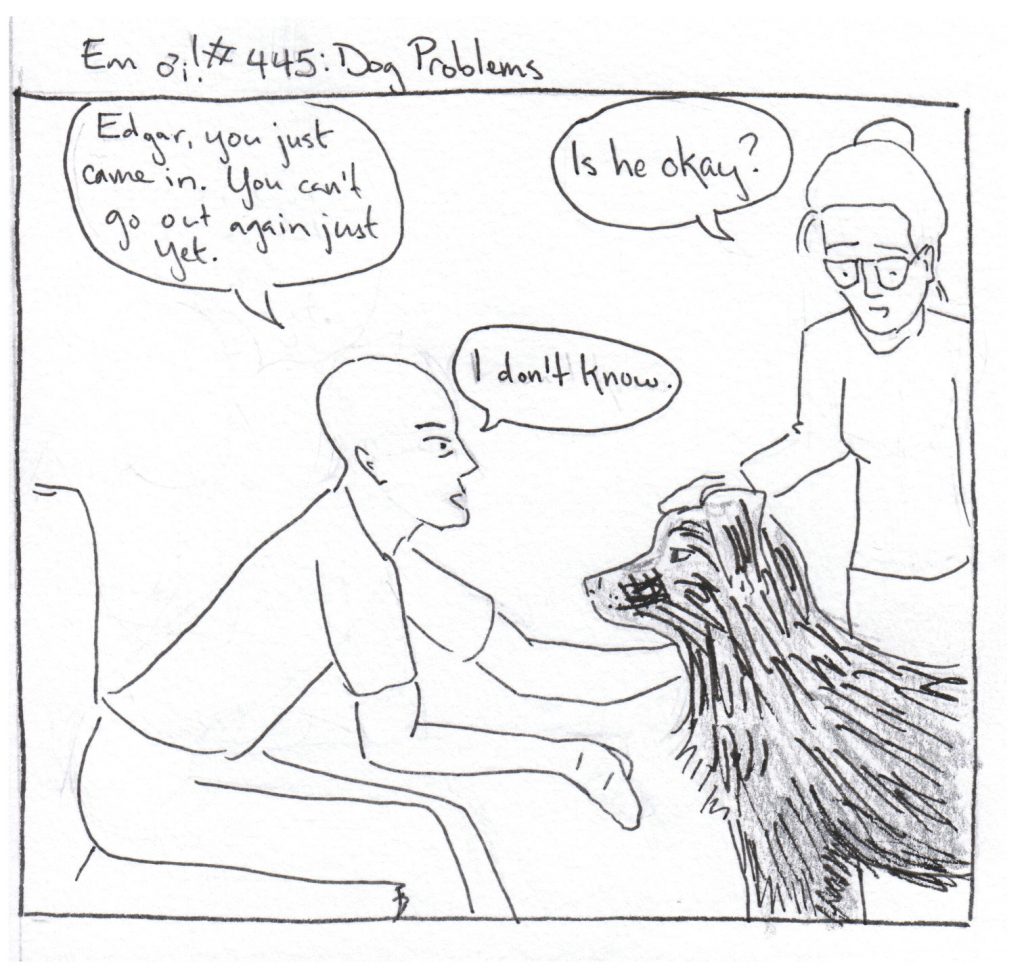
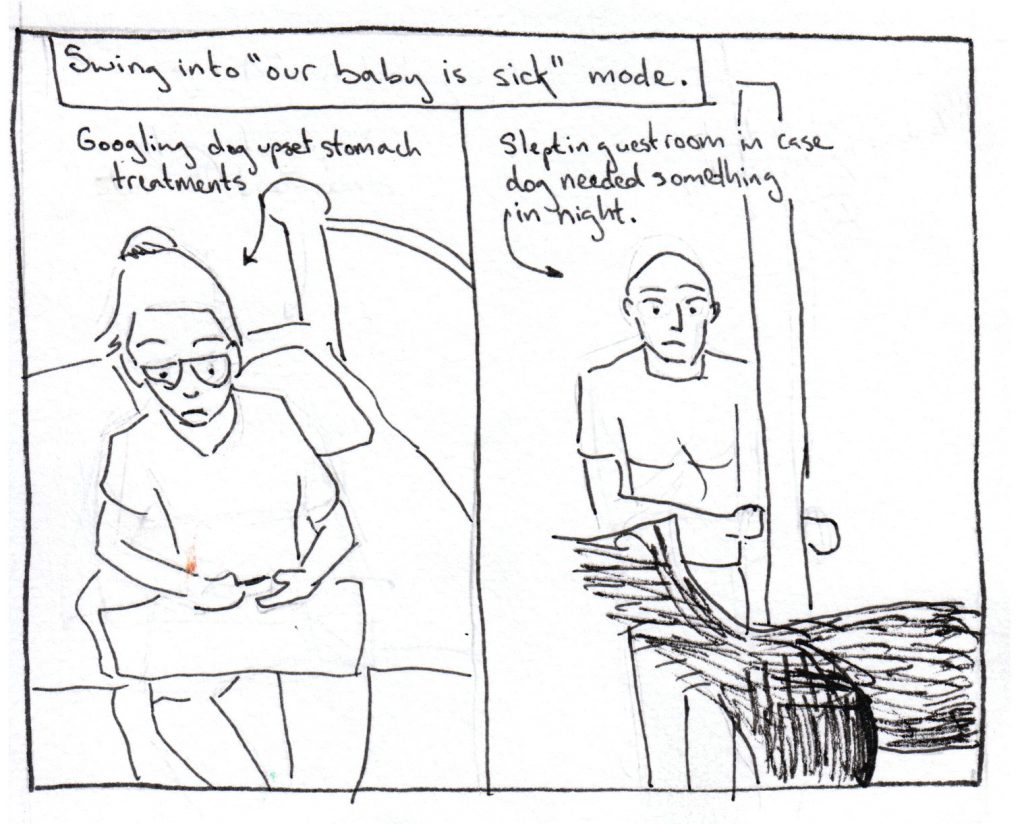
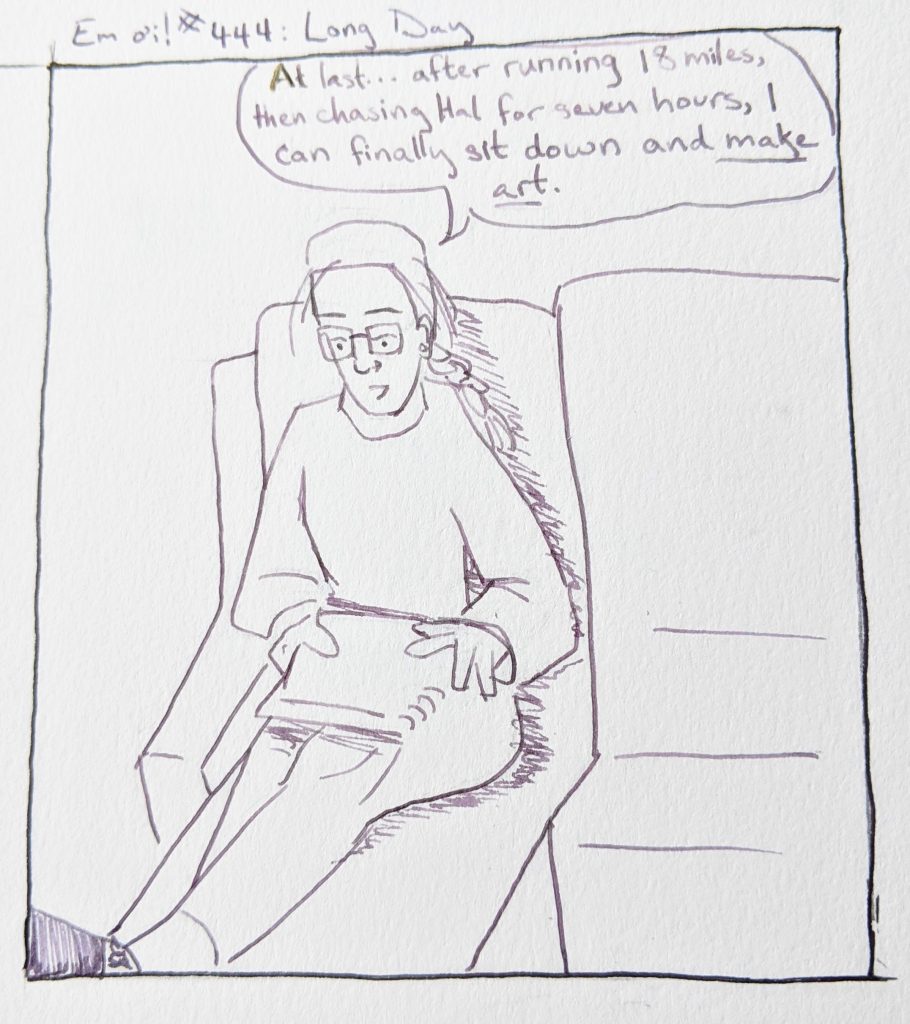
Em oi! 452, 453, and 454 (above). I have another comic that I sketched and inked and then set aside because I needed to focus on something else.
Lazarus, Home from the War. I have written two and a half full drafts of this novel this year, I think. I am so excited to show it to people in 2025. It’s got so much cool stuff that I love–a guy trying to put himself back together! A Jewish neurologist! A really scary snake! It will be out in May 2025, so keep an eye out!
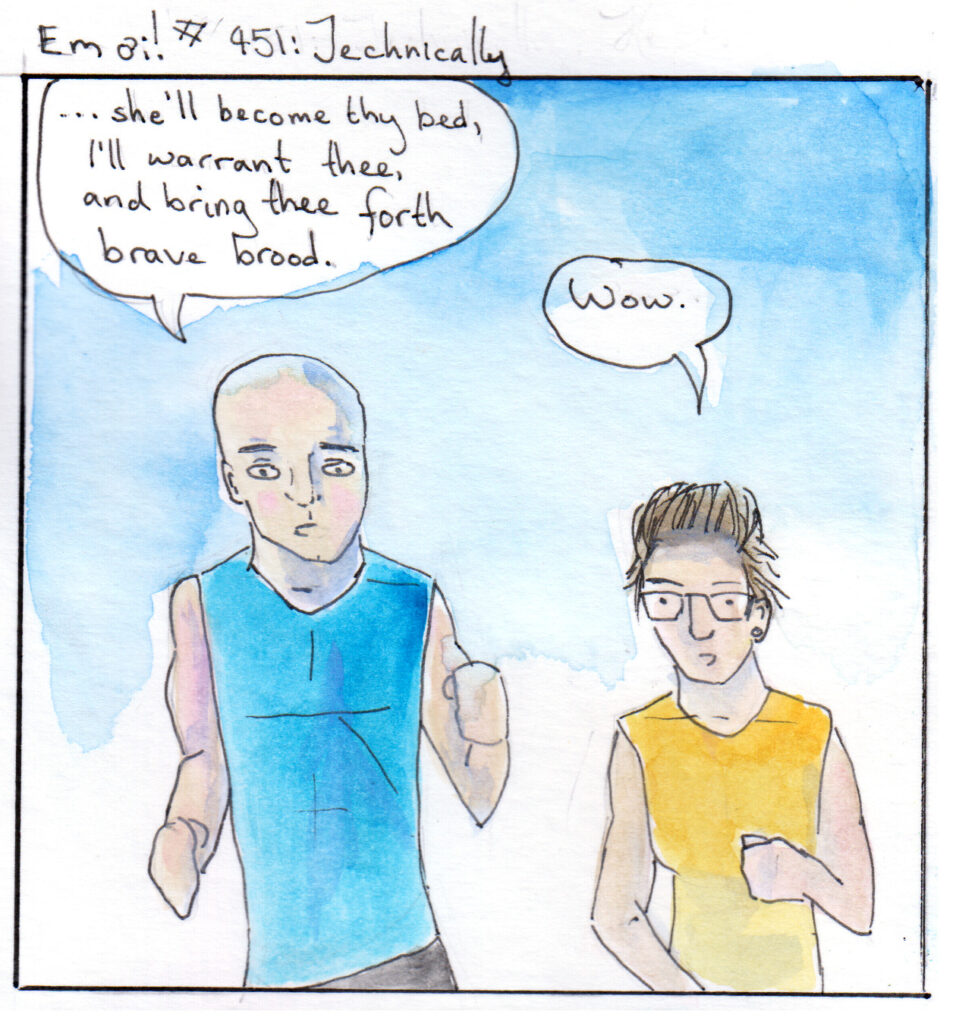
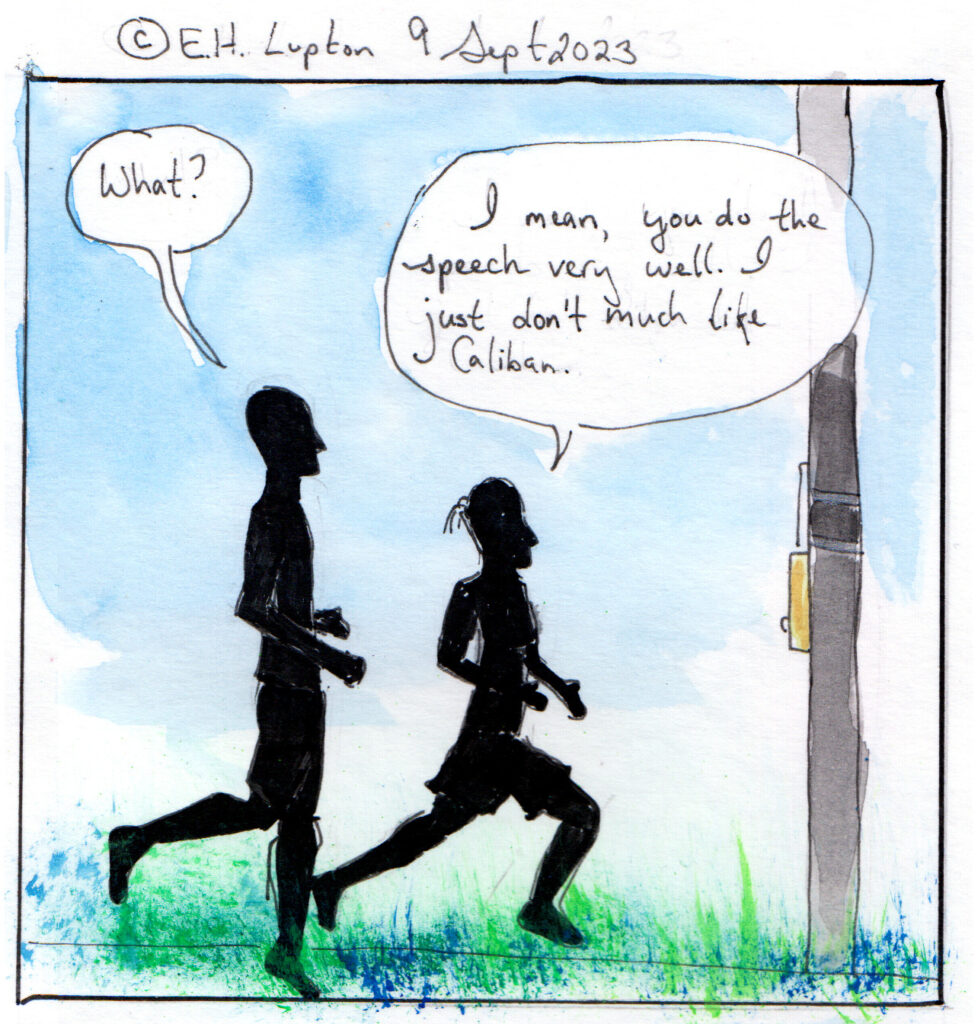
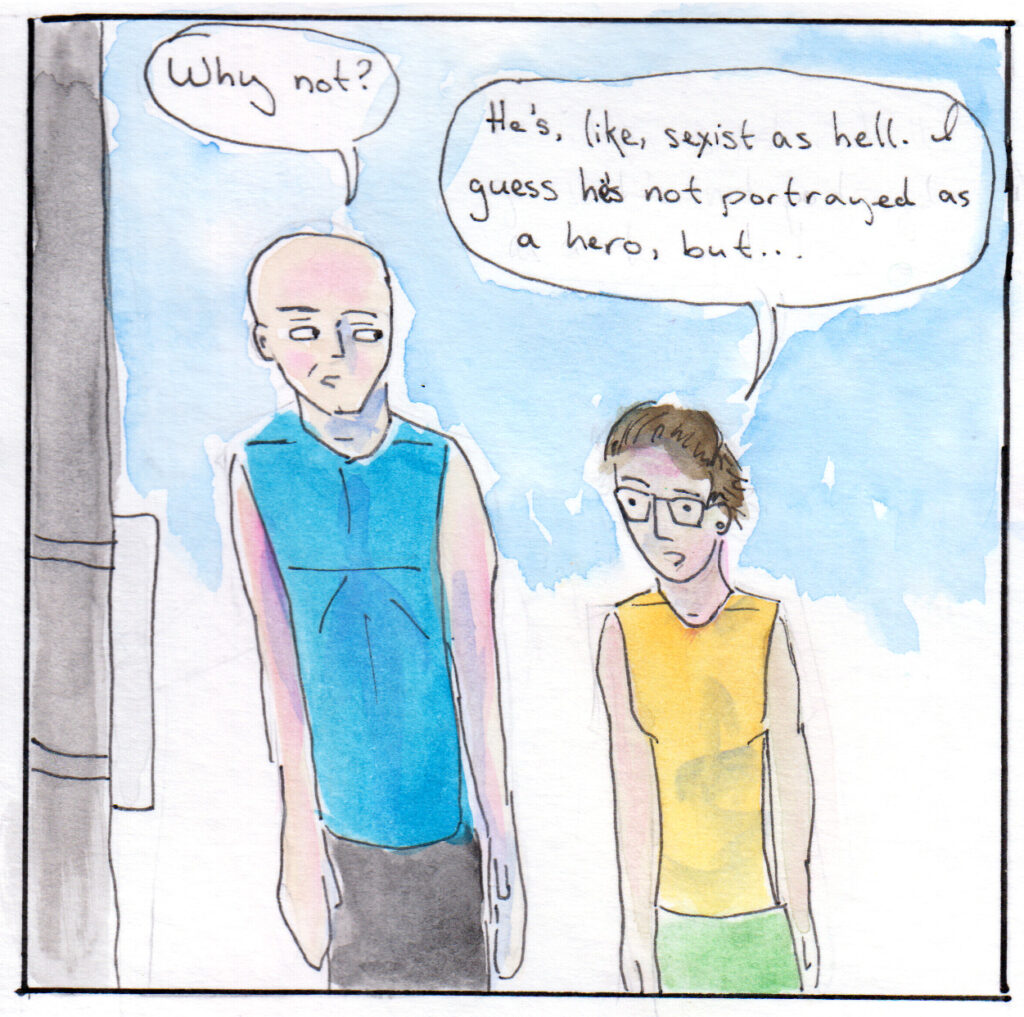
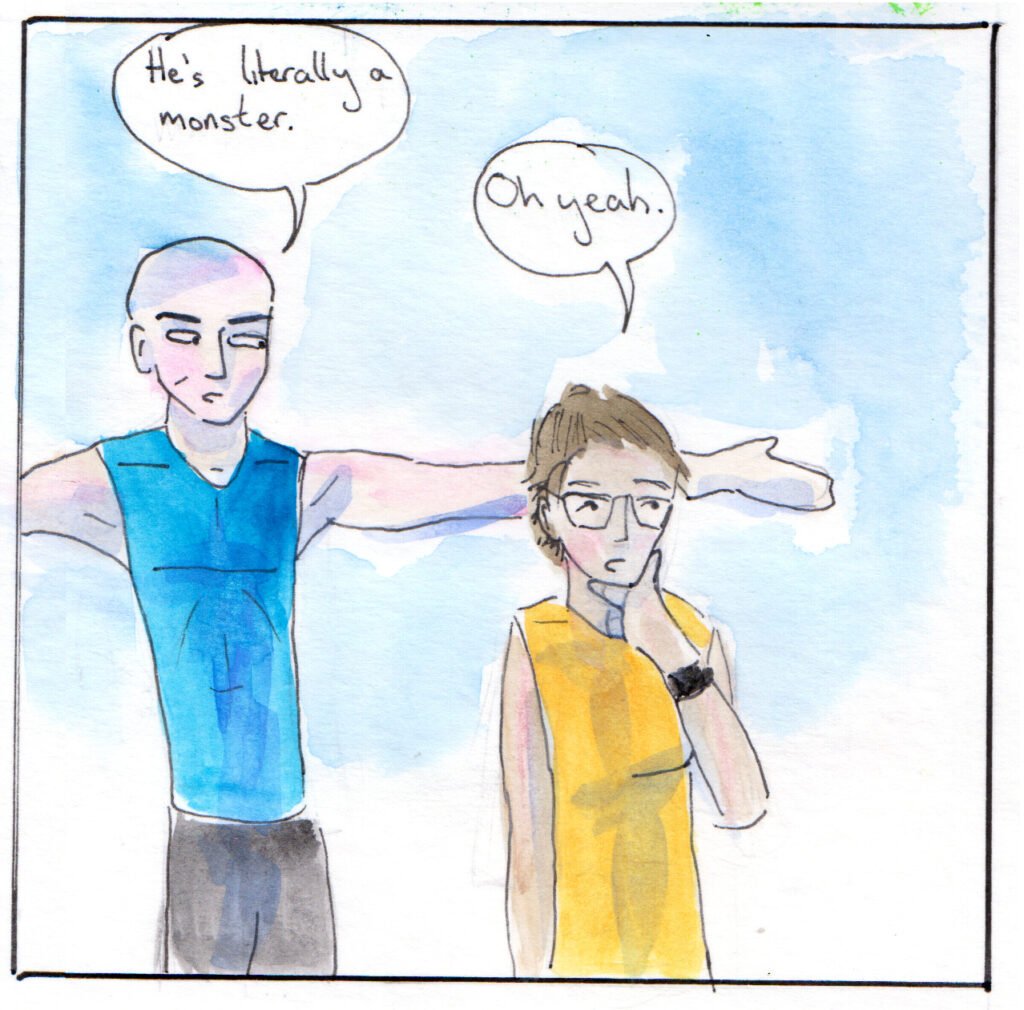
Back before we had many small children, when he had time for community theater, B used to recite the speeches he was working on while we went running together. That was always fine when he was doing something fun (Twelfth Night) and always a little weird when he was doing a villain (Aaron the Moor from Titus Andronicus has a very good one[1]). Now we’re back to doing this because he has a show next Saturday (9/23, here in Madison)–and he’s learning a scene from The Tempest. Which is a great scene, but also interesting to be doing excerpts from in public. (Also, when we actually had this conversation, we were on dreadmills at the gym, so. But it’s a hell of a scene.)
All right, announcements.
I had a poem in the August/September issue of Utopia Science Fiction Magazine. The poem is called “Anxiety #243,” and you can buy a copy of the issue here. If you just want to read the poem, you should sign up for my newsletter and then check out the most recent back issue. I have another poem coming out in the next couple of weeks, and you should definitely sign up for my newsletter if you want to be notified!
I will be reading at Rainbow Space Magic Con at the end of September. I will also be appearing on a panel about writing fantasy and historical accuracy w/r/t the middle ages, a topic about which I have many possibly controversial opinions. Registration is free, so go sign up. I’ll send out a newsletter with the actual schedule once I know it.
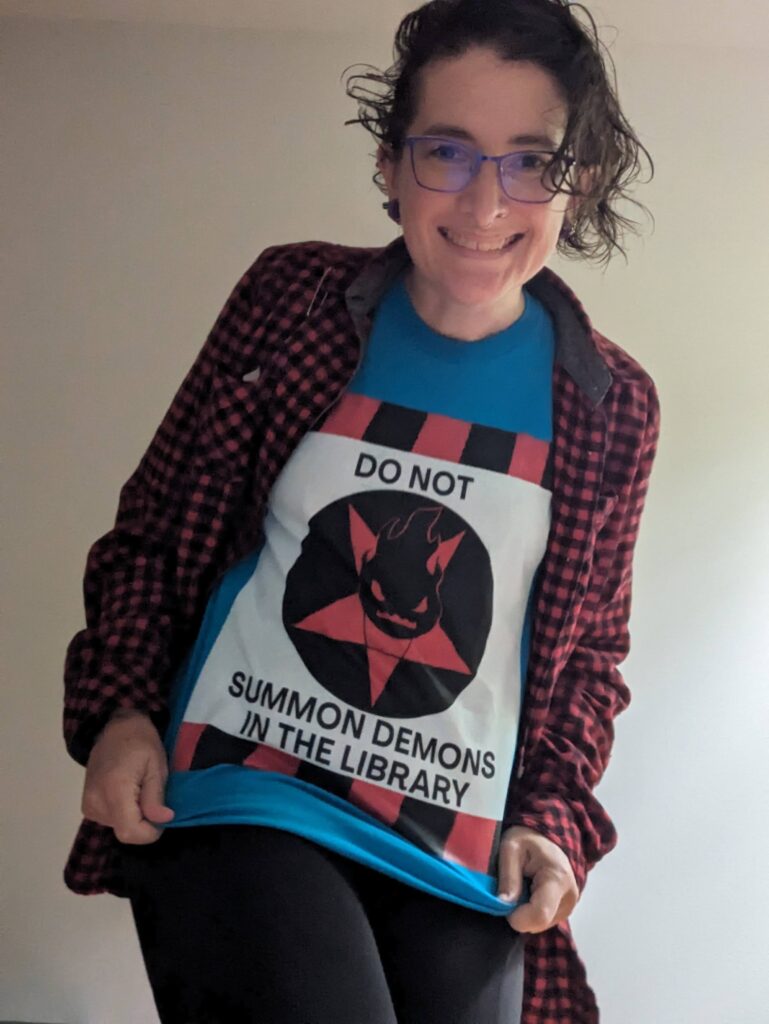
I also recently came out with a new T-shirt. It looks like this:
Click here if you want one. There are a few color and size options (also children’s sizes, because my 6yo wanted one), and also stickers and metal signs, in case you want it in your own library.
Finally, for fans of Dionysus in Wisconsin, book two will be available for preorder in October and out in January.
We’ll file this under PR2833.W5 L86 2023, for English literature–English renaissance (1500-1640)–The Tempest–Criticism. (I’m not 100% sure about that W5–I don’t have access to that table anymore, but I used it last time I did a comic about Shakespeare, so I am guessing it means “Criticism.”)
Footnotes:
[1] From act 5, scene 1:
Lucius: Art thou not sorry for these heinous deeds?
Aaron: Ay, that I had not done a thousand more. Even now I curse the day—and yet, I think, Few come within the compass of my curse— Wherein I did not some notorious ill, As kill a man, or else devise his death; Ravish a maid or plot the way to do it; Accuse some innocent and forswear myself; Set deadly enmity between two friends; Make poor men’s cattle break their necks; Set fire on barns and haystalks in the night, And bid the owners quench them with their tears. Oft have I digged up dead men from their graves And set them upright at their dear friends’ door, Even when their sorrows almost was forgot, And on their skins, as on the bark of trees, Have with my knife carvèd in Roman letters “Let not your sorrow die, though I am dead.” But I have done a thousand dreadful things As willingly as one would kill a fly, And nothing grieves me heartily indeed But that I cannot do ten thousand more.
It’s an amazing speech! Who doesn’t want to twirl their moustache so heartily? But you can see why we used to quiet down when we passed one of the neighbors…
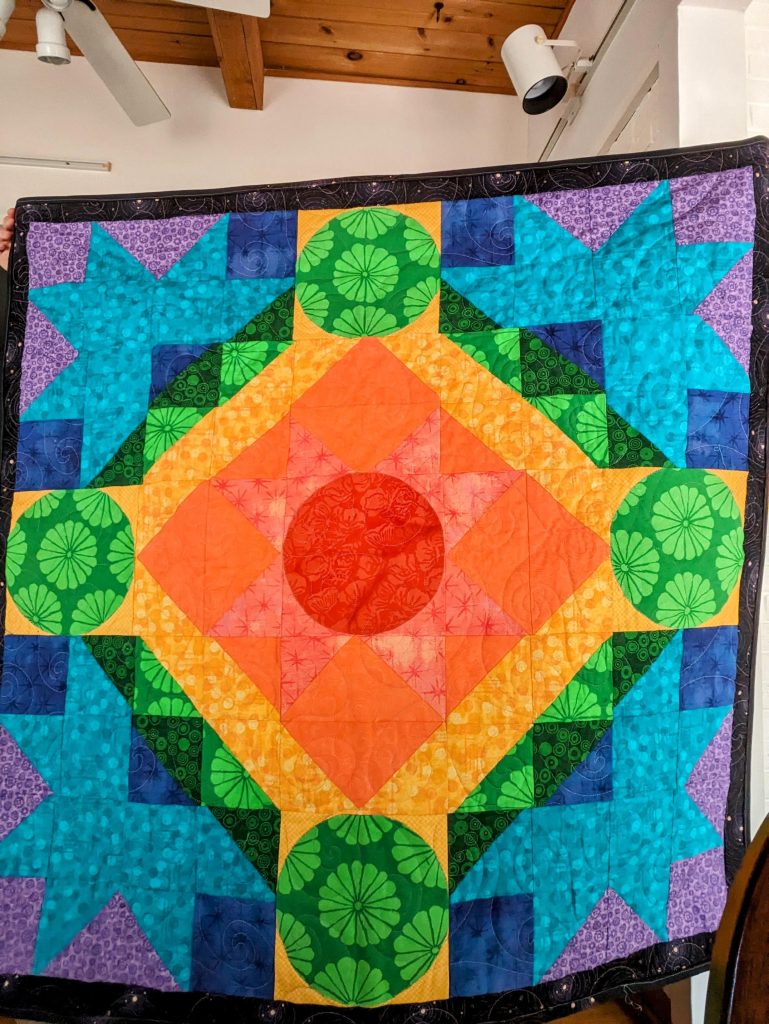
This is my own pattern, but I believe in releasing these things into the wild, so I’m gonna tell you how to make it.
The original is a crib/baby quilt, so it was envisioned to be 40″x40″, which means each square is 8″ plus seam allowance (typically I use a 1/4″ seam allowance, but I don’t sew especially scant on purpose). Feel free to do your own quilt math and make it bigger or smaller. If you want like a 50×50 lap quilt, you could add a thicker border around the edge. I don’t care. It’s your quilt. Make yourself happy. You don’t have to use the same colors, either, but I will refer to the colors in this quilt when I describe the pattern.
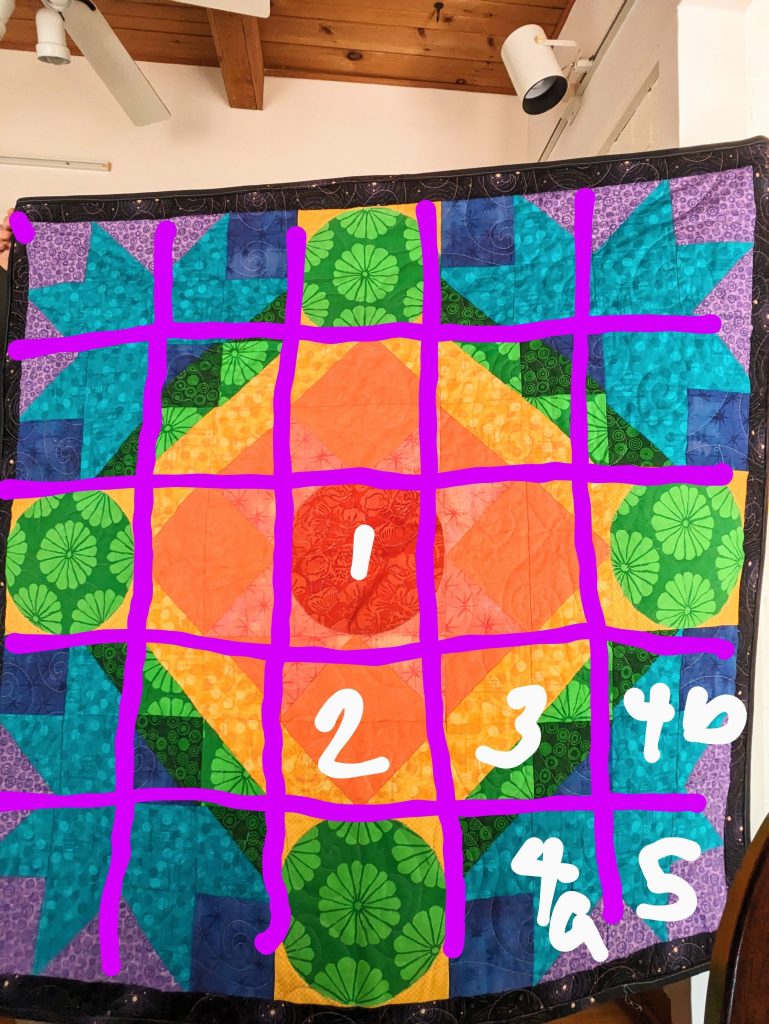
Here’s a diagram that shows the squares:
There are five types of squares that get repeated.
For type 1, I cut a circle out of the focal material and basically glued it down using an iron-on applique product. Many of these have names like “Heat and Bond.” Ask the old ladies at your quilt store if you’re not sure which one to get. After I appliqued it, I stitched around the circle with a thread in a pretty color using a zigzag stitch. Because the stitching does take up the fabric a bit, you may want to cut this square a little big (like…9″ instead of 8.5″ or even a little bigger) and then trim it if you need to. You will need five circle blocks.
For type 2, I did these as two flying geese, because there are ways to make a lot of flying geese pretty easily. You could also do it as four half-square triangles, or an orange square on point and just sew on the corners. I don’t care. I don’t think one way is inherently superior, although depending on your fabric, maybe you want fewer seams. Or maybe more seams is easier for you. You will need four blocks like this. For your 40″ quilt, each finished flying goose (before it is sewed into the square) will have to be 8.5″ by 4.5″.
For type 3, you have four half-square triangles (HSTs): one orange/yellow, two light green/yellow, and one dark green/dark blue. Since there are four of these blocks, that works out to four orange/yellow, eight light green/yellow, and four dark green/dark blue. Each finished HST, prior to being sewn together, should be 4.5″ by 4.5″. (Damn it, that’s math. I wasn’t gonna do that.)
Blocks 4a and 4b are mirror images. Each one contains a square of light blue, a square of dark blue, a dark green/light blue HST, and a light blue/light purple HST. Be careful when you assemble these–it is easy to get confused, especially if you don’t especially like rotating shapes in your head or whatever. You need four of each (so eight total with these colors). These are also 4.5″ x 4.5″ for the hypothetical 40″ quilt.
Block 5 is essentially the same: one light blue square, one light purple square, and two light blue/light purple HSTs. You need four of these, and again they’re 4.5″ x 4.5″.
I put on a dark purple border. If I’d done better math, I would have made it bigger, but whatever. I usually want at least a 2.5″ wide border; smaller than that looks a bit weird in my opinion.
Tips: Iron everything at every stage. I press my seams to the side rather than open. Spray starch if you have to. Quilt it in the way that makes you the happiest. Bind it with either more dark purple (if you have enough, I didn’t) or black (if you have enough, I didn’t), or both in some kind of random arrangement (ding).
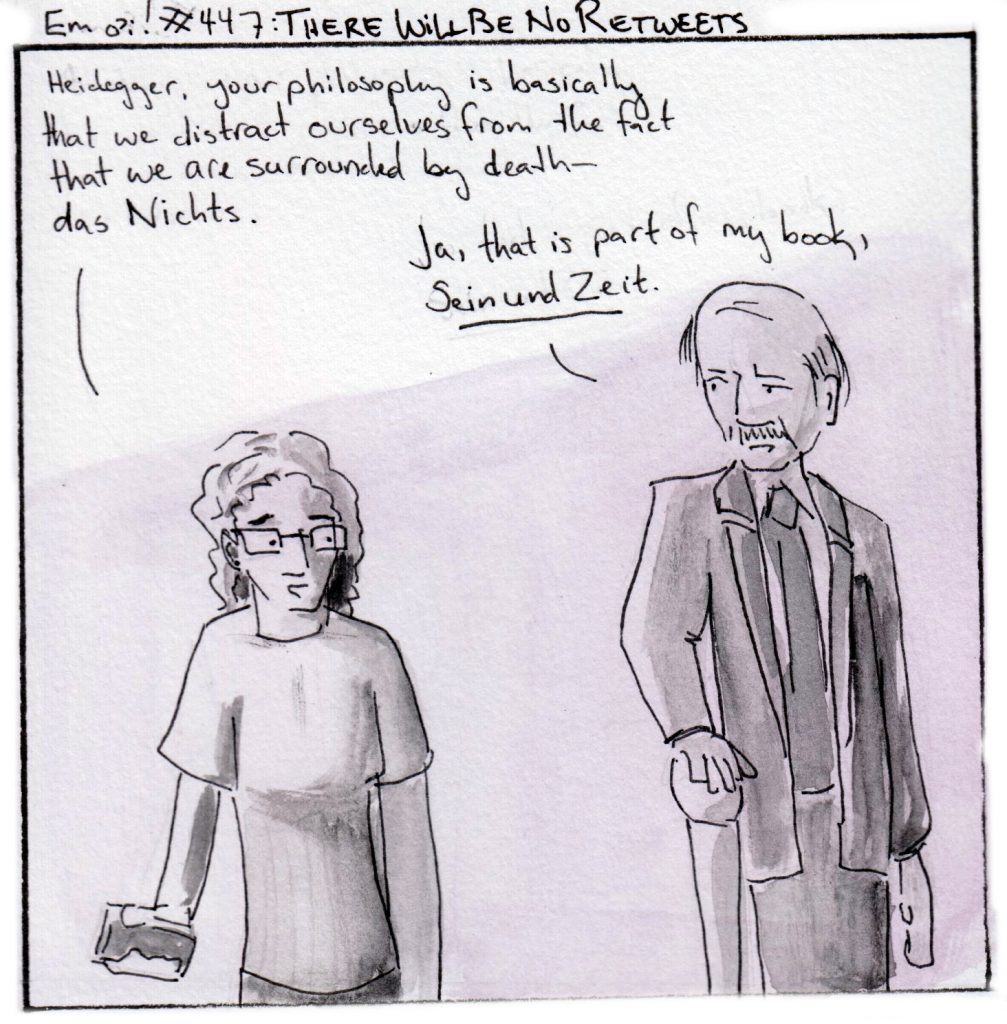
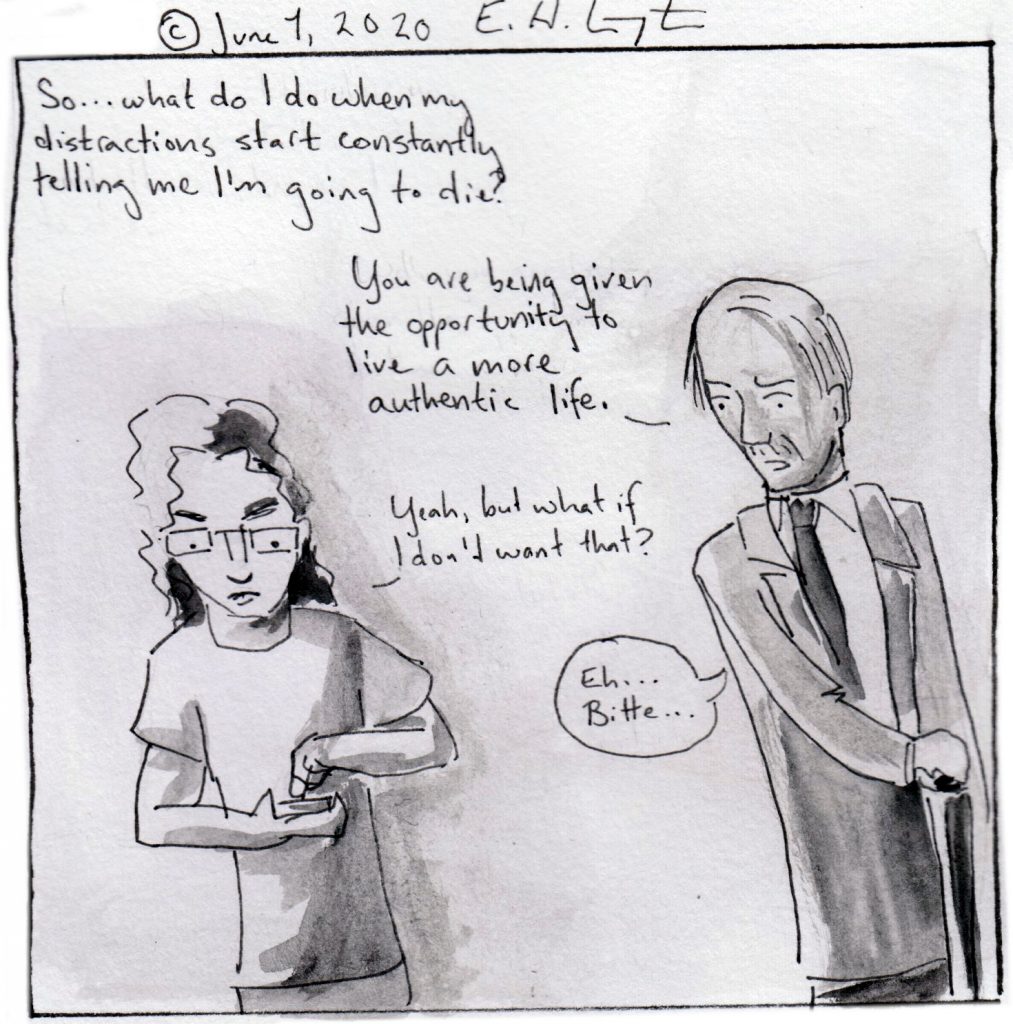
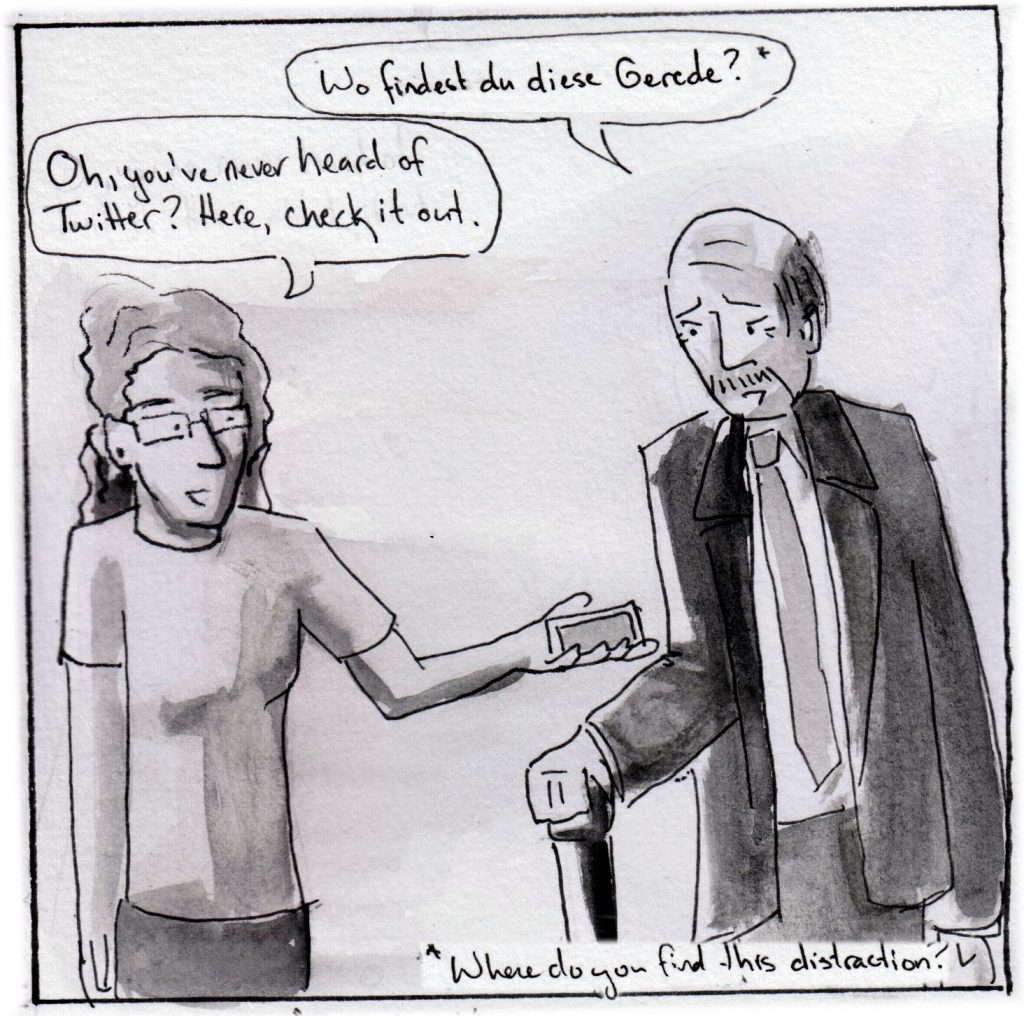
In Heidegger’s lingo, “das Gerede” refers to the distractions sort of generally. It also means “talk” or “chatter.”
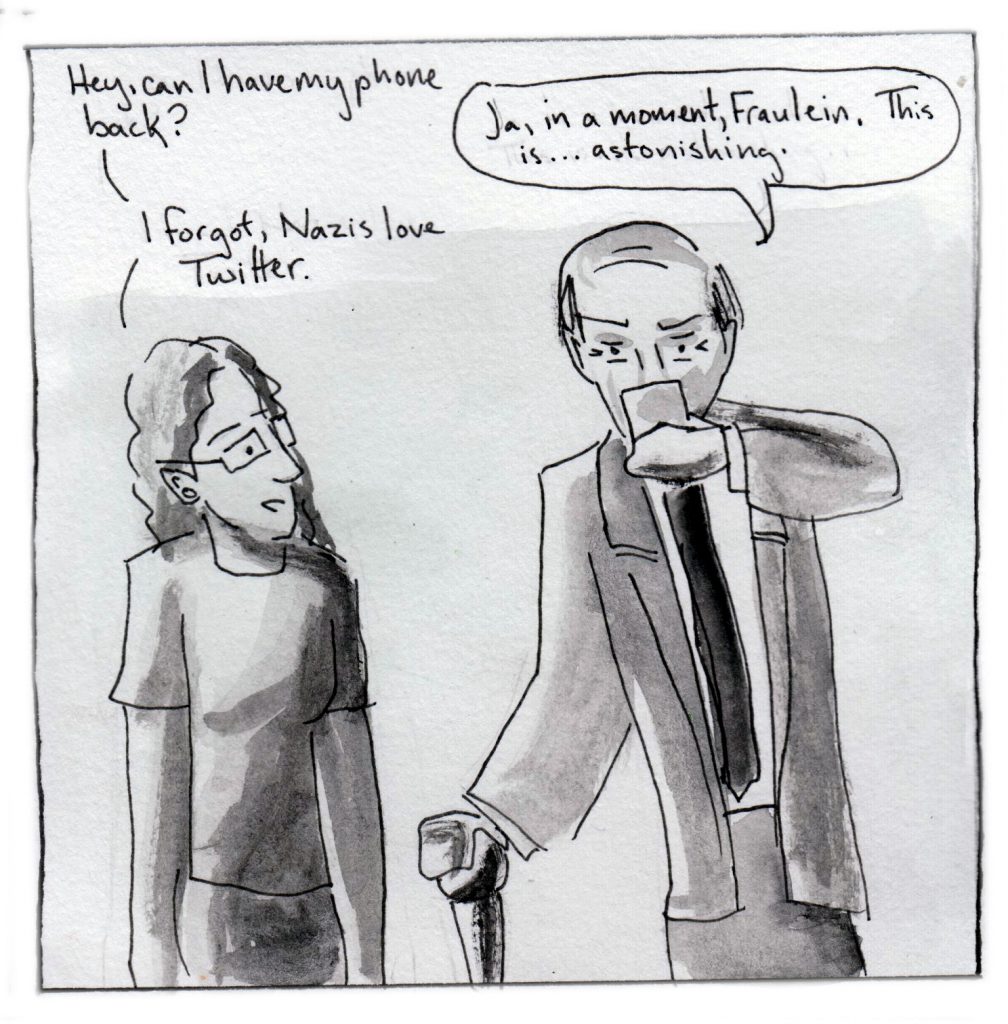
I wrote the script for this comic on May 21st, which is to say I wrote it down on May 21st–it had definitely been kicking around in my head for much longer. The “everything is reminding me I’m going to die” line was originally about COVID-19. It…still feels really relevant, but for different reasons, and as usual I feel weird for using Heidegger… so let’s talk about Heidegger. It feels like a good time to talk about white supremacy in philosophy![1]
Martin Heidegger (1889-1976) was a Nazi. I’ll lead with that, because even though his big masterwork Being and Time was written well before any of the stuff I’m about to talk about happened, his Nazism tends to feel like such a central fact to his life that I think I need to put it in front. I’m going to say in a minute that he was a more complicated guy than that appellation usually permits, but let’s not lose sight of it. Philosophically, he’s sort of loosely associated with both phenomenology (the study of consciousness from a first-person perspective[2]) and existentialism; he was a student of Husserl. His academic career benefited from his association with the Nazi party, as he was elected rector of Freiberg University, and either implemented or allowed to be implemented some of the party’s political policies, depending on who you ask and how generous they’re feeling–he may have stood up for some Jewish colleagues and helped them keep their jobs, though others claimed he denounced colleagues and blocked them from jobs, and he certainly denied student aid to non-Aryan students. During his time as rector, he made several speeches tying his philosophy put forward in Being and Time (aka Sein und Zeit) to Nazi ideology. He stepped down from his rectorship in 1934 and thereafter distanced himself somewhat from Nazi politics, although he didn’t leave the party. After the end of WWII, he was banned from teaching until 1949 as part of a denazification campaign. He became a professor emeritus in 1950 and I suppose did whatever it is that retired professors do until 1976, when he died.
Heidegger had developed his own way of describing the nature of human existence. It wasn’t religious, and it wasn’t scientific; it got its arms around everything, from rocks to the soul. Instead of subjects and objects, Heidegger wanted to talk about “beings.” The world, he argued, is full of beings—numbers, oceans, mountains, animals—but human beings are the only ones who care about what it means to be themselves. (A human being, he writes, is the “entity which in its Being has this very Being as an issue.”) This gives us depth. Mountains might outlast us, but they can’t out-be us. For Heidegger, human being was an activity, with its own unique qualities, for which he had invented names: thrownness, fallenness, projection. These words, for him, captured the way that we try, amidst the flow of time, to “take a stand” on what it means to exist. (Thus the title: “Being and Time.”)
I don’t believe he’s widely taught in undergraduate philosophy departments; certainly when I was a student at UW-Madison, he was not being taught, as far as I am aware[3]; I see now he is included in a class on Existentialism that also includes Kierkegaard, Sartre, Camus, and de Beauvoir, which is…an interesting combination there. I think his lack of inclusion is due at least as much to the fact that he’s extremely difficult to parse as his politics (although I should point out that every philosophy department routinely teaches Kant, you can’t NOT teach Kant, and he’s also difficult). On the other hand, he seems pretty popular in the amateur philosopher world–Philosophize This! did three episodes on him, A Partially Examined Life did three episodes. If you look on YouTube, there are plenty of videos like this one, which informed this comic (I count at least five other introductory videos). My rival, Existential Comics, has done a LOT of really funny comics about him.[4]
So why do we amateurs, who are not bound by the rules of academia[5] keep returning to Heidegger? Probably because his ideas have a certain resonance with us as people living in the exhausting modern world. It’s easy to see that we genuinely do immerse ourselves in distractions that keep us from thinking about the reality we’re dealing with; our experiences are rarely unmediated, whether it is because we are continually viewing things through our phone’s cameras or reacting to things online rather than engaging with them in real life. Being and Time was written in 1927, but it still feels very contemporary and relevant. As an environmentalist, I wholly support the idea that people need to get more in touch with nature in order to get more in touch with their authentic selves (at one point, Heidegger recommends taking long walks in the country). As a specifically difficult text, it also probably engenders a certain amount of satisfaction in the readers that leads them to want to talk about it, which may also account for some of the fascination. Or, quoting Rothman again, “You don’t spend years working your way through “Being and Time” because you’re idly interested. You do it because you think that, by reading it, you might learn something precious and indispensable.”
Heidegger also has the advantage of having been defended, pretty ardently, by Hannah Arendt (this is the complicating part of his biography), who was herself a pretty legit philosopher and also a German Jew. She was also a student of Husserl’s who briefly studied under (and had an affair with the married) Heidegger before completing her PhD in 1929 (Germany was a pretty cosmopolitan place at the time); she then fled Germany in 1933. She defended him post-war, even knowing that he had been a Nazi. This is sort of where his biography gets tricky, because both their relationship and the extent of his Antisemitism weren’t really known about until after his death. He also wrote some stuff in his last book, Only a God Can Save Us, that suggested he was at least disillusioned with Nazism by the end. Of course, with him being dead for like 40+ years at this point, we can’t exactly ask him to weigh all of this and explain, and even if we could, what credence could we attach to his explanations?
Is Heidegger really such an important part of the history of philosophy that we need to keep talking about him? This question comes up a lot when dealing with former Nazis, and in a lot of cases the answer has been, “No, we should chuck the Nazis out”–but coincidentally, this seems to be the choice when the results of whatever research they were doing is rubbish. For example, the medical community doesn’t pay any attention to what Mengele did[6]. On the other hand, Wernher von Braun actually…designed the Saturn V rocket. So, you know. In a broader sense, this is a question that comes up again and again with reference to what has been termed “cancel” culture, whereby a mob will publicly shame someone, typically a celebrity, for real or imagined crimes, and then basically try to ignore that person, cutting them out of society. Does the person get to resume their livelihood? When, if ever? No one is quite sure yet.
For me, the question could be framed more specifically as “Why do I continue to return to Heidegger?” There are ultimately a few reasons. First, there is something compelling about this tiny piece of his philosophy that speaks to me, just like it speaks to so many others. Second, I take a perverse delight in co-opting the philosophy of someone who would have been unhappy about the idea–Heidegger blamed a lot of the modernization he hated on Jews, and saw them as “uprooted from Being-in-the-world”–i.e., incapable of authenticity (Rothman’s quote and summary), so for a Jew to demonstrate the same anxieties and concerns with modernity that he does has a certain ironic appropriateness. Drawing him providing advice to me, someone he probably would not have had time for in life, is extremely funny to me. Third, I like to use him to remember that even smart people can be seduced and make extremely terrible decisions, and that it is a good idea to stop and think things through once in a while.[7] Reading more about him, Heidegger is basically the banal kind of evil you meet every day, a bureaucrat looking for an edge more than a guy personally shooting babies, just rules-bound enough to make life a little more difficult for everyone. But at the same time, I have to feel like maybe there aren’t any innocent Nazis, just like there aren’t any good cops.
But. More and more, watching the George Floyd protests, I’m reminded that a lot of normal people in Germany were probably like Heidegger–secure in their privilege, and not very brave. No one, on a day-to-day basis, stands up to the police, because there’s no accountability, so people have literally taken recordings of people getting murdered in front of them and yet done nothing to intervene with the actual murder. I don’t know if we can exactly blame anyone for not wanting to put their own lives on the line; in part, perhaps it’s a demonstration of how afraid people are. The cops aren’t going to come over here and start busting heads, so we can film them, but if we try to intervene, well–who knows what amount of restraint they’re willing to exercise. (Having written this and then watched a week of protests, I can tell you the answer is “none”–it doesn’t matter who you are, the police will beat you if you get in their way.) You might have called these people collaborators in Nazi German, but looking at the way people in the US have been about, for example, the Trump Concentration Camps at the border, ICE abuses, the long-time abuse of civilians and especially Black people by the police, etc., etc., I think that might be a little strong. Collaboration implies active participation or approval in some way. Heidegger was, arguably, in the weakest sense, a collaborator. Instead, I think we could say that these problems are so big, pervasive, difficult, and frightening that instead of facing them (for longer than a few news cycles), people tend to retreat into das Gerede–the chatter that distracts us all from the Real. Now that the typical outlets of das Gerede (Twitter, Instagram, FB, Reddit, Imgur, etc.) are all full of images of protest and conflict, we have nothing to distract us. The problems will be faced; they must be faced.
Whenever big protest movements come up, people seem to think in terms of the things they would lose were the movement’s ideals to be enacted, both explicitly and not. Defund the police? Then who will find our stolen cars? Give women rights over their bodies? Then how will we be able to keep them powerless at home? If I told you to stop teaching Shakespeare, you might rightly protest that there would be a huge gap in the curriculum, leaving out some of the greatest works of literature in English. But because any class has a limited number of hours per week, limited weeks per semester, and students have a limited number of semesters in the time they spend at school, leaving things out can also offer the opportunity to add things in that are now overlooked. Already any philosophy curriculum suffers from history–there are so many philosophers from Thales onward. Who could we include if we didn’t spend time on Heidegger? What level of excellence would it have to attain to be worth the trade off?
There’s a kind of false argument people often bring up when affirmative action comes up that suggests that if you decide you’re going to try to hire someone nonwhite, someone nonmale, you’re somehow giving them the job out of pity, because they couldn’t possibly just be the best candidate for the job. But I think one thing we’ve learned is that they often are the best candidate, and without diversity initiatives we would have overlooked them and hired another mediocre white guy. So I want to start a diversity initiative in philosophy, and make the claim that just because there are a lot of smart white guys, maybe there are some philosophers who also have interesting, illuminating, even genius things to say who are different from the milieu. This is my modest proposal–no matter how much we are willing to smooth over Heidegger’s crimes, no matter how much of a singular genius he may be (and I think more and more that this is a myth, there is no such thing as a singular genius), maybe we could do better.
It has been difficult for me, sitting at home, to not be able to protest. I feel like words are no longer useful (who needs another think piece? The answer is always “no one”), but words are all that I have to give (I mean, you can give money too–see this next footnote for some resources[7]). Words about the way philosophy is studied are the smallest potatoes imaginable; it’s just an area I feel like I have a little bit of something to say about that maybe other people aren’t already talking about in a better way. So I press on against the current, borne ceaselessly back into the past.
The title is from Amanda Palmer’s album There Will Be No Intermission, aka the album most likely to make me break down in sobs in front of my computer. Saddest song. Favorite song.
[1] After I started working on this, I realized I had a lot to say about the “canon” of philosophers as taught in normal classes (or even as philosophy afficiendos, the philosophers we most pay attention to), who are pretty much exclusively white and male until you get into the late 90s and after, and then still like 90% white and male, as well as the deficiencies of my undergraduate education in general. But this essay is already over 2,000 words long, so I have not said every thought on the matter.
[2] Other major phenomenologists include Hegel and Kant.
[3] I took mostly classes on Philosophy of Science, so studied philosophers like Frege, Russell, Wittgenstein, and Godel, as well as a fair amount of Plato. So it’s possible they were doing classes on Heidegger and I just wasn’t interested at the time. Side note–other major philosophers mentioned here who are not being taught: Husserl and Arendt, both of whom were Jewish. And I do not recall reading any texts by major philosophers of color during my tenure there (we barely read any women–only in my ethics course, really). Side side note, it’s interesting how almost every concept in philosophy is attached to the person who thought it up with the exception of the trolley problem, which is very widely known but most don’t know it as the brainchild of Philippa Foot. Interesting.
[4] Just kidding, we’re not rivals. They’re great.
[5] Rule one: thou shalt stir up benign controversy so people will cite your paper
[6] This is what I have been told, anyway. I have not been able to discover any articles with a cursory search.
[7] It’s worth noting that Heidegger’s disenchantment did not come from, like, the mass murder parts of the Nazi philosophy, so even smart people can make relatively huge errors in judgement.
[8] Free the 350 Bail Fund is the bail fund for Madison, WI. And this site lets you split a donation among several different worthy organizations. And there’s always the ACLU.
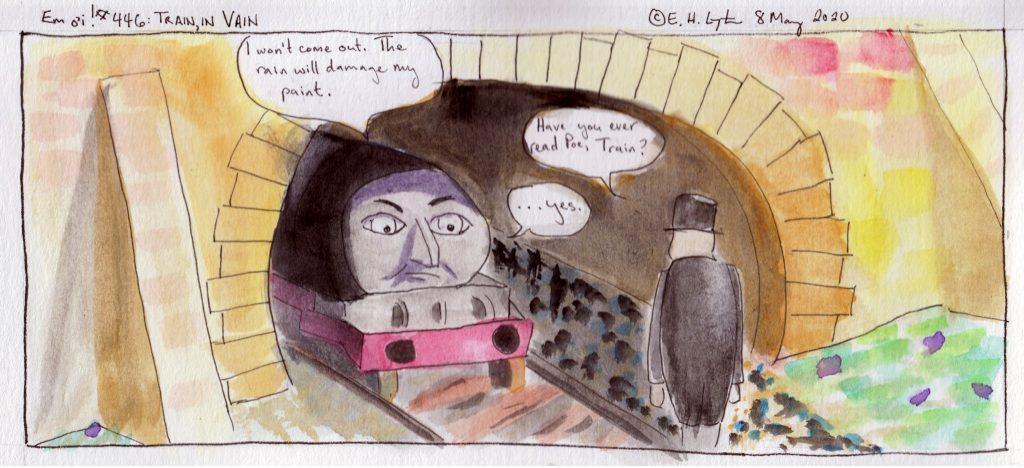
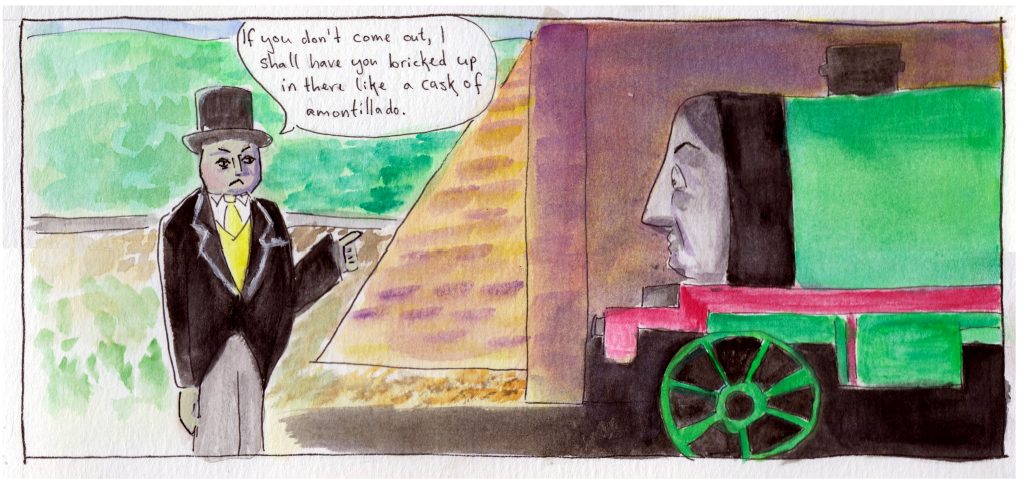
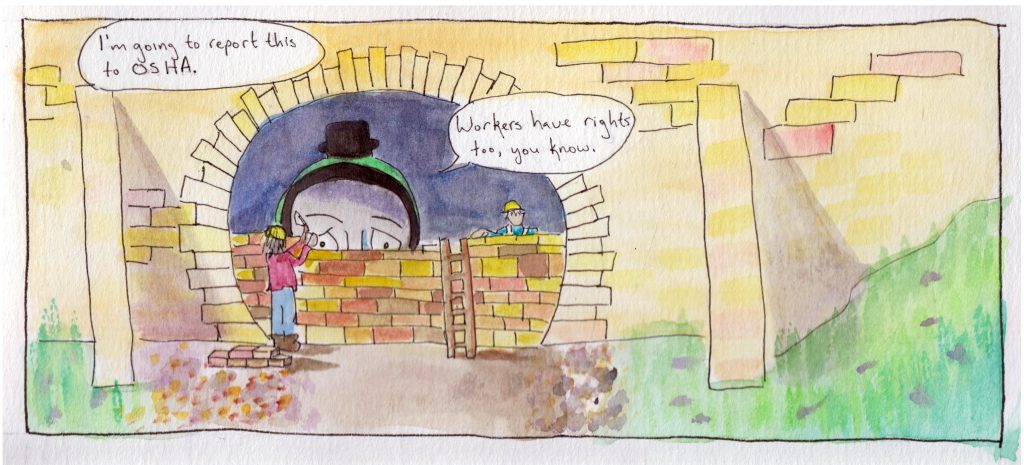
So I need to make it clear that this isn’t something I made up. This is genuinely something that happened in a Thomas the Tank Engine video. You can check out the UK version here, and the subtly different but still incredibly weird US version here.
Here are a few “fun” facts I have found out since I started researching this comic:
Sir Topham Hat is often referred to as “the fat controller” in the British version, but always by name in the US version, because the word “fat” is considered more pejorative in the US.
The story this comic is based on (linked to above) was originally published in 1945.
The character of Sir Topham Hat is originally an engineer and referred to as “the fat director” (i.e. Director of the North Western Railway). Then, when the railway becomes nationalized and joins the British Railway, he becomes the fat controller.
In a show of nepotism (and sexism), he’s married to the sister of the MP from Sodor East and owner of the Skarloey Railway. No wonder he became controller.
In the books, he has two kids, and eventually his son and then his grandson become controllers of the railway (more nepotism, more sexism).
He’s styled “sir” because he’s a baronet. This means he ranks above all knights/dames but is not a peer, BUT it is a hereditary title. Please feel free to check Burke’s Peerage for more information on what this means for how deeply he has to bow when meeting the queen.
Seriously, a long time ago I was worried that grandparents who hadn’t touched a baby in thirty years would:
Put my child down to sleep on his stomach.
Give him solids too early.
Feed him nothing but sugar.
Somehow fuck up his sleep cycle (this happened, but we recovered, and they never managed to fuck things up so badly we were forced to co-sleep or anything, which was a story I heard).
I should have been more worried about the introduction of children’s television.
And it gets worse, because I know I have brought this upon myself. A few weeks ago, we were pretending that Thomas was only viewable at Grandma’s house. Then daycare closed, and we decided to start potty training. I mean, we’d been planning to anyway, but we started a little early because hey, you’re already hanging around the house all day trying to do eight hours of work while watching a toddler, why not also add in an extra level of difficulty with regards to bodily fluid management?[1] The point being that I told Hal one morning, “Hey, we’re going to start potty training today!”
Sensing an opportunity, he said, “You say ‘training’?”
“Ah, yes,” I said, suddenly feeling like a bar owner who understands that there might be a way out of my current dilemma with the health department via paying some cash to a local businessmen’s association. “If you use the potty successfully, you can watch a Thomas video.”
Plus side: Potty training accomplished. Minus side: This is what being hoisted by your own petard looks like.
We’ll file this one under PS648 R3 L86 2020, for American literature–Collections of American literature–Prose (General)–Special forms and topics, A-Z–Railroad stories.
Anyway, there’s a new episode of Ask a Medievalist over at AskAMedievalist.com (or on iTunes/Google Podcasts/Stitcher/etc.) and a new episode coming out next Thursday. Also, for everyone who has given us positive feedback! It’s great to hear from all of you, and it makes us feel really great about the amount of time this project absorbs.
Notes
[1] One million percent gratitude to Sarah, who has allowed us to get some toddler-free work hours. She is a rock star and has made the transition from dog sitter to babysitter with great ease and grace. If we have retained any sanity, it was because of her.
As I sat down to put this up, I realized that #444 was only ever published on Instagram/Facebook, so here it is for posterity:
I was training for a 50k when I drew #444. Now I am not, because all the races are cancelled and we are sheltering at home. Somehow I am still tired. Today I got up at 5am, ran 9.8 miles, then after work took Hal on a walk that ended up with me carrying him on my back up two different hills. Well, how is your quarantine going?
I have actually been doing a lot of random things, including sketching, learning how to draw with pastels, writing more depressing prose poems, trying to edit my novella, and making an awesome podcast! You can check it out here: AskAMedievalist.com. New episodes on Thursdays, probably. We also have a Facebook group, which you can find by searching for Ask a Medievalist on Facebook.
Okay, I would like to keep chatting with you all, but 1/ I used all my wits writing the annotations to the AAM episodes, and 2/ this is getting in the way of my eating ice cream now. Check out the podcast and remember that this won’t last forever. Even though it might last a while longer.
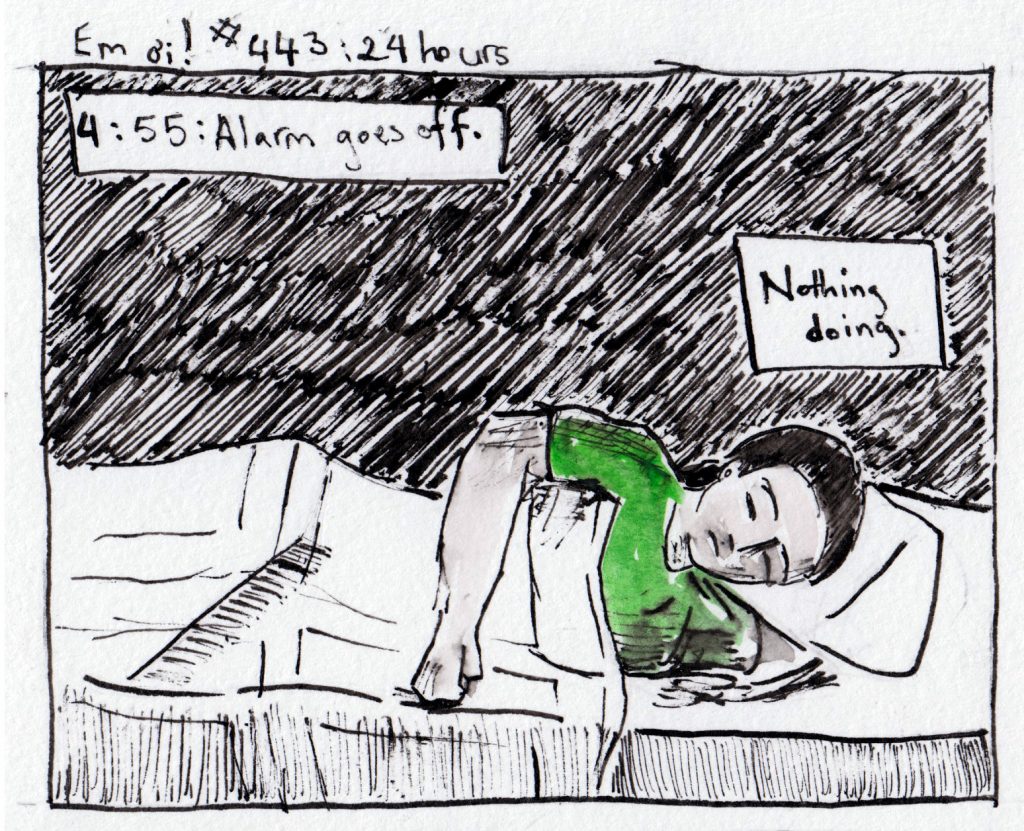
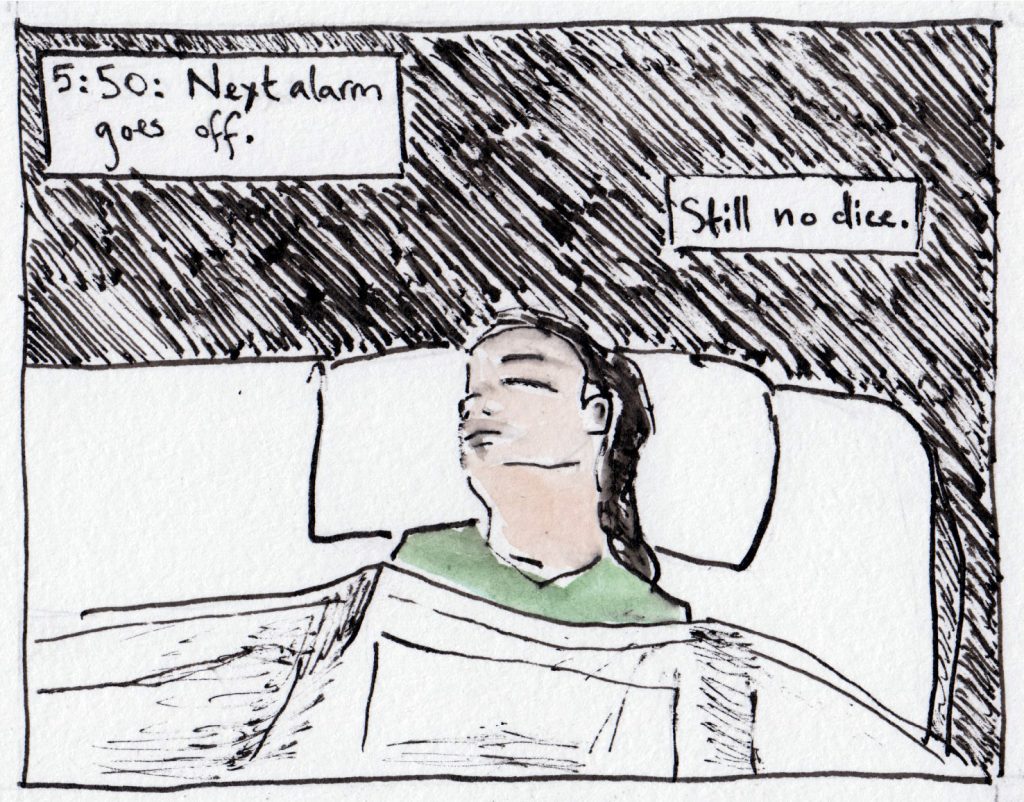
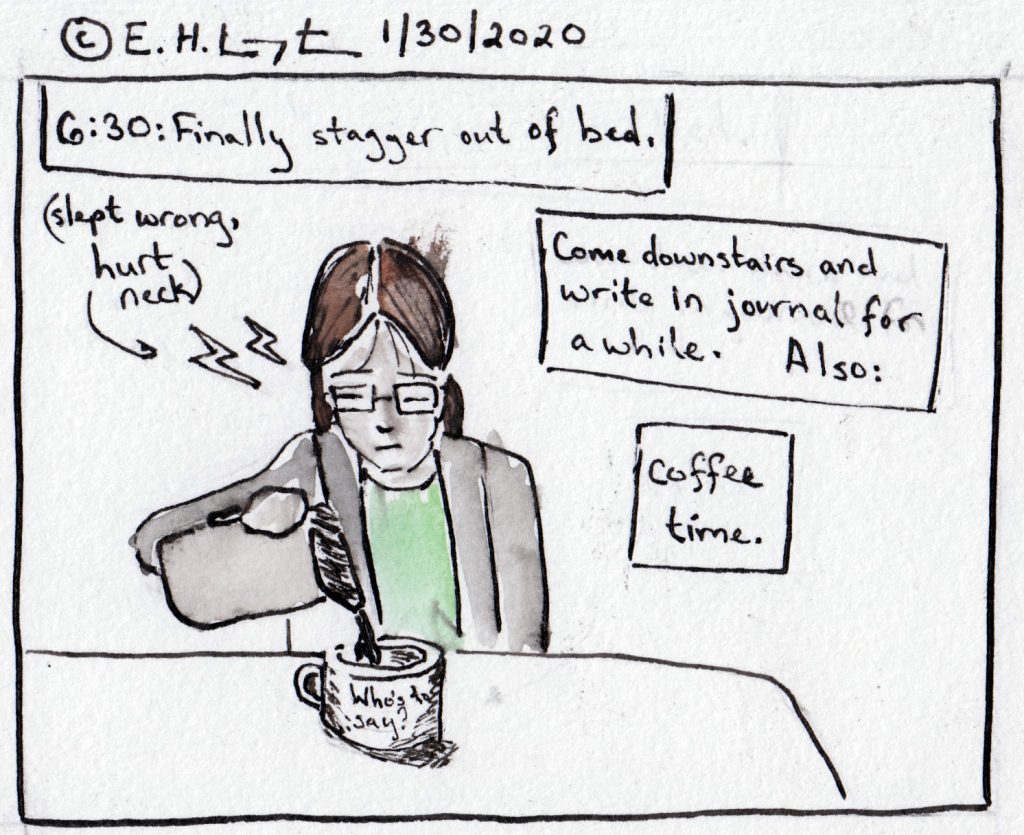
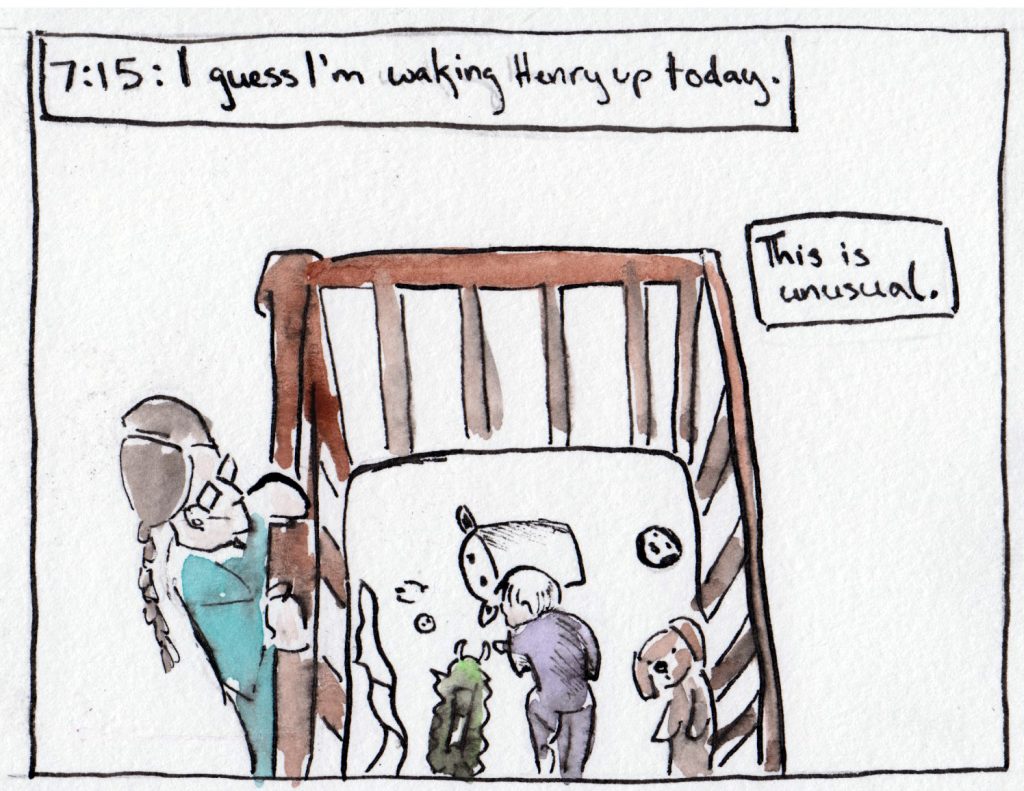
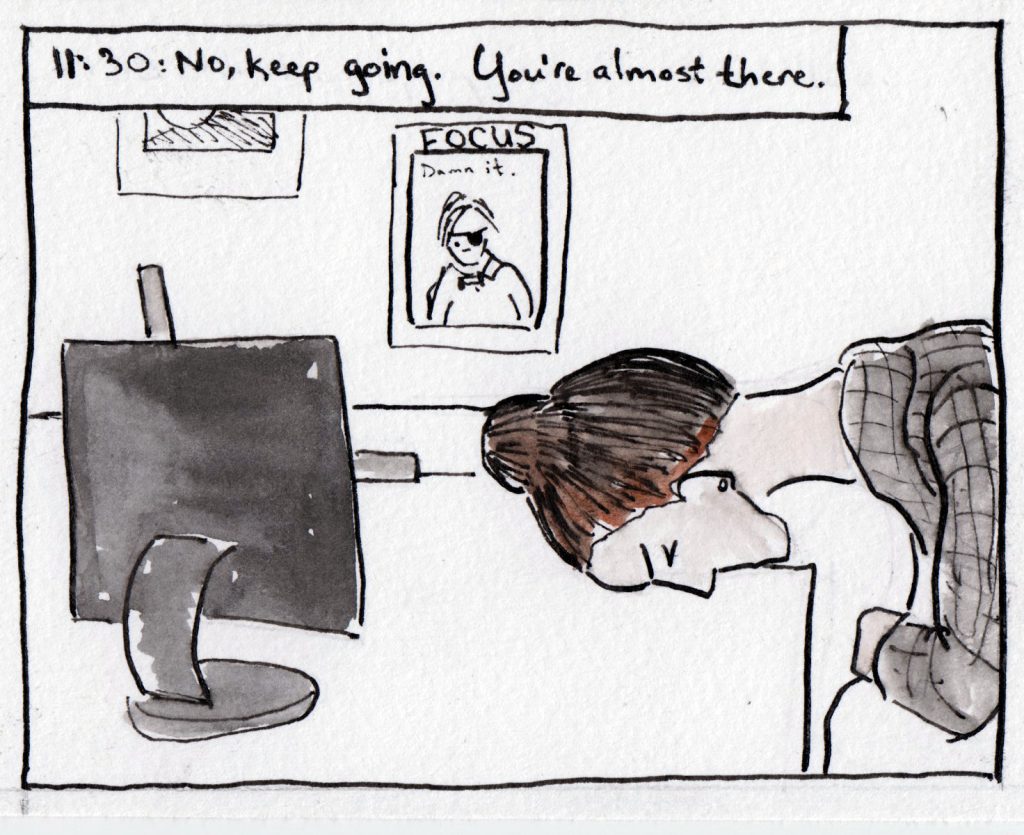
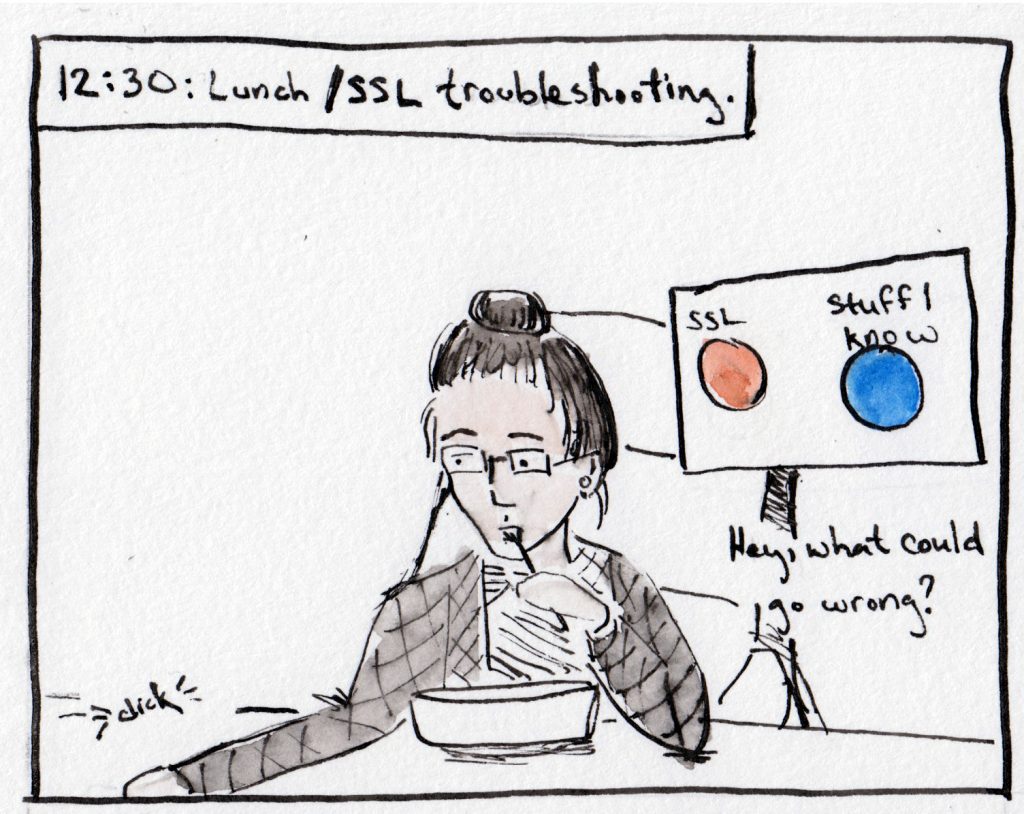
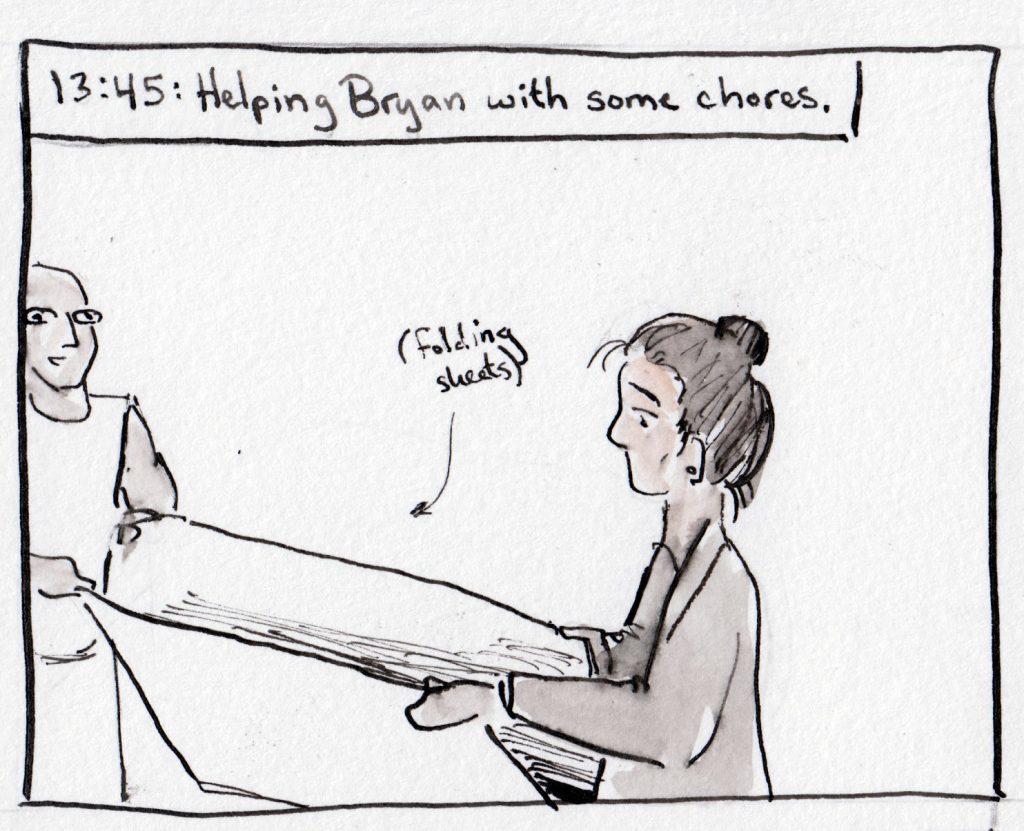
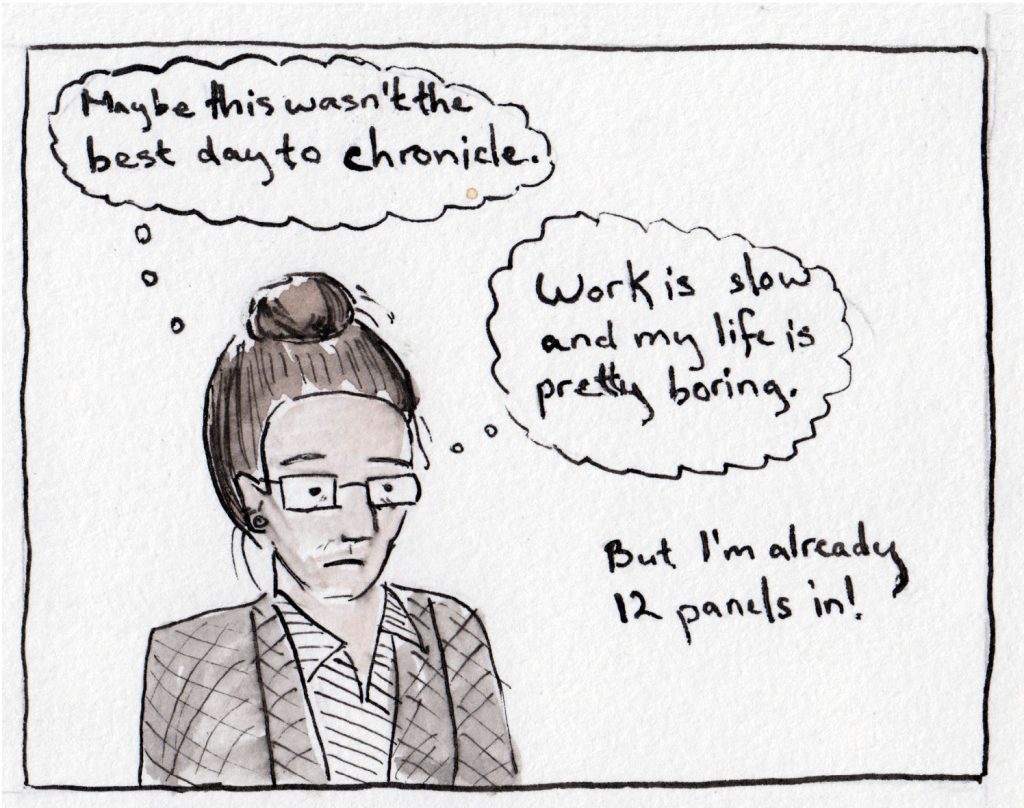
I did a twenty-four-hour comic! Except 2/1 was a Saturday this year and my drawing time on weekends is a little scant, so I did a Thursday. And okay, real talk: a lot of comic artists talk about a type of pen called a Speedball, which is basically a dip pen with a fairly stiff nib (I used a B-6, which has a round end and can produce a nice variety of line widths). And I can sort of see why professionals like these, but inking a comic with a dip pen as a left-handed person is a special type of torture (see, for example, the first two panels. Ow.). And then I went to do a little watercolor on it and discovered the ink I was using was not waterproof. So yeah. Nuts to that.
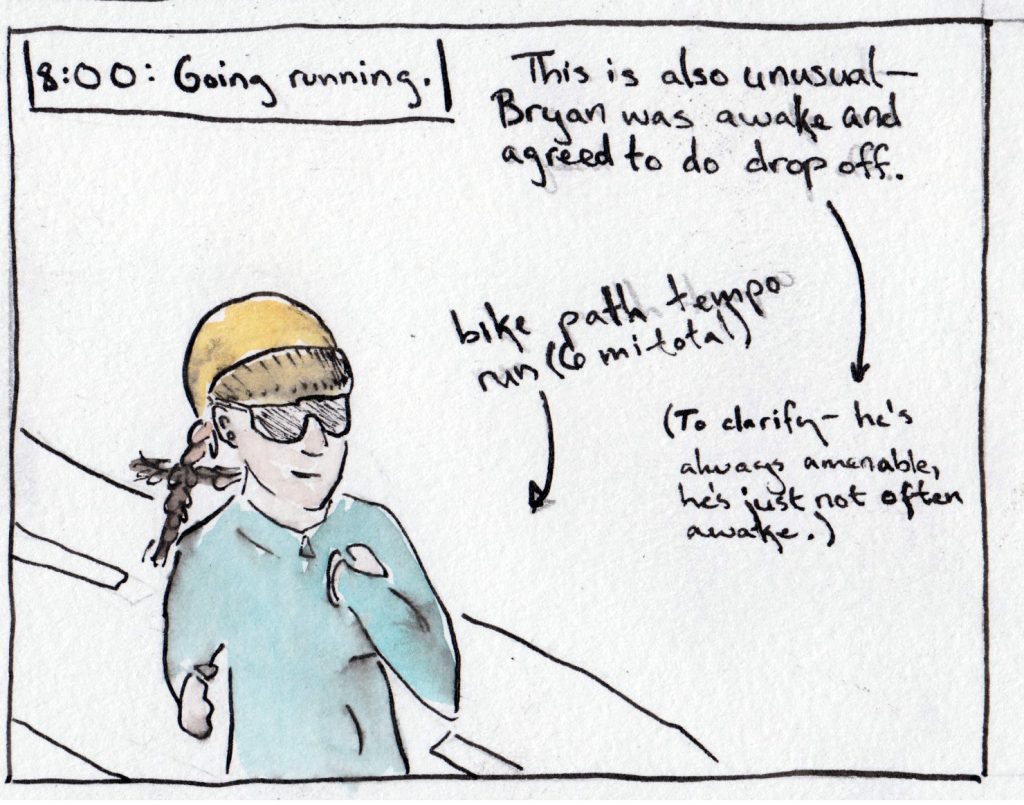
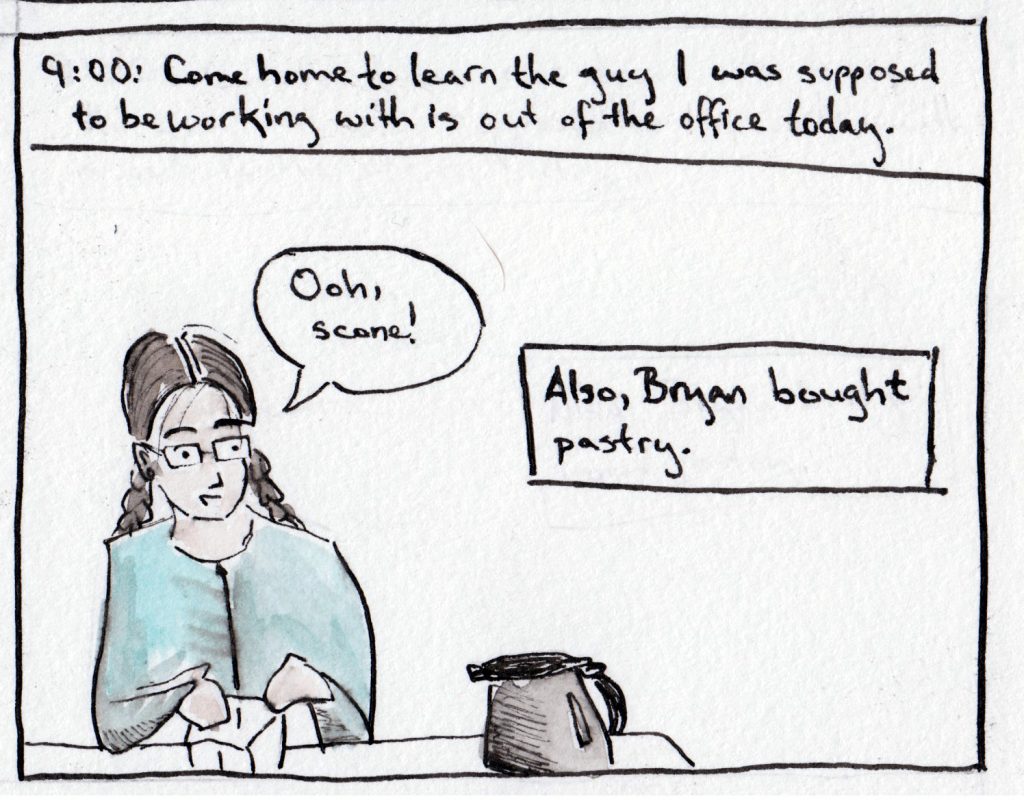
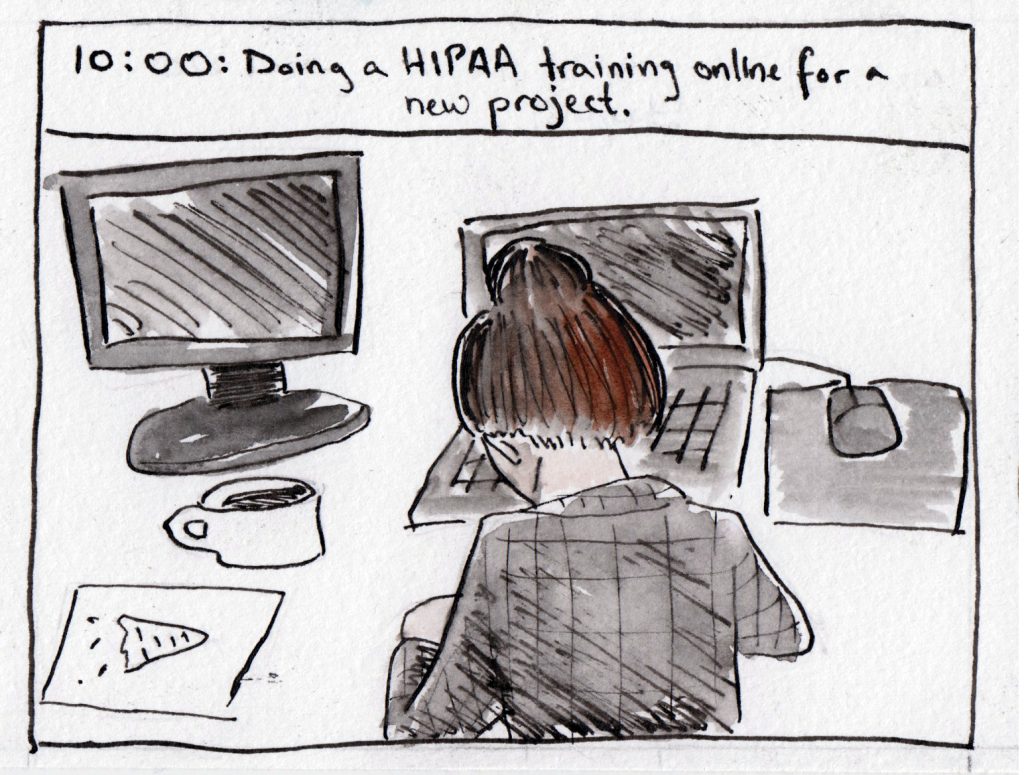
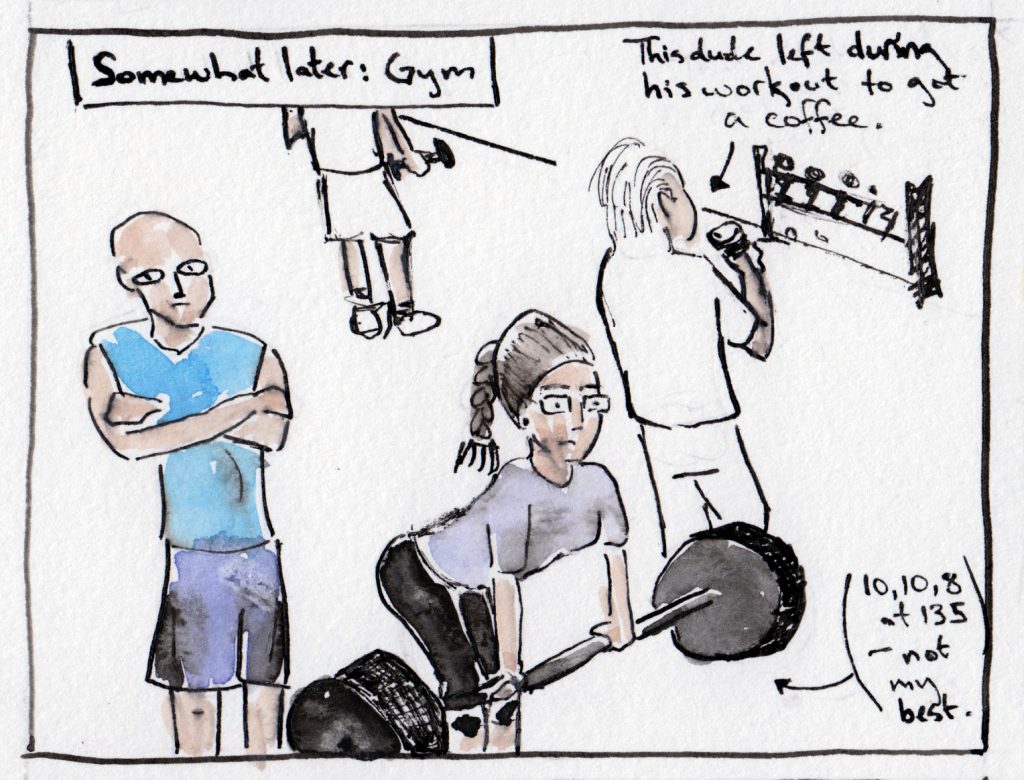
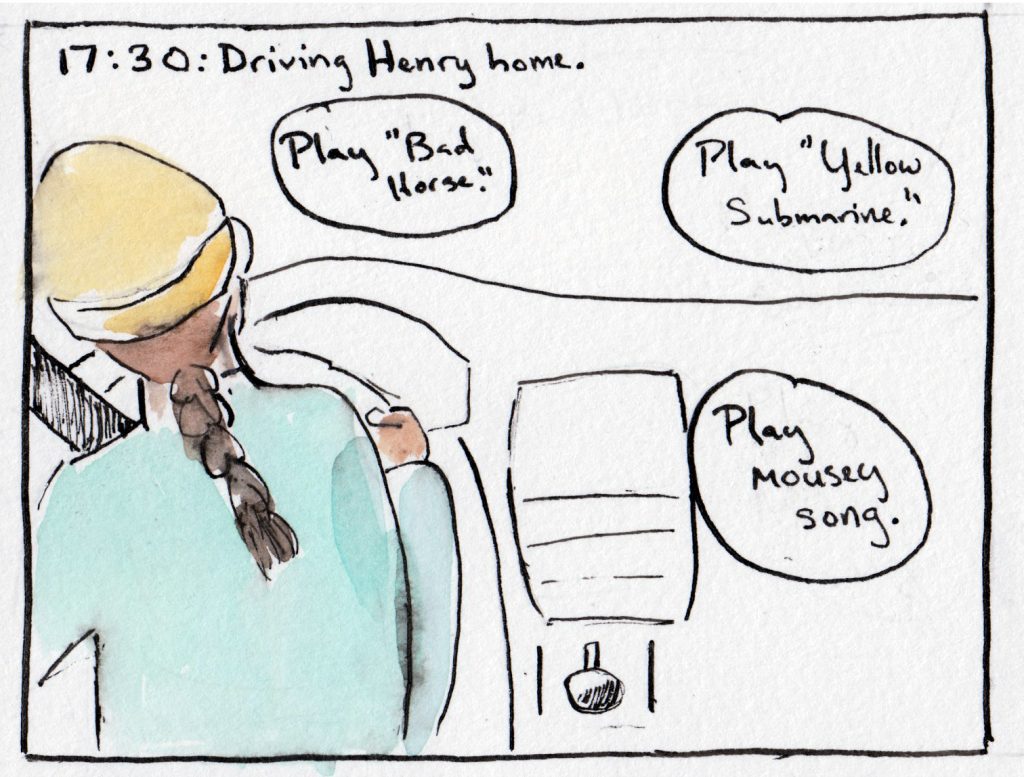
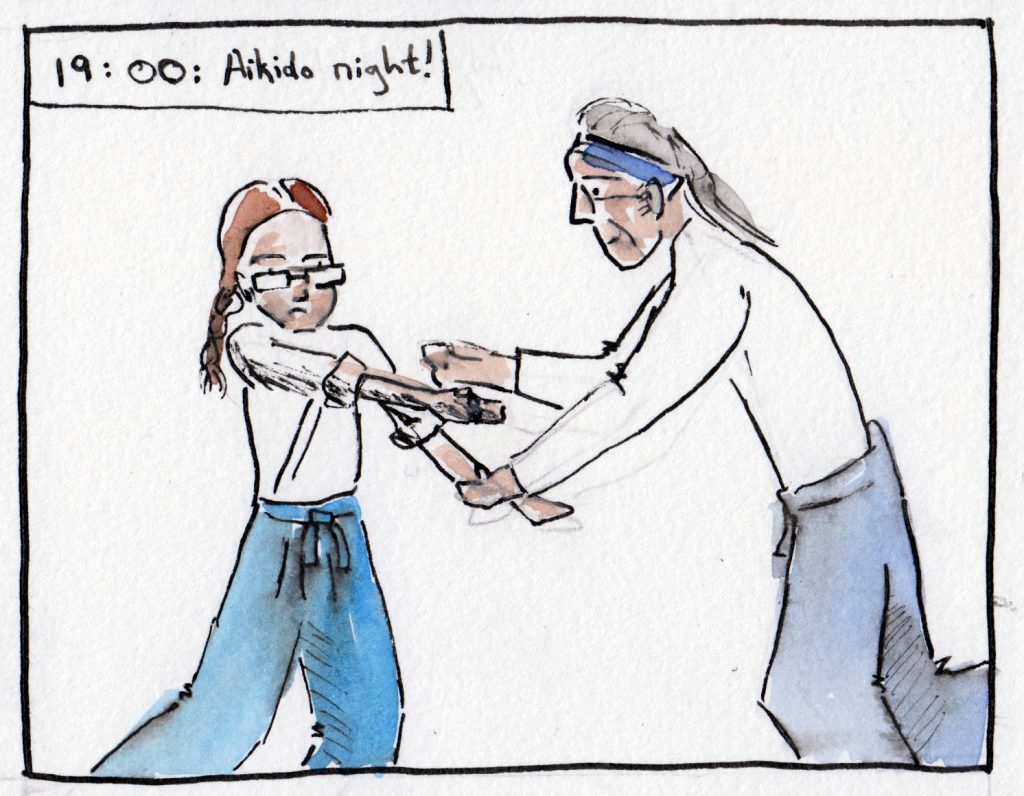
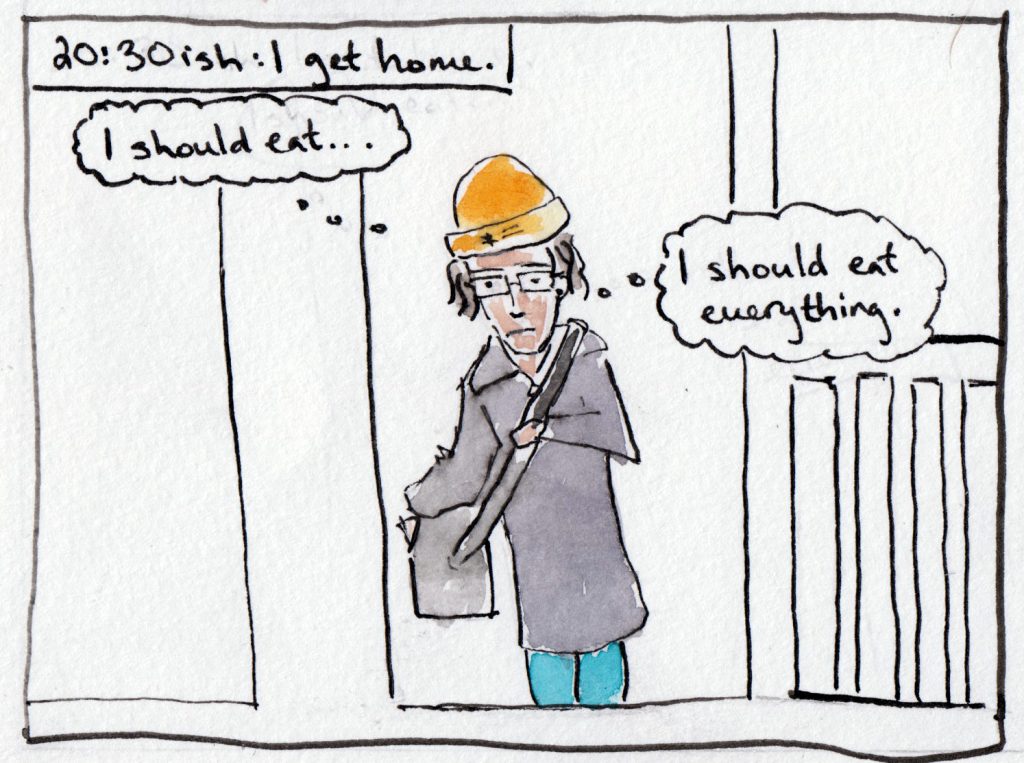
Anyway, a little look at my life. Not that exciting, honestly. Even on nights when I don’t go out to aikido (which is most nights), I’ve still been spending a good amount of time doing things like revising written stuff, submitting stuff for publication, and watching “Portrait Artist of the Year” on YouTube. So it’s not like I’m James Bond on other nights. I don’t know what you were expecting.
You can check out a couple of previous twenty-four-hour comics here and here. The biggest change from both of those comics is that now my coffee maker has a TIMER, so the coffee is just ready when I get up in the morning. If you don’t believe that this is one of the greatest innovations of the late 20th/early 21st century, you are wrong.
And we’ll file this one under PS3612.U686Z46 2020 for American literature—Individual authors—2001-—L—Biography and Criticism—Autobiography, journals, memoirs. By date.
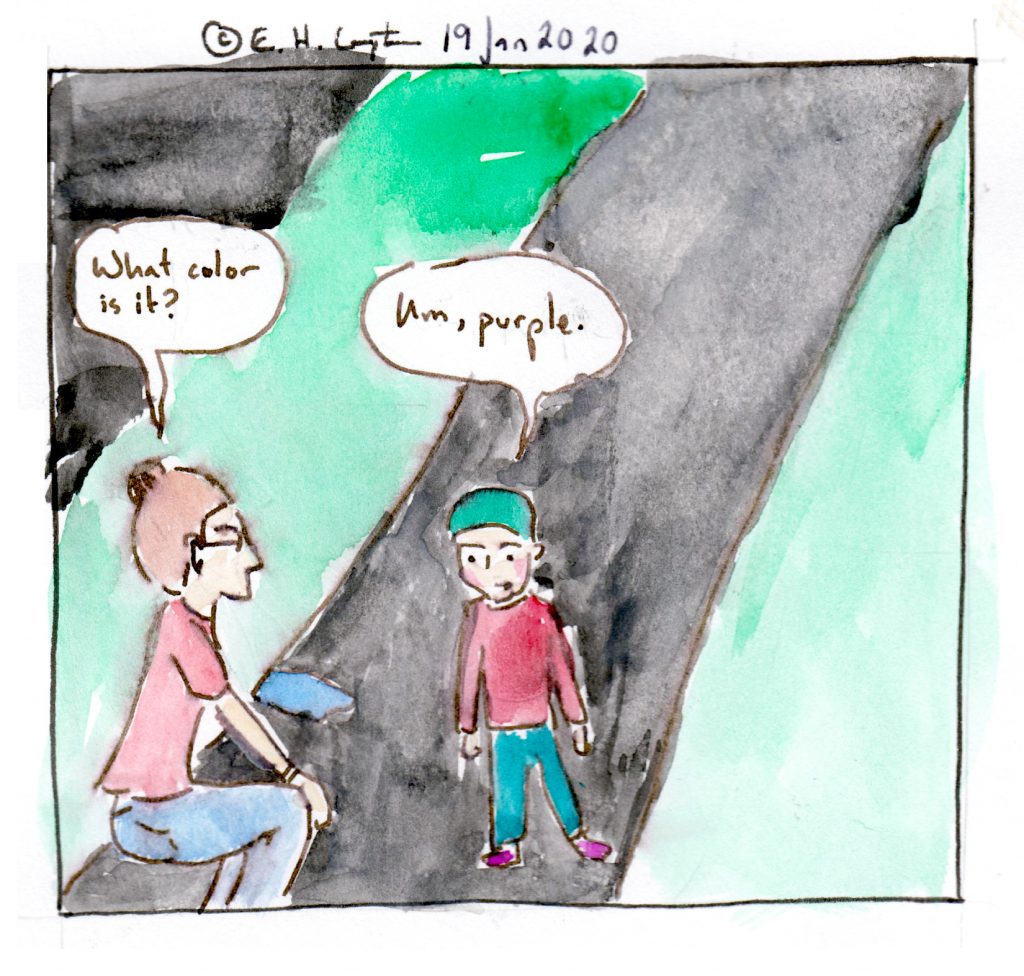
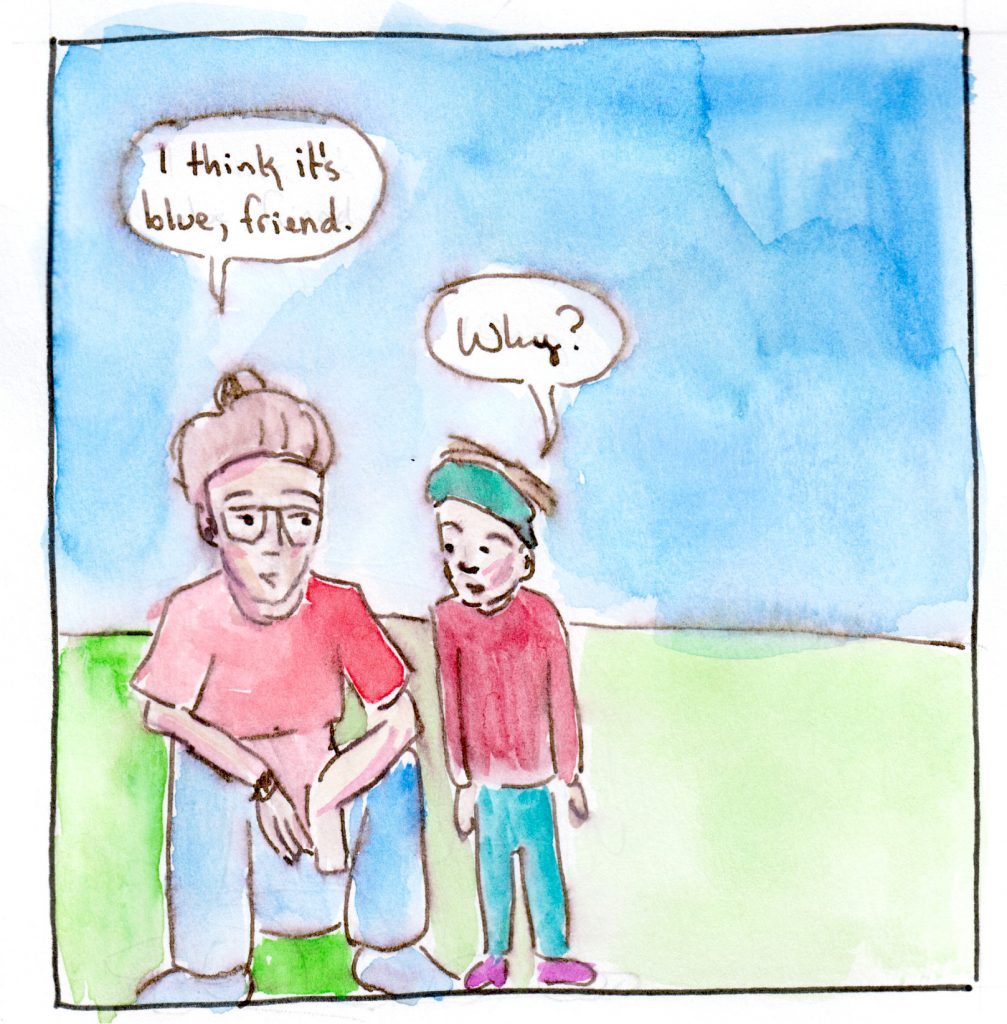
I started this one long enough ago that, among other things, Hal still apparently was speaking in one-word sentences and didn’t get colors right all the time. But when I finally finished it, I updated the drawing to look like he looks now, because small children are super hard to draw (the proportions are very different from adults).
The other thing that happened was I inked this comic with a fountain pen (my fine-tipped markers are in need of replacement) and it turns out the ink it was filled with (Pilot Iroshizuku Yama-guri, which I think means “wild chestnut”) is not waterproof. I figured this out when I was halfway through the process of watercoloring the comic. So if you noticed the bleeding in some panels, that’s why.
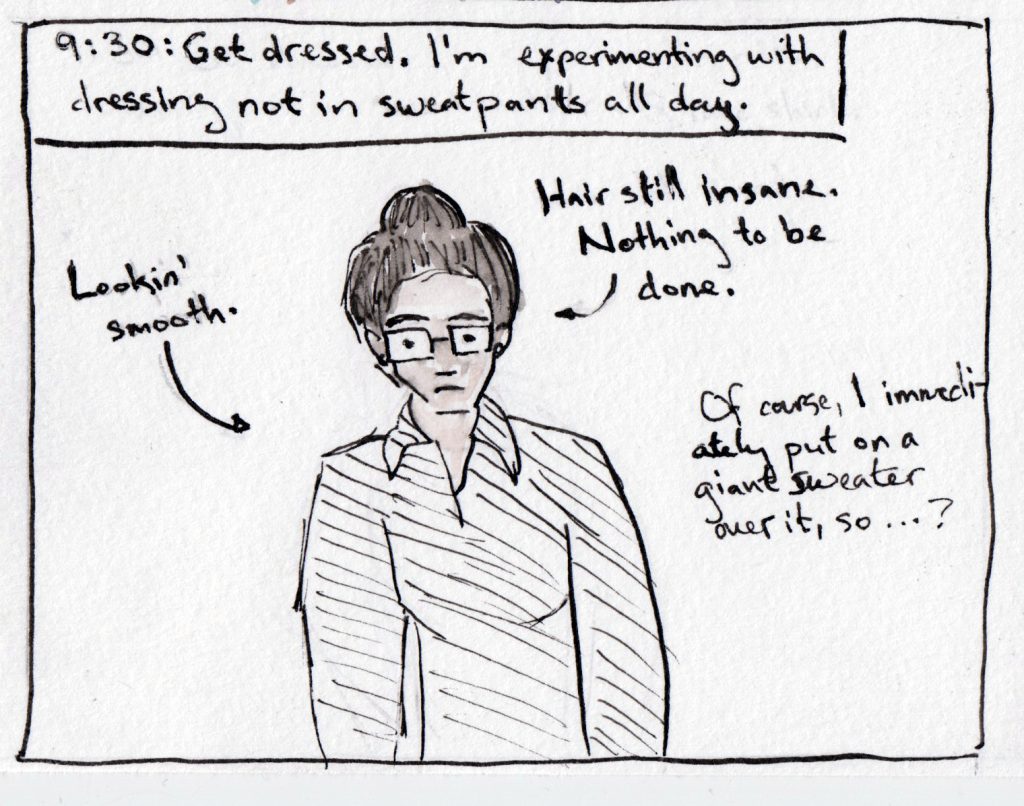
I decided to try and draw my hair the way I often wear it, which is halfway between Gibson girl and bitchy librarian. The Gibson girl hairstyle (as far as I can tell, anyway) works really well with my normal curly mess, but it’s worn much higher/farther forward on the head than I’m used to, so I often wind up with it a bit low, forming what is closer to a typical librarian bun. I think I could have made a pretty good Edwardian though, had I been afforded the opportunity. Sigh. Born too late to be an Edwardian, too early to explore the stars, as the saying goes.
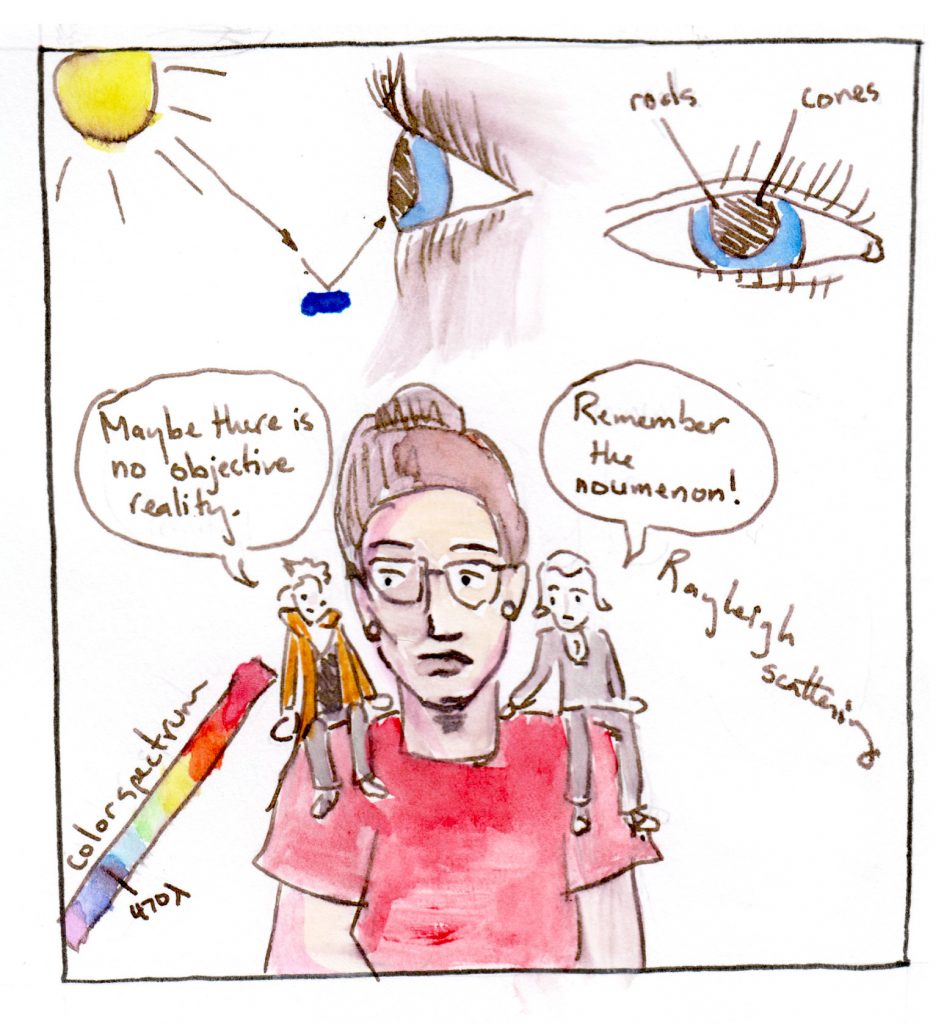
Okay, so there was an XKCD about this (actually he’s done quite a few about color), but just saying “how can you really know what someone else is seeing” doesn’t really touch on how weird color actually is. See, there are a couple of factors that influence what you see. First is the actual wavelength of the light that reaches your eye. Then there’s the way your rods and cones function. Finally, there’s the visual cortex, where everything gets interpreted (Oliver Sacks wrote a lot about how that piece can go wrong). But what this can all add up to is non-spectral colors–basically, when you see wavelengths of light that trigger both the red and blue cones in your eye, your brain knows the color you’re seeing is between those colors, but that it’s not green, because the light would trigger the green cones. So your brain kind of makes up purple. Super weird.
Anyway, let’s do some 2019 numbers to round out last year:
Books read: 18 (about 6,000 pages)
All Systems Red, by Martha Wells. Delightful.
Redshirts, by John Scalzi. Amusing without really being great. I…don’t get why so many people lost their shit over this.
The Valedictorian of Being Dead: The True Story of Dying Ten Times to Live, by Heather Armstrong. Oh Heatherrrrrr….A little bit more science and a little bit less “just caring for my children makes me so anxious that I have to spend my time crawling into my closet and crying and also I cannot hold down a normal job because I am a bloggerrrrr” would have been nice. Since reading this I have learned that electroconvulsive therapy (which is not like One Flew Over the Cuckoo’s Nest) actually has relatively good results for long-term depression that is not responsive to drugs, and while Heather sort of implies that the experiment she was a part of is better or potentially the only available treatment, that’s really not the case. So I don’t know how to feel about this book. On the one hand she super went through something. On the other hand, her understanding of what she went through is different from mine. Also, I have a really hard time when people are like “I have a life that you would have killed for but I gave it up/walked away/whatever.” I’m glad it helped, at least.
Artificial Condition, by Martha Wells. Still fun, although not quite as awesome as the first.
Good Bones, by Maggie Smith. Claire said “she writes about motherhood without being…you know.” And she’s right.
Dawn, by Octavia Butler. Soooooooo…. This was creepy.
Oh Crap! Potty Training: Everything Modern Parents Need to Know to Do It Once and Do It Right, by Jamie Glowacki. (Me now in 2020 writing this list) did I really read this back in (checks) March? Arg.
Anathem, by Neal Stephenson. This was awesome and I loved 90% of it so much that I can forgive the 10% that comprises the facts that this has almost no women and a sort of dubious love story. I don’t think I will ever say this about a 900-page book again but I wish it had been longer.
Maybe You Should Talk to Someone: A Therapist, Her Therapist, and Our Lives Revealed, by Lori Gottlieb. Gosh, this book has a terrible title but it was a really engrossing read and it got me back to therapy, which really helped, so.
Cribsheet: A Data-Driven Guide to Better, More Relaxed Parenting, from Birth to Preschool, by Emily Oster. There’s not a ton of data but what there is is reassuring for the choices I have made.
Under the Banner of Heaven, by Jon Krakauer. I don’t know if I 100% buy the thesis that Mormonism is a violent religion but I definitely see them in a new and less fluffy light.
ROAR: How to Match Your Food and Fitness to Your Unique Female Physiology for Optimum Performance, Great Health, and a Strong, Lean Body, by Stacy Sims. This book was so awful that I’ve been thinking about getting it from the library again to make sure it was as bad as I thought it was.
Reaper Man, by Terry Pratchett (reread). Masterful.
Babel-17, by Samuel R. Delaney. Fantastic. Delaney is a master. The pervasive sense of dread was difficult to deal with though.
Rogue Protocol, by Martha Wells. Still charming.
Starless, by Jacqueline Carey. The first 2/3rds were amazing and the last third should probably have been a second book in the same series.
Nine Princes in Amber, by Roger Zelazny (and about half of the second in the series, The Guns of Avalon). Manly men doing manly things with swords.
Exhalation: Stories, by Ted Chiang. What technology does to us. What we do to ourselves.
Poems published: 7 (plus one more accepted, thought it will be out by the time I finish this blog post)
Rejections: 35 (includes poetry and fiction)
Miles run: 2,323 (goal: 2,300; biggest month: May, with 215; smallest month: February, with 15); this breaks down into 79.92 mi on the elliptical, 165.92 on the dreadmill, 96.07 miles raced, 296.27 miles run as long runs, 832.63 stroller miles, and 820.61 “normal” (not otherwise categorized) miles
Fastest race: Labor Day Dash stroller 5k (25:38)–1st place
Slowest race: New Glarus Woods 10 miler (1:46:43)–11th in age group, 56th overall
Comics posted: 4 (yikes)
That’s all the numbers I have.
We’ll file the comic under B105.C455 L86 2020, for Philosophy (General)–Special topics, A-Z–Color. Special thanks to B for the title.