Welcome to the Renaissance.
When I was in high school debate, we used to conclude every speech by saying, “I am now open for cross examination.” I always feel like I should say that when I launch my novels, although to be honest the idea of being cross-examined about anything I’ve written is kind of terrifying. But I guess I do need to say something valedictory at this particular moment. Although there are still four more books planned, this is the last solo Sam/Ulysses book. This is the end of a big plot arc. This is a send-off of sorts. It needs to be marked.
As I was thinking about this, I found myself turning to John Donne (c1571–1631), an English poet. He is one of a few writers whose work I was dragged through in my undergrad English literature classes and came to actually appreciate. Donne lived something of a weird life that I would divide, flippantly, into the horny period, the depressed period, and the god period. He fell in love with his boss’s niece, married her secretly, got thrown in jail for said secret marriage, was acquitted at trial and saw the marriage confirmed in court. Eventually, he reconciled with his father-in-law, he and his wife had twelve children, and then later he converted to the Church of England and became a priest (at the behest of King James I), and a fairly well-known one at that. He wrote some good poems, including “Song: Go and Catch a Falling Star,” and “A Valediction: Forbidding Mourning,” which I will now quote part of here:
Our two souls therefore, which are one,
Though I must go, endure not yet
A breach, but an expansion,
Like gold to airy thinness beat.If they be two, they are two so
As stiff twin compasses are two;
Thy soul, the fixed foot, makes no show
To move, but doth, if the other do.And though it in the center sit,
Yet when the other far doth roam,
It leans and hearkens after it,
And grows erect, as that comes home.Such wilt thou be to me, who must,
Like th’ other foot, obliquely run;
Thy firmness makes my circle just,
And makes me end where I begun.
(The whole poem is here.)
This was written at a time when Donne was leaving his wife to travel to the continent. Here, he compares his and his love’s souls to the legs of a compass. A compass (also called a pair of compasses, like a pair of scissors, hence “twin compasses”) consists of two legs joined together in a V shape with a hinge at the top. One foot has a point at the end and is placed at the center of the circle that you want to draw, and the other holds a pencil and can be moved around the first to draw the circle. As one foot travels in a circle, the other may lean, but does not move, and through its steadfastness, the other foot is able to complete its circle. Similarly, as Donne travels, his wife’s steadfastness allows him to complete his errand and return home. Also, although it’s entirely correct to say a compass might lean over as you draw and then come back to the vertical as you finish, I am pretty sure “grows erect, as that comes home” is a penis joke.
(I am sorry to all my English professors for the quality of this analysis.)
Not only does this feel somehow appropriate to Sam and Ulysses’s relationship, there’s something about traveling a far distance and ending up where one began that feels right when I look at Renaissance. Maybe when you’ve read it, you will see what I mean. (Also the penis joke feels correct. Donne viewed sex in sacred terms, which has occasionally come up in the last few novels for various reasons.)
Interesting side note, John Donne was one of the earliest users of the word valediction in print—the OED has him as the earliest quote for this sense of the word. (No one is willing to say he coined it, but they don’t seem to say they know for sure he didn’t.) Officially they date the word to 1614, although this poem was written a few years before that. He is credited with coining the phrases “no man is an island” and “for whom the bell tolls.”
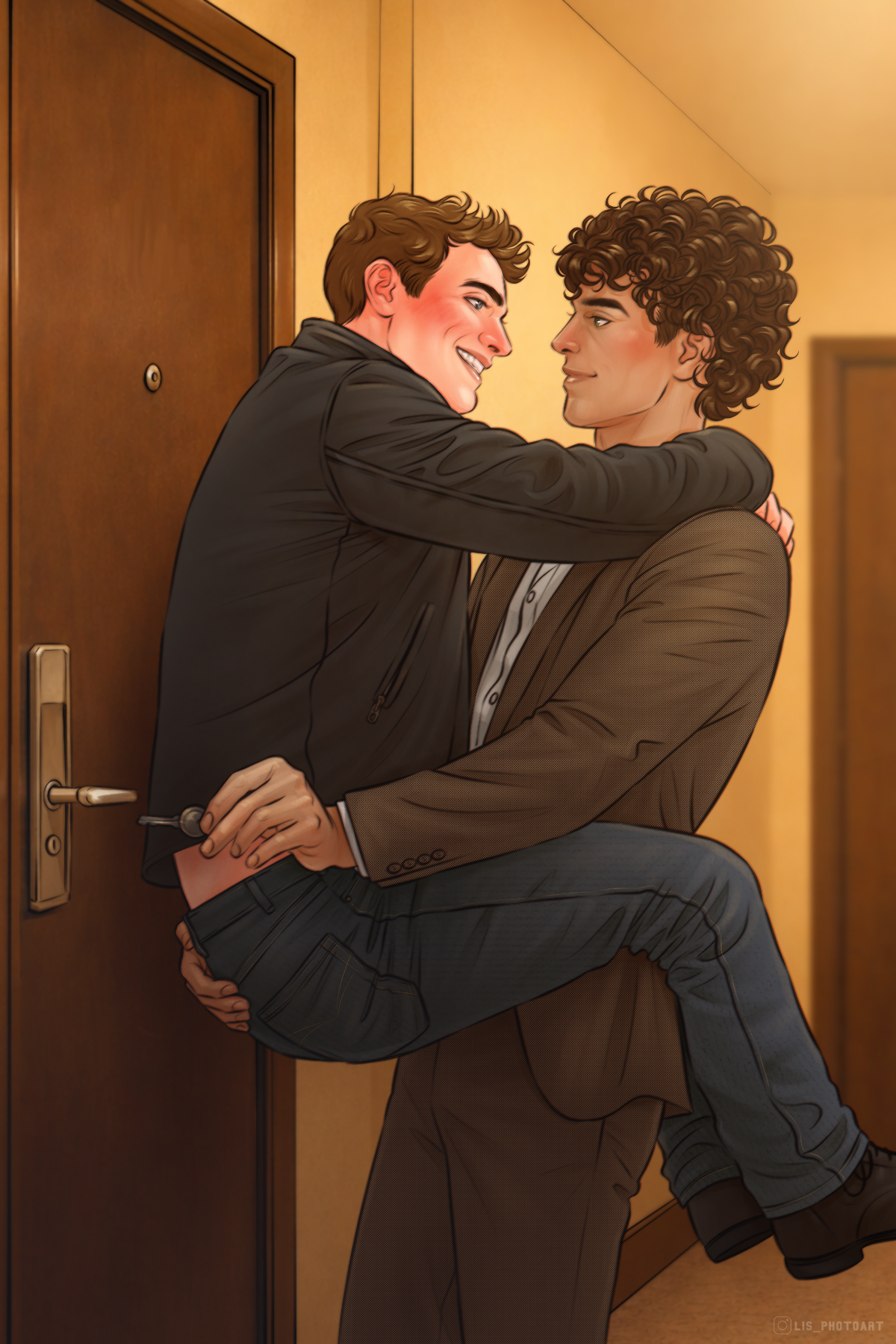
Anyway, I commissioned LIS Artworks to do a little drawing of a scene from chapter 1. Here it is:
 Until next month, thank you all for your continuing support. And special thanks to Eliot, my editor; Rowan, my book doula; and Bryan, my husband and alpha reader. This was a really hard book, and I couldn’t have done it without any of you. (Or about ten other people; check the acknowledgements for the full list, okay?)
Okay, here are some links:
Amazon: https://www.amazon.com/Renaissance-Wisconsin-Gothic-Book-5-ebook/dp/B0GDZ5R2CB
Ingram Spark: https://shop.ingramspark.com/b/084?params=tKwOnk3uStxCbMjB0tdkZi7D4tgSOeV703KclIw2YS9
Kobo: https://www.kobo.com/us/en/ebook/renaissance-155
Smashwords: https://www.smashwords.com/books/view/2009525
Itch.io: https://xanthippe42.itch.io/renaissance
Other sites: https://books2read.com/u/4EOE6E
Other Ingram Spark-supplied websites, such as Bookshop.org, should be available in a few days as soon as the databases update. If you want to order it from your favorite bookstore, the ISBN is 979-8-9883944-4-0. (That may also take a few days for database updates before they can find it; I don’t know for sure.)
Until next time, thank you all so much for reading. I hope you enjoy it.