Episode 1: Telemachus

I hope you have all had a chance to read the first episode. Check the project’s introduction for an explanation and links.
My primary copy of Ulysses.

Stately, plump Buck Mulligan came from the stairhead, bearing a bowl of lather on which a mirror and a razor lay crossed. (1.1–2)

My main copy of Ulysses (of course I have more than one) is rather heavily annotated at this point. The first marginal notation I come across here says “State-cross: Locate S [Stephen] w/in historical/political terms—G.B., HR Church.” I don’t know where this insight came from, probably the professor who gave the course in which I first read this book[1], but it’s a very interesting idea. Look at the sentence again:

Stately, plump Buck Mulligan came from the stairhead, bearing a bowl of lather on which a mirror and a razor lay crossed.

Lest you think this is grasping at straws, Stephen later reiterates it in conversation: “I am a servant of two masters . . . an English and an Italian. . . . The imperial British state . . . and the holy Roman catholic and apostolic church” (1.638–43).[2]

Ireland in 1904 was a colony of Great Britain. It’s not the sort of colony we usually think of when we talk about colonialism, because nowadays the Irish are seen as white and colonialism is something that white people do to non-white people (for example, the French in Algeria, the Belgians in the Congo, the French in Indochina, the British in India, the British in Burma). But the British have very much colonized Ireland and were governing them. On the other hand we have the Roman Catholic Church (or Holy Roman Apostolic Church, as Stephen Dedalus would refer to it), which exercised at the time (and for most of the 20th century and on into the 21st) enormous power over the people of Ireland. One thing I’m going to argue in this essay is that there are strong colonialist themes running through this book. This is not a controversial claim—a cursory search of the internet provides a number of papers, such as Roghayeh Farsi’s “James Joyce’s Ulysses: A Post-Colonial Text,” which argue essentially this. Worth noting is that Joyce began writing in 1918, shortly before Ireland declared its independence (January 1919) and began the Irish War of Independence with Britain; this war concluded around the time Ulysses was published in full (1921 versus 1922). Where is the line between a colonial novel and a post-colonial novel? We must be very close to it.

I’m getting a little ahead of myself. Let me back up a bit. The first three episodes of the book make up the “Telemachiad,” which is to say their focus is on our Telemachus, Stephen Dedalus.

Stephen Dedalus is one of the main characters in the book; in this section we meet two major supporting characters, Buck Mulligan and Haines. They are all three staying together in a Martello Tower, which is one of a bunch of towers put up in Ireland to look out for the possible invasion of Napoleon.[3]

Buck Mulligan is a medical student who is witty, quick to make up songs and ditties, and who holds nothing sacred, as he tells Stephen: “And what is death . . . your mother’s or yours or my own? You saw only your mother die. I see them pop off every day in the Mater and Richmond and cut up into tripes in the dissectingroom. It’s a beastly thing and nothing else” (1.4–6).

Haines, on the other hand, is “a ponderous Saxon [i.e., British] . . . [who is] bursting with money and indigestion” (1.51–2). He is every inch the colonial Brit, although he would no doubt claim himself enlightened. Tellingly, Mulligan observes that Haines’s father “made his tin by selling jalap to the Zulus or some bloody swindle or other” (1.156–7). This is a reflection of British colonialism[4]—the Zulus lived in Southern Africa and were defeated in the Anglo-Zulu War in 1879, which led to the fall of the Zulu empire. Haines is writing about Irish folklore (a book, I believe, possibly related to his degree) and has come to Dublin to do research. It is interesting that he is in fact living with two Irish men, neither of whom is exactly interested in serving as a native informant to him, but both of whom really want something from him—Mulligan wants money, and Stephen wants him to go away[5]. In fact, Stephen and Mulligan’s attitudes toward Haines are well, if unintentionally, summarized by Frantz Fanon in The Wretched of the Earth, when he writes of how native intellectuals are taught by colonialist bourgeois to believe in the ideals of Western civilization, which he describes as existing on a “Greco-Latin pedestal” (46). During the course of the decolonization process, the native intellectual begins to understand how indoctrinated into the ideology of his conquerors he has been, and eventually “he turns himself into an awakener of the people; hence comes a fighting literature, a revolutionary literature, and a national literature” (223).[6] So on the one hand we have Stephen the bard who wants to be rid of the British, and on the other hand Buck Mulligan the medical student who wants to Hellenize Ireland (1.158). What a pair. Haines’s attitude is typically apathetic, saying “An Irishman must think [that he is a servant of the imperial British state], I daresay. We feel in England that we have treated you rather unfairly. It seems history is to blame” (1.647–9). This is, implicitly, the viewpoint Jean Paul Sartre is raging about in his introduction to Fanon’s aforementioned text.[7]

The presence of the Catholic Church should also be regarded as a force for colonization; as Fanon puts it, “The Church in the colonies is the white people’s Church, the foreigner’s Church. She does not call the native to God’s ways but to the ways of the white man, of the master, of the oppressor” (42). And indeed, the Catholic Church’s oppressiveness in Ireland has been well documented (see for example Christopher Hitchens’s article(s) on Mother Theresa, or any of the millions of things written about the Magdalena asylums).

I’m nearly seven hundred words into this section and I have covered about a page and a half of the text. Seems about right. That aside, I think I have begun to make my point about the colonial/post-colonial themes in this episode. This is something that took me very much by surprise when I began re-reading this section, as it happens—in between my previous reading of the book and this one, I spent a great deal of time studying post-colonialism and post-colonial literature, so it really jumped out at me in a way it didn’t before. I will not discuss the next episode here (spoilers!), but suffice to say that these themes continue there in several ways.

In the rest of the episode, the boys have breakfast, get milk from the milk woman, and walk down the shore. They make plans to meet again later for drinks—Mulligan promises Haines that “[Stephen] proves by algebra that Hamlet’s grandson is Shakespeare’s grandfather and that he himself is the ghost of his own father” (1.555–7). Then Mulligan and Haines go to bathe in the ocean and Stephen continues on to work, which takes us to the next episode. Tune in next time!

Notes

[1] I’ll do him the honor of not giving his name here. He probably wouldn’t want to be associated with this kind of project. Also, he was kind of an asshole.

[2] The basic rule of Joycean scholarship is assume everything is intentional, because it generally is. At least, this is my interpretation; I can’t claim to be deeply immersed in the academic side of Joyce at this point.

[3] I recall being told that the Irish were hoping that Napoleon would help to liberate them from the British, but I cannot find a citation for that. However, Gifford does note that the French made four attempts between 1796–8 to provide assistance to the Irish during a revolution (23). For a picture of a Martello Tower and more on their history than is strictly necessary, see their Wikipedia page. Hope that was fun for you.

[4] Edward Said often looks at the small mentions of colonialism that mostly live in the background of British literature, such as the very brief discussion of the slave trade in Jane Austen’s Mansfield Park. Which is to say, this is a brief but important mention.

[5] As with many things in Joyce’s works, this is evidently drawn from an experience he had in which one of the other guests in the place he was staying had a nightmare and fired several shots from his gun into the wall above Joyce’s bed in the night. Joyce noped out in the morning, which is why Stephen expresses to Mulligan that he wants Haines to leave and refers to Haines ranting during the night.

[6] Fanon characterizes this as the phases through which a native intellectual passes,[+] however within a single society it does seem possible to see intellectuals who are in different phases simultaneously—for example, see the letters of non-fictional people Mohandas Gandhi and Rabindranath Tagore. (Note to self: add a citation when this book is published.) I have borrowed some of this terminology from Spivak, who discusses the epistemic violence the education of the non-Western intellectuals causes and the tendency of the Western intellectual to overlook the influence of ideologies in critiquing the position of the subaltern AT LENGTH in her amazing article “Can the Subaltern Speak?”

[+] Just as an aside, I swear I had a really good quote about this but I’ve lost it. I guess I am reading too many things at once.

[7] Sartre writes, “You know well that we are exploiters. . . . With us, to be a man is to be an accomplice of colonialism, since all of us without exception have profited by colonial exploitation” (The Wretched of the Earth, 25). His entire introduction is a stirring excoriation of European imperialism and is well worth a read.

References

Farsi, Roghayah. “James Joyce’s Ulysses: A Post-Colonial Text.” The Criterion: An International Journal in English, vol. 4, no. IV (2013): 1–8.

Fanon, Frantz. The Wretched of the Earth. Translated by Constance Farrington. New York: Grove Press, 1961.

Gifford, Don, with Robert J. Seidman. Ulysses Annotated: Notes for James Joyce’s Ulysses. 2nd ed., rev. and exp. Berkeley: University of California Press, 1988.

Said, Edward. Orientalism. New York: Vintage Books, 1978.

Spivak, Gayatri Chakravorty. “Can the Subaltern Speak?” in Cary Nelson and Lawrence Grossberg (eds.) Marxism and the Interpretation of Culture. London: Macmillan, 1988. Found online at http://www.mcgill.ca/files/crclaw-discourse/Can_the_subaltern_speak.pdf. (Online version is the referenced pagination.)
Thing I cannot cite yet, Routledge, 2014.

An Introduction to the Project

I quipped to my mother the other day that I wanted to re-read Ulysses and blog about it. In the month of June. And she said, “The whole thing?” Sure, why not? We have just passed the centenary of the release of Dubliners, and Bloom’s Day is coming up (June 16th).[1] Plus, Ulysses is a good book of the kind that is often on people’s bucket lists but seldom read. So I thought, “Why not write up a few of my thoughts about each section and post them?” I will try to keep it short, and perhaps my general impressions will give you a desire to delve into this amazing, beautiful book. Part of this will be chronicling my own path of discovery as I dive back into a work that is one of my favorites, but that I haven’t read in about a decade; part of this will be a sort of general discussion of the book and its themes from as writerly of a perspective as I can manage, since that is perhaps the one thing I can claim expertise in. Maybe. The one thing I will assert is that, unlike William York Tindall, I do not think Ulysses is “too difficult for careless reading” (123). Like any book, it can be read in a multitude of ways; any reasonably focused reader can make her way through it, enjoying the beauty of the language and storytelling without necessarily grasping the historical or philosophical references.

All of my citations will be to the text in the Gabler edition (see below for citation), but I will give an episode.line number citation (e.g., 1.10) so anyone who wants to follow along in one of the free online editions can do so (the line breaks follow the Garland, New York, 1984 critical edition). Do be aware that since the Gabler edition corrects several long-standing typos, the texts may differ slightly. The primary concordance I use is the Gifford—I’ll provide a citation for that when it proves necessary.

For those not familiar with Ulysses, although the chapters are not formally titled, Joyce created two schemas that divided it into eighteen episodes, all of which have names that refer to the Odyssey. These are the Gilbert schema and the Linati schema. I will probably not refer to these frequently, but you should know where some of this material is coming from. Other reference works I will cite as I go along.

As for what is the best way to read the book, I don’t think there’s any one right way to go about it. In high school, the first few times I attempted to make my way through the text, I had only the text itself. The first time I actually made it through, in college, I had the Gifford annotations by my side and frequently read it simultaneously with Joyce’s text. On this reading, I am making my way first through the episodes, then referring to the Gifford to clear up any lingering questions (and draw inspiration for these little essays). Any of these methods may work for you. For those who don’t have time to run to the library before starting this little adventure, this website containing hypertext annotations may be of use to you.

I feel at the outset that I should define my goal more specifically before I begin. This is not meant to be a series of scholarly essays into the text of Ulysses, although some of my essays do take on that form to a certain extent. This is also not meant to simply reproduce the information contained in any of the particular references I’ve consulted. Instead, I want you to read along with me and consider this a kind of book club discussion. You can find an ebook version here at Project Gutenberg or elsewhere on the web. I hope you’ll join me for a brief tour through a magnificent work of art.

Sections

Telemachus

Nestor

Proteus

Calypso

Lotus Eaters

Hades

Aeolus

Lestrygonians

Scylla and Charybdis

Wandering Rocks

Sirens

Cyclops

Nausicaa

Oxen of the Sun

Circe

Eumaeus

Ithaca

Penelope

Notes

[1] I’d originally planned to post one essay per day between May 29-June 16, but that isn’t happening, is it. Take what you can get, that’s my advice.

References

Joyce, James. Ulysses. Edited by Hans Walter Gabler, with Wolfhard Steppe and Claus Melchior. New York: Vintage Books, 1986.

Tindall, William York. A Reader’s Guide to James Joyce. New York: The Noonday Press, 1959.

Em oi! #389 and #390

I still am, but a little less.


Words (rule the world)

In honor of defending my MA thesis (successfully), two comics about the final throes. I have discussions in the vein of #390 with those who copyedit my fiction as well. Hm. We’ll file these two under LB2385 L86 2013c and LB2385 L86 2013d for Theory and practice of education–Higher education–Academic degrees-M.A. You can also check out LB2385 L86 2013a and LB2385 L86 2013b. You know, for all that I seem somewhat frustrated with my advisor, he’s really been a good fellow to me, and given me a lot of space to make my own discoveries, which I’m kind of glad about. He said some really nice things about my thesis during my defense, and we shook hands. I guess that’s, finally, a détente.

I’ve recently seen a spike in traffic, probably all you crazy people who bought my book. What fun! But looking over the blog, I see that like 99% of the posts I’ve written since July have been about how terrible it is to be in graduate school. And…to some extent this post is not a change from that. Whoops. Sorry. Next week I will have comics that are not about being exhausted and stressed out. I promise. I already have them drawn, even!

Anyway, the big news can be seen in this photo:
20131219_220535

No, not the copy of House of Leaves in the background. The postcards are here! If you want a signed one, send me your snail mail address to ehlupton+postcards(AT)gmail(dot)com [ehlupton plus sign postcards at sign gmail period com]. As you can see, I have a lot of postcards, and I believe thus far only three people have asked for them, so get your order in!

Publication Day

So in answer to all of my anxiety dreams last night, my novella has been published! Yay!

JoyOfFishesFinalCover96dpiRGB

Now you’re asking, “Emily, where can I buy this marvelous thing?” Glad you asked. Check out these links:

  1. Amazon
  2. Barnes and Noble
  3. Smashwords
  4. Battered Suitcase Press (not up yet)

But that’s not all. I know some people like to get their books signed, and this is difficult with an e-book. So if you bought the book (and enjoyed it, I guess? Otherwise what’s the point?), send me an email to ehlupton+postcards(AT)gmail(DOT)com (yes, that is my name, ehlupton, the plus sign, the word “postcards,” and then gmail dot com). Include your name and snail mail address, and I will send you a postcard with the book’s gorgeous cover on it. I’ll write a message, if you want one, or draw a picture of a dog (probably of my dog), even sign it. If you’re extra obsessive, like me, let me know and I’ll mail it to you in an envelop so it doesn’t get cancelled or otherwise undergo the rigors of the postal service.

Please note on the postcards: I probably won’t get the order before the end of next week, so I can’t guarantee I’ll be able to get youthe postcard by mail before Christmas unless you live locally. If you buy the book, you will get it delivered electronically in less than five minutes, so that will have to fulfill your desires for instant gratification for the nonce.

Anyway, I hope you enjoy it! I hope, if you really enjoyed it, that you will consider reviewing it, or recommending it to your friends. But even if you don’t do those things, I am glad that you took a little time to read it. Thank you.

Em oi! #388: The New Guy

em_388
Edgar came to live with us close to four weeks ago. I think it will be four weeks tomorrow, actually. It’s actually surprising how much about him has changed since we brought him home:

  1. He will walk on a leash and not freak out.
  2. He will go up and down stairs by himself, although he’s a bit clumsy.
  3. Weighs 46 lbs rather than 42.
  4. Is willing to walk past cars that are parked as well as cars that are turned on but not moving. Still terrified of moving cars though.
  5. We are reasonably sure he is flat-coated retriever and Aussie rather than part Newfie.
  6. I have decided on the best way to draw him. As you can see in the comic above, there was some experimentation.

At first Edgar was very shy and stayed in his crate most of the time, even though we left the door open so he could come and go as he wanted. I think he appreciated having the little cave to hang out in, because re-homing is incredibly stressful and confusing. And that’s for people; imagine how the dogs feel. Anyway, Edgar is a rescue dog and he had spent a lot of his life in to a shelter before entering the foster care system and then coming to us, so we knew that it would take him longer than it took Maya to warm up to us. After all, Maya was 12 weeks when we got her, versus Edgar at six or seven months–much more life to have traumatized him thus far. However, I am happy to report that he is thriving. I drew this follow-up comic to demonstrate Edgar hanging out in the atrium every morning while I eat breakfast:

breakfast comic

I’ll file this comic under SF427 .L86 2013 for Animal Culture–Pets–Dogs–Culture and care. Sadly, there was no entry for “doggy personal ads.”

And here’s a photograph of him I took earlier this afternoon:
Majestic as Fuck

And a picture of Edgar and Maya playing in the snow:
20131210_153913

So the reason we were able to get another dog is that we recently moved to a new house. I think I may have mentioned this before. But the thing is that we have been slowly going through a lot of stuff at the old condo that didn’t get moved, stuff that we should probably throw away so we can get the house on the market. Earlier this evening while doing this, I came across this piece of paper:
Found

If you can’t read, it says, “ทำงานทุกวันและเล่นไม่ได้ทำให้คุณจากคนไม่สนใจ,” which translates as “Working everyday and not playing makes Jack an uninteresting person.” Nowadays I would spell “Jack” as “แจก” rather than “จาก” I guess. But. I wonder what was going on when I made those notes? It also seems to say “Liz Bernstein–another Jew in Asia,” “มหา [maha] Ghosanada,” “CompLit,” and “No one is soverign [sic] in love.”

…It’s probably a good thing I’m finishing my thesis and graduating soon.

I should mention that the novella is due out at the end of the week. It will be available as a PDF and on all major ebook platforms (i.e., Kindle and Nook). So, uh, prepare to spend money on it? It should be pretty awesome. Here, in case you haven’t seen it yet, is the cover.

JoyOfFishesFinalCover96dpiRGB

Scott Walker and the Abortion Law

If you have read my comic for a while, you may have gotten the feeling that I am pro-choice. This is not something I have talked about much on the blog, because I think that it is a complex topic with many ethical gray areas that cannot really be well-discussed in a short amount of time. But recently, the republicans in the Wisconsin legislature began to push through some anti-abortion laws that made me very angry.[1]

I thought, when I was younger, that we lived in a pluralistic country founded on the principles of freedom of religion and separation of church and state. Increasingly, however, that seems to not be the case. But passing laws based on evangelical Christianity to govern a diverse country just isn’t cricket.

I only want to protest if there are sock puppets involved.

That isn’t to say that I feel like abortion is a straightforward question. There are certainly arguments to be made that there is a point in a fetus’s development where the ethicalness of an abortion (in most situations, but not all) tips to the “don’t do it” side. But I want this debate to be played out by bioethicists.

After all, there are things that doctors can legally do but they don’t, because it would be unethical (like the kinds of experiments Andrew Wakefield did). And there are other things that actually are unethical (like promising someone that they can be cured by homeopathic treatments) that are also legal. So why should abortion be singled out as the medical treatment that the government decides to legislate on? And why should legislators, who are not by and large doctors, nor are known for the depth of their scientific knowledge, be allowed to pass judgment on this?

I do understand why they’re doing it, sort of. In theory, evangelical Christians believe that abortion is murder (which I think is mostly wrong, but I’ll let the point stand for the sake of argument). If thought that people were being routinely murdered in the US, I would be against it (and I am–against the death penalty, and against uncontrolled, unregulated gun ownership). But laws like this ultrasound law don’t actually speak to the sense that murder may be going on–it just says, “There are reasons for getting an abortion, some of which are OK and some of which are not, and we want to police women’s sexual and reproductive agency by being the ones who get to decide what constitutes a reason.” It turns out that I have a problem with old white men telling me what I should do. In reproduction. In art. In life.

The problem is that the governor has repeatedly showed that he is motivated only by money, and is unwilling to listen to dissent or debate. There were protests about these laws, but–no one cared. Somehow during the 1960s and early 70s, there were enough people protesting the Vietnam War that the government had to take them seriously. But protesters in the US have not held that kind of sway since. In addition, Walker has been so outrageous on so many topics–busting collective bargaining, trying to disenfranchise huge numbers of voters, opening Wisconsin to environmental piracy and more–that most people are pretty tired of being angry. We’re just resigned. So I decided to write a letter to him to vent spleen.

Dear Scott,

I hope you don’t like me calling you Scott. I know it is not the preferred address for someone in your position, but I assume that because you feel it is acceptable to legislate about my internal organs, we must be on a first name basis. I also hope to come across as mildly condescending, because I believe that the recent bill requiring women to undergo a transvaginal ultrasound prior to receiving an abortion is predicated on the assumption that women are stupid, an assumption with which I take issue.
The bill, nicknamed the “Woman’s Right to Know Her Unborn Child Act,” seems to rest on the belief that women who go for abortions don’t really know that they have a fetus in their uterus. “So let’s show them the fetus!” the reasoning goes. But in fact, women who seek abortions are quite aware that there is a fetus in their uterus—that is why they are seeking an abortion. If there was ever a chance of there being something different in there—a new car perhaps?—I would not be as opposed to this procedure as I am.[i]

But in fact, the truth is that this bill is not designed to induce women to have fewer abortions. If you wanted to make it easier for women to raise children, you would consider projects that could reduce poverty such as making sure women get paid the same as men,[ii] increasing funding for daycare, or improving welfare payments for women with children. You could even offer a guaranteed paid leave for women and their partners.[iii] If you wanted to decrease abortions on the other side, you could increase funding for comprehensive sex education, make birth control more readily available, and offer family planning clinics to help women make informed decisions about when to have children.

I don’t believe the rhetoric about “every fetus is a gift” either. If you really believed that, why not move condoms behind the counter in the drug store or institute mandatory waiting periods for men seeking vasectomies? You could even require they undergo a trans-anal ultrasound to check the health of their prostates.

This bill is designed to shame women; that is its sole purpose. That is made clear in the exceptions allowed for cases of rape and incest. The truth is, they only make sense when you consider the bill in this manner. Perhaps a case study will further prove my point. Consider: Two women require abortions. Sally was raped. Molly had sex with her husband, but his vasectomy failed, and they have determined they cannot afford to raise another child (they already have two). Sally filed a police report and is as such exempt from the ultrasound. Molly is not—but isn’t she equally blameless for her situation?

Scott, I am tired of the rhetoric in the Republican Party that suggests that women are second class citizens who deserve to be treated as little better than gestational carriers who are capable of making sandwiches. I will not stand for such a message, and I hope that I am not the only woman who is hearing it. The next election is coming, and we will remember what you have done. 2014 is coming, and the people of Wisconsin will no longer tolerate your placing the “needs” of your rich donors above the well-being of our state’s people and economy. So enjoy your political career now. It is my dearest hope that it will not continue much longer.

Sincerely,


[i] That’s a joke. I would still be opposed.
[ii] You don’t care about this, either—remember when you repealed the equal pay act? I do.
[iii] Did you know that the US is one of the only countries worldwide that doesn’t require some amount of paid parental leave?

Walker is, for some reason, occasionally referred to as an up-and-coming republican wunderkind of some sort, possibly because he is good at 1) taking money and 2) kissing asses. I don’t really get it–he’s not presidential material (he didn’t finish college; even George W. Bush had a graduate degree), and he looks like a version of Paul Ryan where he slept on his face and it stuck that way, so he doesn’t have Dan Quayle’s reported appeal to FEMALES either. (Although, I just looked up a picture of Dan Quayle and all I can think is, maybe he looked better standing next to George H.W. Bush? Eech.)

Personally, I’m hopeful that someone even a little bit charismatic will come out of the woodwork for the 2014 elections and beat SW. In fact, I’m hoping to volunteer for whoever’s campaign that winds up being.

My letter was cosigned by nine people.[2] I was very grateful for the support. The letter is even now winging its way to the capital (well, it’s in the mailbox). I don’t expect a response, but writing it made me feel better.

Now to make everyone happier, here’s a picture of my dog being cute. Next time I’ll write about kittens.

When you're made of pillow, who cares where you sleep?
When you’re made of pillow, who cares where you sleep?

[1] The article only talks about the ultrasound law. There was also one allowing religious organizations to opt out of covering birth control on their health insurance.

[2] I won’t list their names here, because I make it a rule to not mention people in Google-able ways unless they give explicit permission.

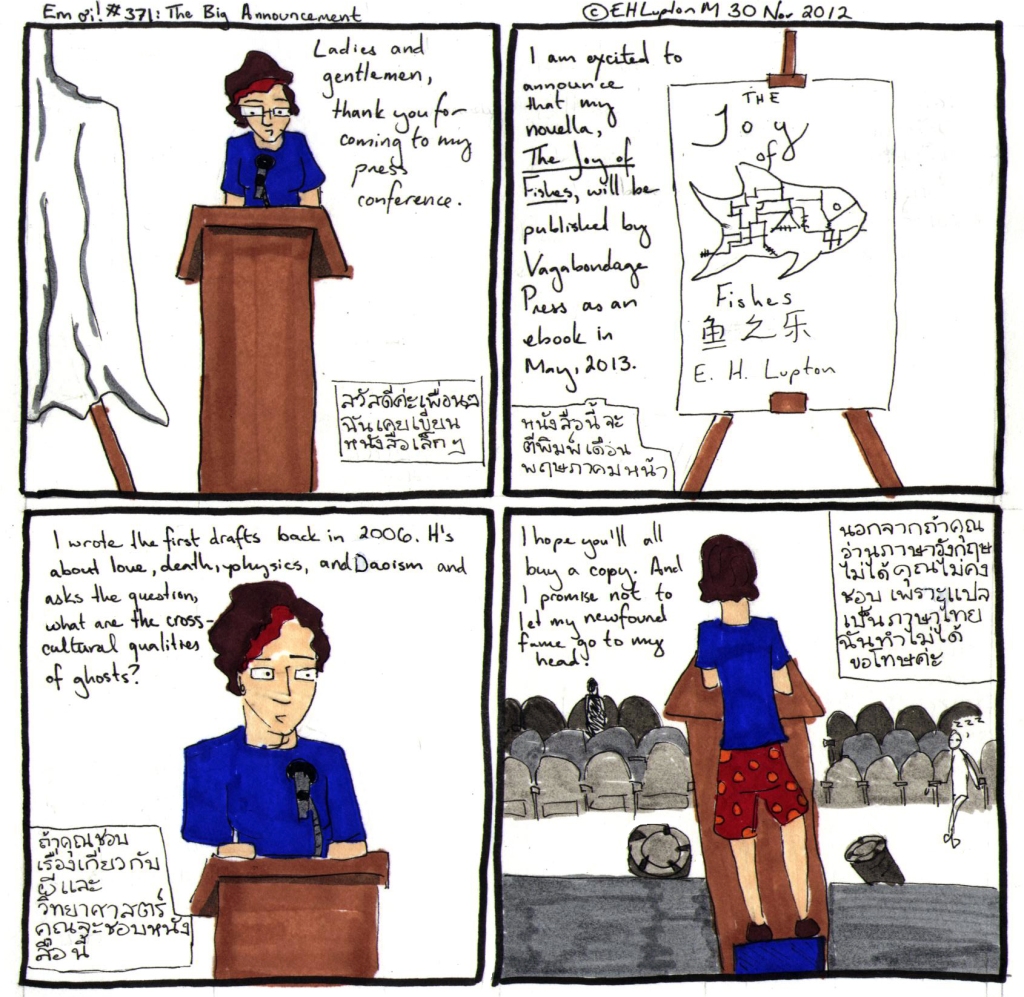
Em oi! #371: The Big Announcement

MAGNIFIQUE
This is absolutely true: Vagabondage Press will publish my novella as an ebook in May, 2013. I am very excited. This work was originally composed as my senior thesis for my English/Creative Writing degree in 2006. Since then, it has been through a number of rewrites (and will go through a few more before it is ready for prime time). More importantly, perhaps, I have begun to mature as a writer and I think I have been able to do the story justice.

This is a very brief summary of the story I wrote for my cover letter:

Mara Daniels is a physicist doing cutting-edge research into the nature of reality at the University of Chicago. She’s an astronomer. She’s an amateur student of Chinese philosophy. And she’s still recovering from last summer’s car crash that killed Benjamin Zhu, her fiancé. It’s a slow process; she can walk without a cane now but she still suffers from migraines, nightmares, and she’s seeing Zhou’s ghost everywhere she goes. The Joy of Fishes follows her through the day on which these threads begin to unravel.

To paraphrase Robert Persig, I will say that I am an expert on neither Daoism, nor astrophysics, nor neurology. However some of the bits about ghosts are pretty neat.

In honor of this being my first stand-alone publication, I’m going to file this comic under PS3612.U68 J69 2012, for American literature—Individual authors—2001-—L, subdivided on Table P-PZ40 under Separate works. By title.

To get you all thinking, I’ll add this: If you have a book club in the upper Midwest that would like to read the book and have me come and talk/answer questions, drop me a line and we can work something out.

(ถ้าคุณอ่านภาษาไทยในเรื่องนี้ ฉันต้องพูดขอโทษ เพราะฉันเขียนภาษาไทยไม่เก่งและไม่สวยด้วย)